When people talk about generic vaccines, they’re thinking of something simple: cheaper versions of life-saving shots, just like how you can buy a generic version of ibuprofen for a fraction of the price. But vaccines don’t work like that. You can’t just copy a vaccine the way you copy a pill. The reason? Vaccines aren’t chemicals. They’re living systems. They’re made from viruses, cells, proteins, or mRNA - all of which require precise, complex, and fragile manufacturing. And that’s where the real problem begins.
Why there’s no such thing as a true generic vaccine
Unlike regular drugs, which are made of simple molecules and can be replicated exactly, vaccines are biological products. Even two batches from the same factory can vary slightly. That’s why regulators don’t accept the same shortcut used for pills - the Abbreviated New Drug Application (ANDA). For vaccines, every new maker has to prove safety and effectiveness from scratch. There’s no shortcut. You can’t just say, "It’s the same as the original." You have to rebuild the entire process. This isn’t just bureaucracy. It’s science. A vaccine like the mRNA ones from Pfizer or Moderna requires lipid nanoparticles - tiny fat bubbles that protect the genetic code. Only five or seven companies worldwide can make these lipids. If you don’t have access to them, you can’t make the vaccine. Even if you get the recipe, you still need ultra-cold freezers, sterile labs, and trained technicians who know how to handle delicate biological materials. It’s not a factory. It’s a high-precision biology lab.The global vaccine map: who makes what, and who gets left out
India is the unsung hero of global vaccine production. The Serum Institute of India alone churns out 1.5 billion doses a year. It makes 90% of the world’s measles vaccine. It supplies 60% of all vaccines used by the World Health Organization. And it did this for pennies - charging $3 to $4 per dose for the AstraZeneca shot when Western companies charged $15 to $20. But here’s the twist: India doesn’t make vaccines for itself. It makes them for the world. And when India had its own COVID-19 surge in 2021, it stopped exporting. Global supply dropped by half overnight. Meanwhile, Africa, which has 17% of the world’s population, imports 99% of its vaccines. It has zero capacity to make mRNA vaccines. It has no lipid nanoparticle suppliers. It has no cold chain infrastructure to store them. In 2021, 83% of the vaccine doses Africa received through COVAX went to just 10 countries. Twenty-three African nations had vaccinated less than 2% of their people. And yet, Africa is home to over 200 pharmaceutical companies. Most of them make pills - not vaccines. The same pattern shows up in Latin America and Southeast Asia. Countries with strong generic drug industries - like Brazil, Egypt, or Vietnam - still can’t make vaccines. Why? Because the tools, the training, and the raw materials aren’t there. It’s not about skill. It’s about access.The supply chain is a single thread - and it keeps breaking
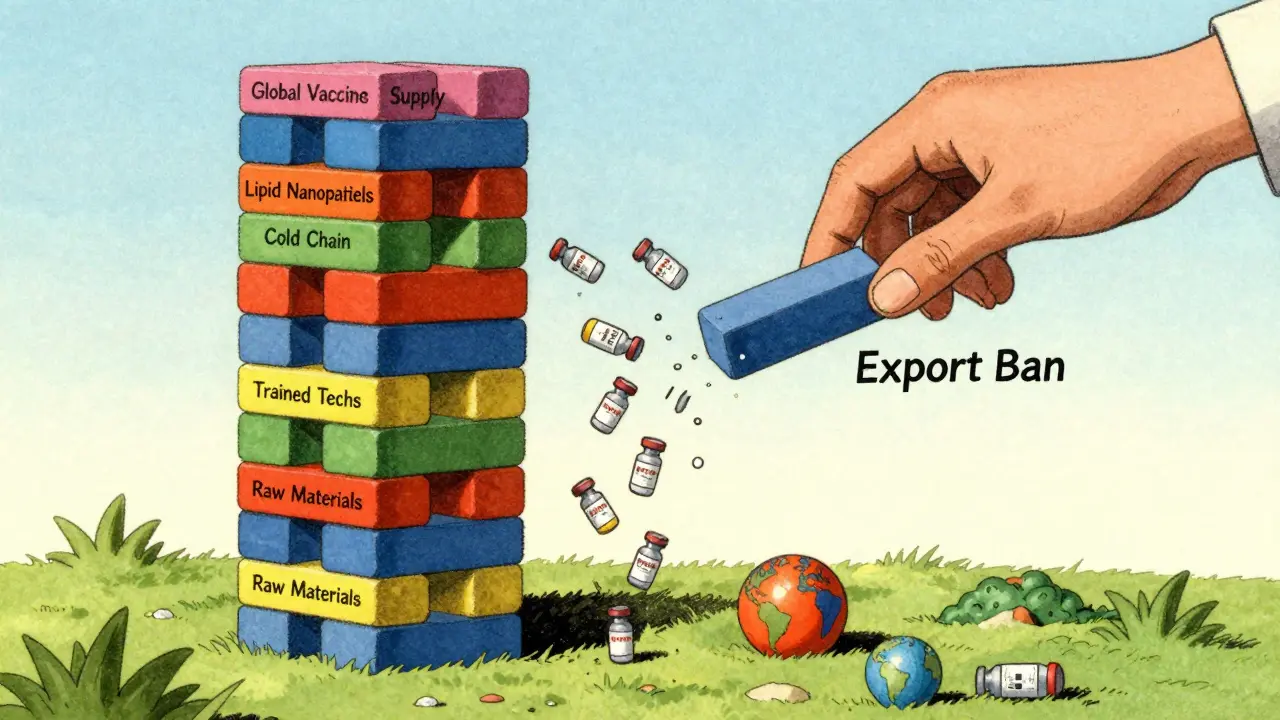
Vaccine manufacturing isn’t just hard. It’s fragile. Think of it like a Jenga tower. Pull one block out - and the whole thing collapses. During the pandemic, the U.S. banned exports of key raw materials under the Defense Production Act. That included the very lipids needed for mRNA vaccines. India, which relied on China for 70% of its vaccine ingredients, suddenly couldn’t get what it needed. Production slowed. Millions of doses were delayed. This wasn’t a glitch. It was a systemic failure. The world had outsourced vaccine production to a few players - and built a supply chain that depended on political goodwill. Even the WHO’s mRNA technology transfer hub in South Africa, launched with help from BioNTech, took 18 months just to start production. Why? Because they couldn’t find the right machines. The right filters. The right calibration tools. These aren’t off-the-shelf items. They’re custom-built for vaccine production. And the companies that make them? They’re based in Germany, Japan, and the U.S. - and they don’t sell to just anyone.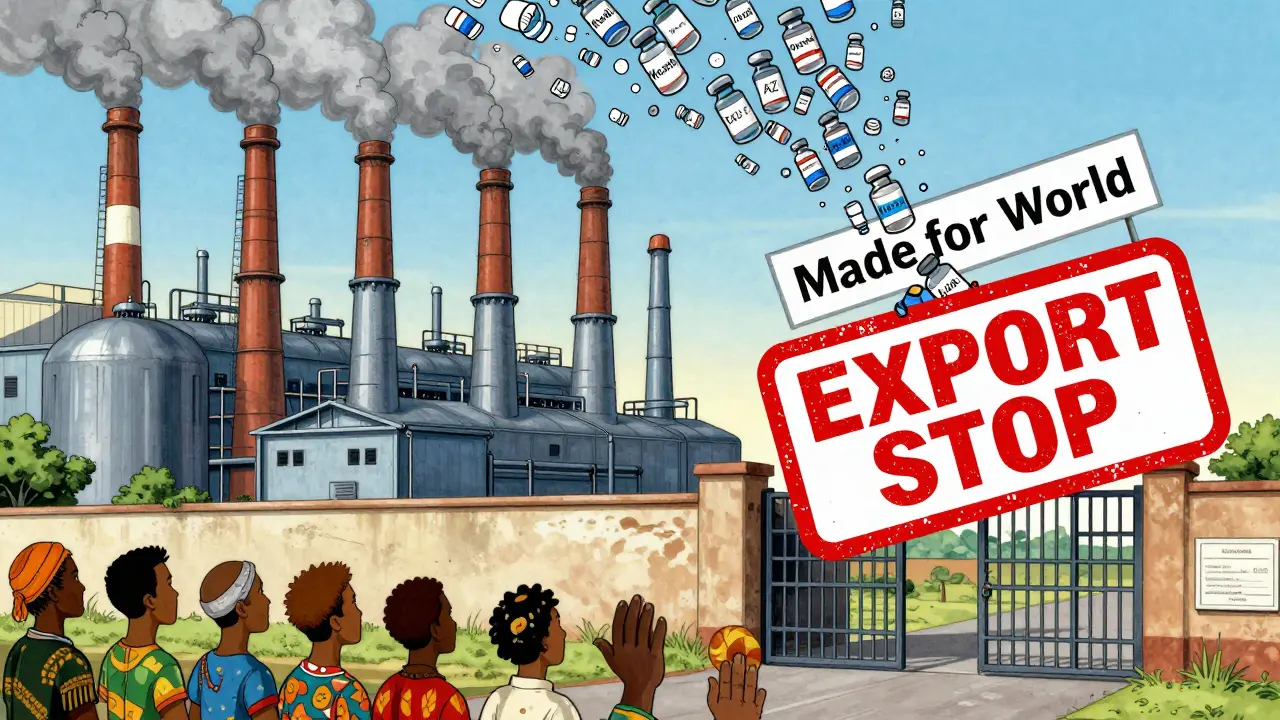
Costs and profits: why no one wants to build more factories
Building a vaccine plant isn’t like building a smartphone factory. It costs $200 million to $500 million. It takes five to seven years. And once it’s done, you’re locked into producing one type of vaccine. If the next big disease is a different virus? You can’t just retool. You need a whole new plant. Compare that to generic pills. A small factory in India can make 100 different drugs on the same line. The profit margin? Thin, but predictable. With vaccines? You’re gambling. You might make a few billion doses for a global emergency - and then have nothing left to sell. No one wants to invest in that. That’s why the market is so concentrated. Five companies - GSK, Merck, Sanofi, Pfizer, and Johnson & Johnson - control 70% of the global vaccine market. They’re not just big. They’re the only ones who can afford the risk. And they price accordingly. The pneumococcal vaccine, for example, still costs over $10 per dose for low-income countries - even though the cost to produce it is under $1. Gavi, the global vaccine alliance, has been negotiating for years. But the math doesn’t add up.What’s being done - and why it’s not enough
There are efforts to fix this. The WHO’s mRNA hub in South Africa is a start. The African Union wants to get to 60% local vaccine production by 2040. The U.S. FDA is now prioritizing domestic generic drug manufacturing. But these are drops in the ocean. The South Africa hub produces 100 million doses a year. Global demand? Over 11 billion. That’s less than 1%. The African Union’s $4 billion investment plan sounds big - until you realize it’s less than what Pfizer spent on marketing its COVID-19 vaccine in one year. And here’s the real kicker: even if you build the factories, you still need the raw materials. You still need the training. You still need the regulatory approval. And you still need a market that will buy from you. Right now, wealthy countries prefer to buy from established Western firms. They trust them. They’ve been working with them for decades. A new African or Latin American plant? They’re a risk.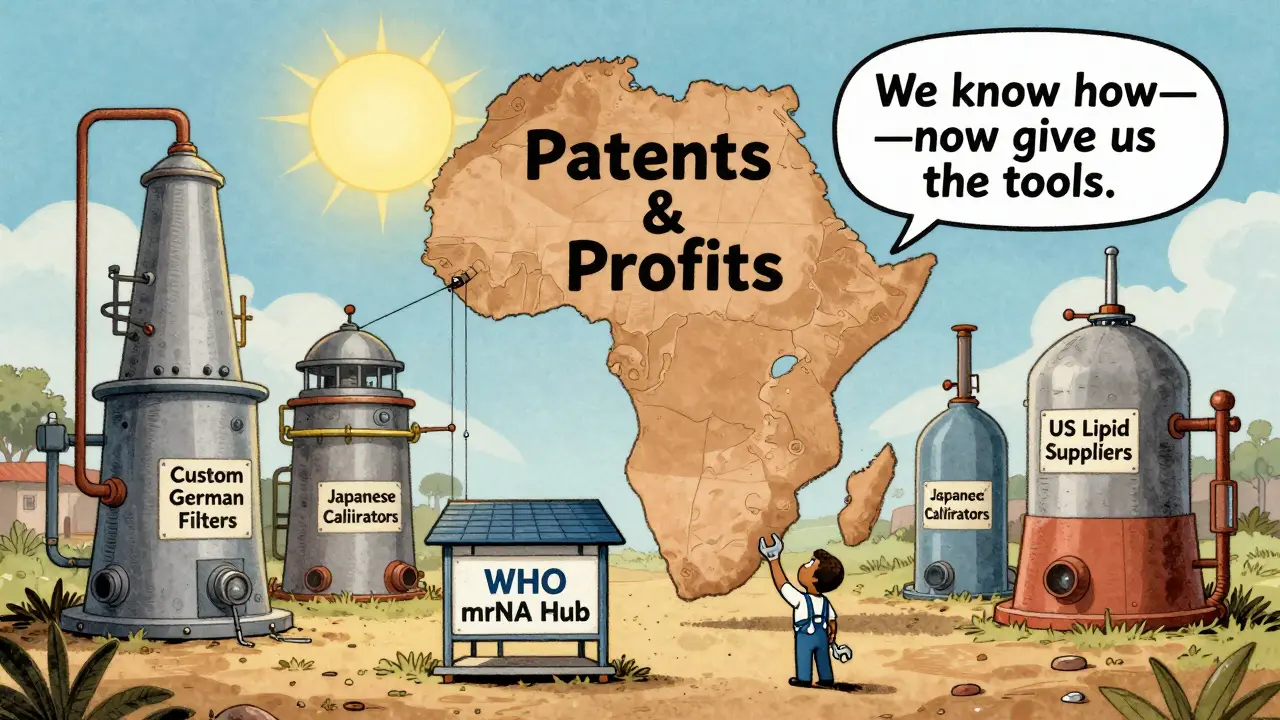
The future isn’t just about making more - it’s about changing the rules
The problem isn’t that we don’t know how to make vaccines. We do. The problem is that the system doesn’t let us make them where they’re needed most. India shows us what’s possible. It has the capacity. It has the expertise. It has the will. But it’s still dependent on foreign suppliers for 70% of its raw materials. If China cuts off exports again? So does India. What we need isn’t just more factories. We need:- A global stockpile of critical vaccine ingredients - not just for emergencies, but for routine use.
- Shared patents and technology, not locked behind corporate walls.
- International funding to build regional manufacturing hubs - not just in Africa, but in Latin America, Southeast Asia, and Eastern Europe.
- Regulatory harmonization - so a vaccine approved in South Africa can be trusted in Nigeria or Senegal without repeating every test.
What’s at stake
This isn’t just about COVID-19. It’s about polio. It’s about measles. It’s about the next disease we haven’t even named yet. If we don’t fix vaccine production now, we’re not just failing the next generation. We’re failing the ones already living in places where a single dose of a vaccine could mean the difference between life and death - and where no one is coming to deliver it.Why can’t we just copy vaccines like we copy pills?
Vaccines are biological products made from living cells, proteins, or mRNA - not simple chemical compounds. Unlike pills, they can’t be proven equivalent through standard tests. Each vaccine must go through a full approval process because even tiny variations in manufacturing can change how the immune system responds. There’s no shortcut like the ANDA process used for generic drugs.
Is India the only country that makes vaccines for the world?
India is the largest producer by volume, supplying 60% of global vaccines used by the WHO and 90% of its measles vaccines. But it’s not alone. Countries like China, South Korea, and Russia also produce large volumes. However, India is unique because it produces high-quality vaccines at low cost for low-income countries - something few others do. Most other manufacturers focus on wealthier markets.
Why don’t more countries build vaccine factories?
Building a vaccine plant costs $200 million to $500 million and takes 5-7 years. The return on investment is uncertain because demand is unpredictable - it spikes during pandemics and drops off after. Plus, the supply chain for raw materials is controlled by just a few global suppliers. Without guaranteed buyers and stable materials, most countries and investors avoid the risk.
Can low-income countries ever become self-sufficient in vaccine production?
Yes - but not without massive international support. The WHO’s mRNA hub in South Africa proved it’s possible to transfer technology. But scaling it requires shared patents, global funding, stable supply chains, and regulatory cooperation. Right now, efforts are too small and too fragmented. Without coordinated global action, most low-income countries will remain dependent on imports for decades.
What happened when India stopped exporting vaccines in 2021?
When India faced its own massive COVID-19 surge, it halted vaccine exports to prioritize domestic needs. This cut global supply by an estimated 50%. Countries relying on Indian-made vaccines - including many in Africa and Latin America - saw delays of months. It exposed how fragile the global system is: one country’s emergency can collapse the entire supply chain.

Comments
Let’s be real - vaccines aren’t pills. You can’t just print out a new batch like you’re photocopying a recipe. It’s like trying to clone a symphony instead of copying a grocery list. The lipid nanoparticles? The cold chain? The sterile labs? It’s not manufacturing - it’s high-stakes biology art.
And yeah, India’s the unsung hero here. 1.5 billion doses a year? For pennies? That’s not business - that’s global stewardship. But when their own crisis hit, the whole system cracked. Because we built a world where one country’s emergency = everyone else’s blackout.
YES YES YES!! 🙌 This is exactly why I’ve been screaming into the void for years!! Vaccines aren’t aspirin!! You can’t just ‘generic’ a living system!! 😭 The lipid nanoparticles alone? Only 5 companies in the WORLD can make them?? That’s not capitalism - that’s a hostage situation!!
And India stopping exports?? That’s not selfish - that’s survival. We’ve turned global health into a game of musical chairs… and the music stopped.
Oh wow. So we’re supposed to feel bad because India didn’t want to vaccinate the whole world while its own people were dying? What a shocker. Maybe next time they’ll just ship vaccines out in ziploc bags with a QR code to a YouTube tutorial.
Meanwhile, the WHO’s ‘hub’ in South Africa took 18 months to start because someone forgot to buy a freaking filter. I’m not mad… just disappointed in humanity.
Here’s the brutal truth no one wants to say: we don’t need more factories. We need more trust.
Look - if a vaccine is made in Vietnam, approved by their regulators, and meets WHO standards… why should Germany or the FDA demand another 3 years of testing? It’s not science - it’s legacy bias. The same companies that made billions off COVID are now the gatekeepers of global health equity. That’s not innovation. That’s institutional hoarding.
India’s got the skill. Africa’s got the will. Latin America’s got the talent. But they’re all stuck on the outside of a system built to protect profits, not lives. We’ve got the tech. We’ve got the knowledge. We just lack the moral courage to share it.
There’s a philosophical layer here that rarely gets discussed: the assumption that biological equivalence equals therapeutic equivalence. But vaccines aren’t chemical compounds - they’re dynamic interactions between engineered biological agents and the human immune system.
Even two batches from the same facility can differ in minor antigenic profiles, and those differences can cascade into variable immune responses. That’s why regulators require full clinical trials - not because they’re bureaucratic, but because immunology is inherently variable.
And yet, we treat this like a software license. You can’t just ‘port’ a vaccine from Pfizer to a factory in Lagos and expect identical outcomes. The system isn’t broken - it’s just misunderstood.
Just to clarify - the problem isn’t that we can’t make vaccines. It’s that we won’t invest in making them where they’re needed. Building a facility costs half a billion dollars. But the ROI? Only during a crisis. After that? You’re stuck with idle machinery and expired vials.
Meanwhile, generic drug factories in India churn out 100 different pills on one line. Why? Because demand is steady. Vaccines? Boom and bust. No investor wants that. No bank will lend. So we’re stuck with a system where the only companies that can afford to make vaccines are the ones who already own the market.
OH MY GOD. I JUST REALIZED - we’re basically asking poor countries to play Jenga with their lives. Pull out one block - the lipid supply from China - and the whole tower CRUMBLES. And then we act surprised when kids in Nigeria don’t get measles shots?
I’m crying. I’m so mad. I’m so sad. This is the definition of systemic injustice. We need a global vaccine commons. Like, right now. Like, before the next pandemic kills more people because we were too lazy to fix this.
So let me get this straight - we’re supposed to trust a vaccine made in Africa because… why? Because it’s ‘fair’? Because it’s ‘moral’? You think a lab in Nairobi with a $2 million budget can match the sterile conditions of a Pfizer facility? Please. We’re not talking about fair trade coffee here. We’re talking about biological safety.
And don’t get me started on ‘shared patents.’ You think Pfizer’s gonna give away their IP just because someone wrote a nice tweet? Wake up. This isn’t a Netflix documentary. It’s global health. And it’s messy. And it’s dangerous. And no amount of idealism changes that.
Look. I’ve read this whole thing. Twice. And here’s what I think: the real issue isn’t the science. It’s the politics. We have the tech. We have the money. We have the expertise. But we refuse to share it because we’re scared. Scared that if Africa builds its own supply chain, they’ll stop buying our overpriced vaccines. Scared that if Vietnam learns how to make mRNA, they’ll undercut us. Scared that if India starts exporting to Brazil, we’ll lose our monopoly.
We don’t need more factories. We need less greed. But we’re not going to get that. Because the people who control this system? They’re not scientists. They’re CEOs. And they’re not here to save lives. They’re here to keep their stock prices high.
So yeah. The next pandemic will come. And we’ll be just as unprepared. And we’ll blame the ‘lack of capacity.’ But we won’t admit the truth: we had the capacity. We just chose not to use it.