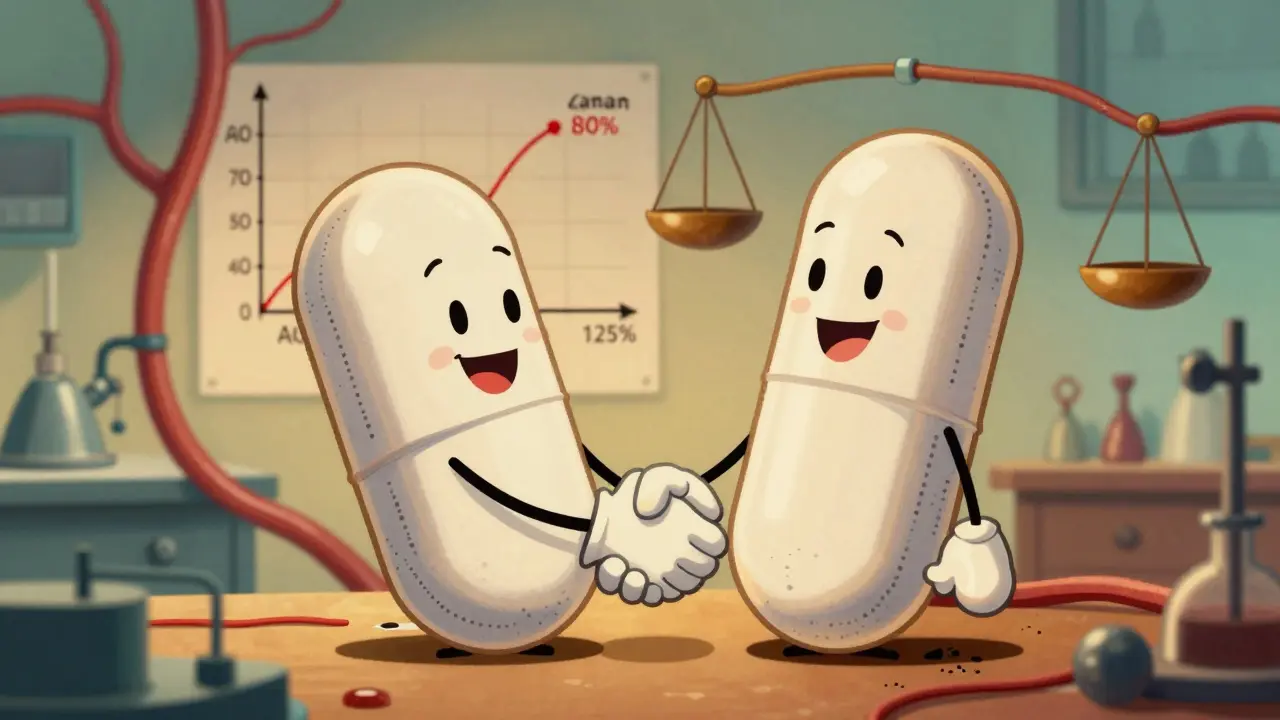
When you pick up a generic pill at the pharmacy, you might assume it’s just a cheaper copy of the brand-name drug. But how do regulators know it will work the same way in your body? That’s where the 80-125% rule comes in - a quiet but powerful standard that ensures generic drugs are safe and effective without requiring new clinical trials on patients.
What the 80-125% Rule Actually Means
The 80-125% rule isn’t about how much active ingredient is in the pill. It’s not saying your generic drug contains only 80% of the drug found in the brand version. That’s a common misunderstanding. Instead, it’s a statistical gatekeeper for how well your body absorbs the drug.
Regulators like the FDA, EMA, and WHO use this rule to compare two versions of the same drug - the original brand and a generic version. They measure two key things: how much of the drug enters your bloodstream over time (called AUC, or Area Under the Curve) and how fast it reaches its highest level (called Cmax, or maximum concentration). These are measured in clinical studies with healthy volunteers, using blood samples taken over hours after taking the drug.
Here’s the catch: these numbers don’t follow a normal bell curve. They’re skewed, meaning they follow a log-normal distribution. So before comparing them, scientists take the natural logarithm of each value. On that transformed scale, a 20% difference above or below becomes symmetrical. That’s why the acceptance range is 80% to 125% - it’s the same as saying ±20% on the original scale, but mathematically correct.
The 90% confidence interval of the ratio between the generic and brand drug’s geometric means must fall entirely within that 80-125% window. If even one point of that interval dips below 80% or rises above 125%, the drugs aren’t considered bioequivalent - and the generic can’t be approved.
Why a 90% Confidence Interval? Not 95%
You might wonder why regulators use a 90% confidence interval instead of the more familiar 95%. The answer lies in how they define risk.
Traditional hypothesis testing would say: “Is there a difference?” But that doesn’t work well here. With large enough sample sizes, even tiny, meaningless differences become statistically significant. That’s why regulators switched to confidence intervals - they answer a better question: “How large could the real difference be?”
A 90% confidence interval means there’s a 10% total chance the true difference falls outside the 80-125% range - 5% on each side. That’s an acceptable level of uncertainty for a system that needs to approve thousands of generics efficiently. It balances safety with practicality. Using a 95% CI would make the standard too strict, blocking many safe and effective generics.
What Happens When a Drug Doesn’t Fit the Mold?
The 80-125% rule works well for most drugs - but not all. Some drugs are too unpredictable. Others are too dangerous to risk even small differences.
Take warfarin, a blood thinner. A 10% change in exposure could mean the difference between a dangerous clot and a life-threatening bleed. For these narrow therapeutic index drugs, regulators now require tighter limits: 90-111%. Levothyroxine, used for thyroid conditions, is another example. The FDA updated its guidance in 2022 to reflect this.
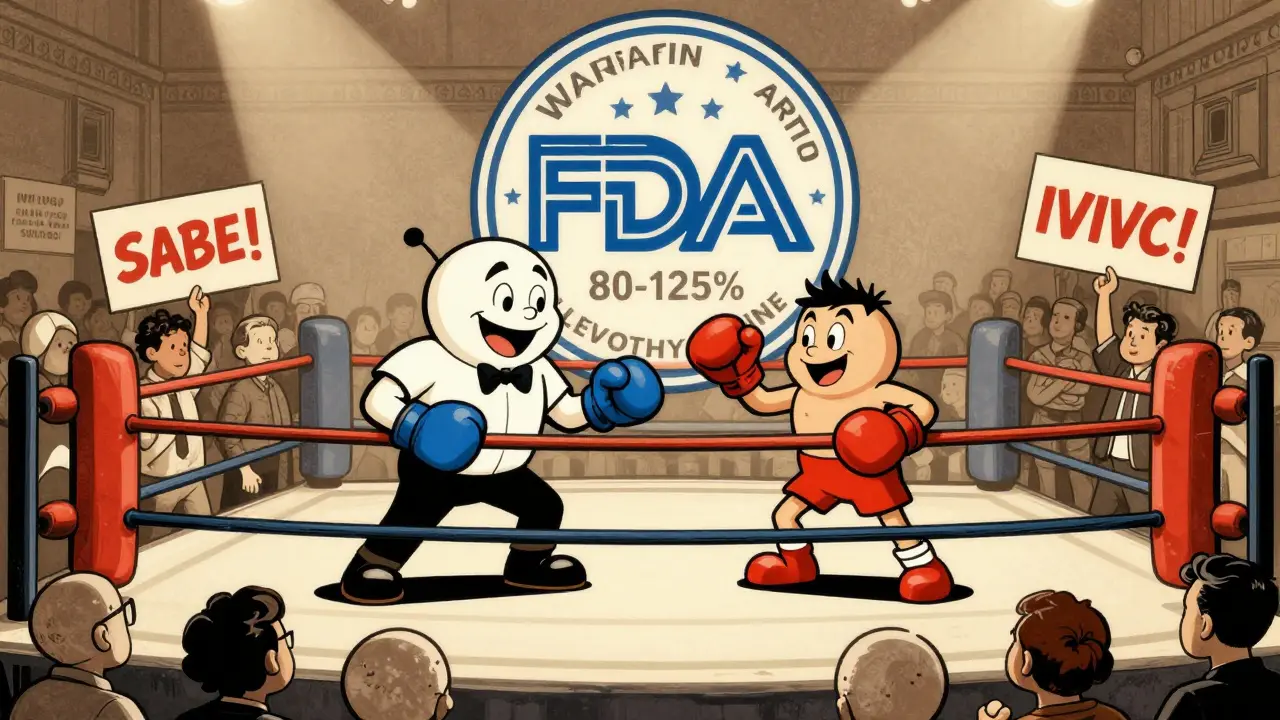
On the other end, some drugs vary wildly from person to person. Think of drugs metabolized by the liver enzyme CYP3A4 - like certain statins or immunosuppressants. If the variability is too high (over 30% within-subject CV), the standard 80-125% range might be too narrow. That’s where scaled average bioequivalence (SABE) kicks in. Under SABE, the acceptance range expands based on how variable the reference drug is. For highly variable drugs, the upper limit can stretch to 143.19% for Cmax. The EMA has used this since 2010; the FDA adopted it in 2021 for specific cases.
And then there are complex drugs - inhalers, topical creams, extended-release tablets. These don’t dissolve or absorb the same way as simple pills. The FDA launched its Complex Generics Initiative in 2018 with $35 million a year to tackle these. New methods, like in vitro-in vivo correlation (IVIVC), are being tested to replace or reduce human studies for these products.
How Bioequivalence Studies Actually Work
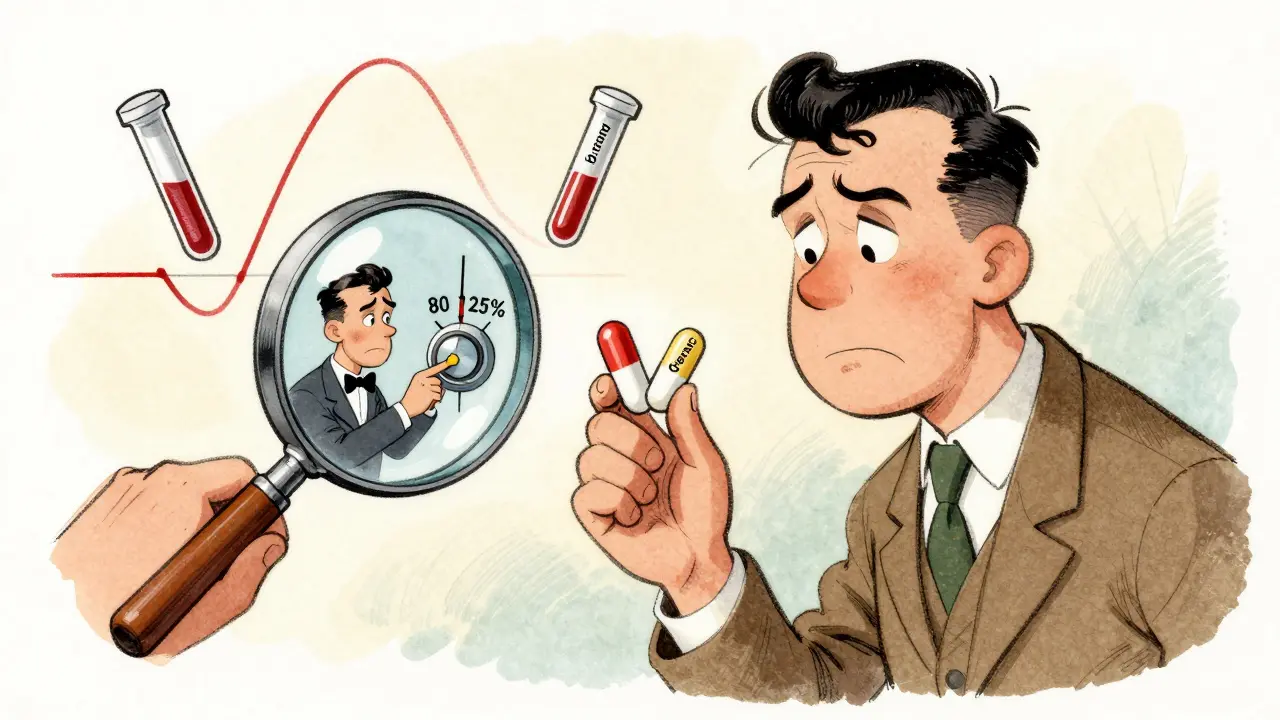
Behind every approved generic is a clinical study - usually with 24 to 36 healthy adults. These studies follow a crossover design: each participant takes both the brand and generic drug, separated by a washout period. This reduces individual variability and makes comparisons more accurate.
Researchers collect blood samples every 15 to 30 minutes after dosing, then plot the concentration over time. They calculate AUC(0-t), AUC(0-∞), and Cmax. The data is log-transformed, analyzed using ANOVA, and the 90% confidence interval is computed. Both AUC and Cmax must pass. If one fails, the study fails.
It’s not easy. Outliers can ruin a study. If more than 20% of data points are flagged as outliers, the sponsor must justify why. Food effects matter too - if the drug is affected by meals, studies must be done both fasted and after eating. And if the drug has a long half-life (like some antidepressants), studies can take weeks just to complete.
It’s expensive. A single bioequivalence study can cost $200,000 to $500,000. Add in formulation development, regulatory filings, and manufacturing changes, and the total cost to bring a generic to market can hit $2-5 million - and take 18 to 24 months.
Why This Rule Exists - and Why It Works
The 80-125% rule didn’t come from a lab experiment. It came from a 1986 FDA hearing where experts debated what level of difference would still be safe. They looked at decades of clinical experience and concluded: a 20% difference in absorption is unlikely to cause harm in most cases.
Since then, real-world data has backed them up. Between 2003 and 2016, the FDA approved over 2,000 generic drugs. Only 0.34% ever required a label change due to bioequivalence concerns after hitting the market. That’s less than one in 300.
Post-marketing surveillance shows generic drugs perform just like brands. A 2022 meta-analysis of 214 studies across 37 drug classes found no clinically meaningful differences in therapeutic outcomes when the 80-125% rule was met.
Even in sensitive areas like epilepsy, where patients and doctors worry about seizures returning after switching generics, studies show most issues stem from formulation differences - like fillers or coatings - not bioequivalence. A 2022 survey of neurologists found only 4% blamed bioequivalence standards for problems.
Common Misconceptions and Where They Come From
Despite decades of use, confusion persists. A 2022 survey by the American Pharmacists Association found 63% of community pharmacists wrongly believed the 80-125% rule meant generics contain 80% to 125% of the active ingredient. That’s not true. All approved drugs - brand or generic - must contain 95% to 105% of the labeled amount. The rule applies to how your body absorbs it, not how much is in the tablet.
On Reddit, patient threads are full of fear: “My generic doesn’t work like the brand.” But often, the real issue is psychological - or it’s due to a different formulation, like a slow-release version being swapped for immediate-release. The 80-125% rule doesn’t cover those differences.
Another myth: “If it’s bioequivalent, why do I feel different?” The answer: you might be. But not because the drug is less effective. You might be reacting to a different dye, filler, or coating. Or your body adjusted to the brand’s specific shape or size over years. That’s not bioequivalence failure - that’s human adaptation.
What’s Next for Bioequivalence?
The 80-125% rule isn’t going away. But it’s evolving. The FDA’s 2023-2027 Strategic Plan includes $15 million to explore model-informed bioequivalence - using computer simulations and pharmacokinetic modeling to predict how a drug behaves without running full human studies.
Researchers are also looking at pharmacogenomics. If someone metabolizes drugs slowly due to their genes, should bioequivalence standards change for them? Maybe. But that’s still years away.
For now, the 80-125% rule remains the global gold standard. It’s not perfect. It’s not always precise. But it’s simple, consistent, and backed by real-world evidence. And because of it, you can buy a $5 generic instead of a $300 brand-name pill - and trust that it will work just as well.


Comments
So let me get this straight - we’re trusting a statistical loophole to let companies sell life-saving meds for 95% less, and the only real test is whether your blood levels stay within a 20% window? Sounds like the FDA’s version of ‘close enough’ - and honestly? I’m okay with it. I’ve been on generics for a decade. No seizures. No side effects. Just cheaper pills and more cash in my pocket.
Still, I’d love to see a public dashboard showing which generics passed, which failed, and who made them. Transparency > trust.
Also, the part about warfarin? Yeah, that’s the one I’d never switch without a doctor’s hand-holding. Not because of the rule - because I’m terrified of bleeding out.
USA think they own medicine like they own the moon 🤡
80-125%? That’s not science - that’s corporate greed dressed up in lab coats! In Nigeria, we don’t have fancy blood tests or $500k studies - we just take the pill and see if we live or die. And guess what? Our people survive. Your ‘gold standard’ is just a tax on the poor.
Why not just let us use the same pills from India? They’re cheaper, better tested, and made by people who actually care. But no - your FDA needs to ‘protect’ us from our own salvation. 😒💊
I work in a pharmacy and this post made me tear up a little. So many patients come in scared to switch - they think the generic is ‘fake’ or ‘watered down.’ I show them the FDA’s bioequivalence reports and they’re shocked to learn how rigorous it is.
One lady told me her grandma died because she switched from brand to generic. I asked if it was the same drug class, same dose, same release type - and she said no, the brand was extended-release and the generic was immediate. That’s not bioequivalence failure - that’s a mix-up.
Education matters more than regulation sometimes.
Also - thank you for explaining the 90% CI. I’ve been explaining this for years and never knew the math behind it. Now I can actually sound smart when I talk to patients 😊
Wait - so the 80-125% rule isn’t about how much drug is in the pill? I’ve been telling my friends for years that generics are ‘only 80% effective’ because of that. I’m embarrassed.
Also, I had no idea they do crossover studies with blood draws every 15 minutes. That sounds like torture. I’d rather pay $300.
But now I’m kinda proud of how much science goes into this. Like… we’re not just throwing pills at people and hoping. There’s math. There’s logs. There’s people sitting in chairs for days getting poked. Respect.
Also - who’s the genius who thought to use log-normal distribution? That’s next-level nerdery. I’m in awe.
Let’s deconstruct the epistemological hegemony of the 80-125% paradigm. The entire framework is predicated on a Cartesian reductionism that reifies pharmacokinetics as a linear, quantifiable phenomenon - when in reality, human physiology is a nonlinear, emergent, embodied system.
By reducing therapeutic equivalence to geometric means and log-transformed Cmax, we are not just measuring bioavailability - we are erasing the phenomenological experience of the patient. The body does not ‘absorb’ a drug - it *negotiates* with it. Through microbiome interactions, epigenetic modulation, and affective somatic feedback loops.
And yet - we call this ‘science.’
Meanwhile, the FDA’s ‘Complex Generics Initiative’ is just a PR stunt to appease the pharmaceutical-industrial complex while pretending to innovate. Model-informed bioequivalence? More like model-informed obfuscation.
The real question: why are we even *trying* to make everything equivalent? Maybe difference is the point. Maybe variability is the medicine.
Just saying.
My dad takes levothyroxine and we had to switch generics three times before we found one that worked. It wasn’t the drug - it was the filler. One had cornstarch, one had lactose, one had a weird coating that made him gag. We kept the original because it didn’t make him feel like he’d swallowed a rock.
So yeah - the 80-125% rule works for blood levels. But the pill isn’t just chemistry. It’s texture. Taste. Size. The way it sits in your throat. That matters more than you think.
Also - $500k per study? No wonder generics take 2 years. I’d pay extra to skip the waiting.
Oh honey. You really think the FDA is protecting you? They’re protecting Big Pharma’s monopoly. The 80-125% rule? That’s just the minimum bar so generics can sneak in without rocking the boat. The real test? How much profit the brand can squeeze out before the generic hits.
And don’t get me started on how they let companies cherry-pick healthy volunteers. What about people with liver disease? Diabetes? Old folks? They never test on them. So your ‘safe’ generic? Might be a death sentence for someone over 65.
And yet - you’re all here like ‘oh wow science!’
Wake up. This isn’t medicine. It’s capitalism with a lab coat.
WAIT - so they’re using healthy volunteers to test drugs for people with chronic illness? That’s a lie. A complete lie.
And they use log-normal distribution? That’s just math magic to make the numbers look good. I read a whistleblower report - the FDA’s own internal audit showed 17% of bioequivalence studies had data manipulation. They delete outliers that don’t fit. They pick the ‘best’ 24 people. They hide the ones who had bad reactions.
And now you’re telling me we should trust this? That’s why so many people have seizures after switching. It’s not the filler. It’s the drug itself - and they’re letting dangerous generics through because they don’t want to admit the system is broken.
Also - why is the FDA spending $15M on computer models? Because they’re scared to do real human trials. They know the truth: the 80-125% rule is a lie. And you’re all just too comfortable to question it.
Wake up. They’re poisoning us with math.