
Mirtazapine Sedation & Timing Optimizer
Configure Your Parameters
Analysis & Recommendation
Recommended Intake Time:
20:00 (8:00 PM)
Waking up feeling like you’ve been hit by a truck is not how any of us want to start our day. If you are taking mirtazapine for depression or anxiety, this groggy, heavy-headed sensation might be your new normal unless you adjust your strategy. Mirtazapine (often known by the brand name Remeron) is famous for two things: it helps lift mood, and it knocks you out cold. But that powerful sleep-inducing effect can easily spill over into the next morning, turning a productive workday into a struggle to stay awake.
The good news? You don’t have to choose between better sleep and being alert during the day. The secret lies in understanding the drug’s unique chemistry-specifically, how dose size affects sedation-and timing your intake with precision. By tweaking when and how much you take, you can keep the antidepressant benefits while minimizing that dreaded daytime fog.
The Science Behind the Sleepiness
To fix the problem, we first need to understand why mirtazapine makes you so tired. Unlike many other antidepressants that primarily target serotonin, mirtazapine works on multiple fronts. It is classified as a noradrenergic and specific serotonergic antidepressant (NaSSA). This fancy term means it boosts both norepinephrine and serotonin levels, which helps improve mood and energy. However, it also blocks histamine receptors.
Blocking histamine is exactly what antihistamines like Benadryl do to make you sleepy. Mirtazapine is a potent antagonist at these H1 receptors. In fact, studies show it binds to these receptors 10 to 20 times more strongly than some other common antidepressants like trazodone. This strong blockage is what causes the intense sedation. Because the drug reaches peak concentration in your blood about two hours after you swallow it, taking it at bedtime aligns this peak with your natural sleep window. This maximizes the chance that you’ll fall asleep quickly and stay asleep longer.
However, mirtazapine has a long half-life, meaning it stays in your system for a long time-typically between 20 and 40 hours. Even if you take it right before bed, a significant amount of the drug remains active in your body the next morning. This residual presence is often the culprit behind waking up feeling groggy or unable to focus until noon.
The Counterintuitive Dose-Sedation Relationship
Here is where things get tricky, and where many patients (and even some doctors) go wrong. You might assume that if you aren’t sleeping well enough, you should increase your dose. With most medications, higher doses mean stronger effects. With mirtazapine’s sedative properties, the opposite is true.
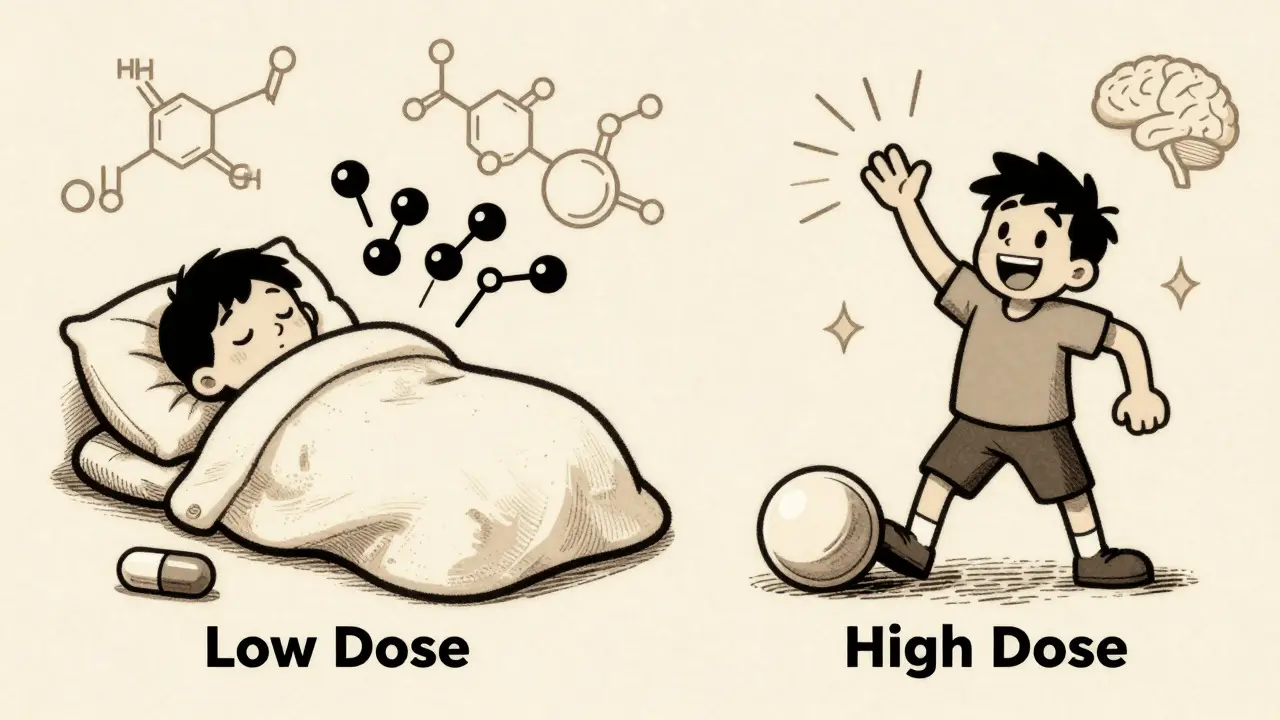
Mirtazapine exhibits an inverse dose-response relationship regarding sedation. At lower doses, specifically between 7.5 mg and 15 mg, the histamine-blocking effect dominates. This is when the drug acts as a powerful sleep aid. As you increase the dose to 30 mg or 45 mg, the noradrenergic (norepinephrine-boosting) effects kick in harder. Norepinephrine is associated with alertness and energy. So, at higher doses, this energizing effect partially cancels out the sleepiness caused by the histamine blockade.
| Dose Range | Primary Effect | Sedation Level | Best For |
|---|---|---|---|
| 7.5 - 15 mg | Strong Histamine Blockade | High | Prominent Insomnia & Anxiety |
| 30 - 45 mg | Balanced Noradrenergic/Serotonergic | Moderate to Low | Major Depression with Less Sleep Disturbance |
This phenomenon was highlighted by researchers Blier and Berger, who noted that noradrenergic effects counteract histamine blockade at higher doses. If you are struggling with severe insomnia, sticking to the lower end of the dosage spectrum is usually more effective for sleep than pushing toward the higher end. Conversely, if you find yourself too sleepy during the day, increasing the dose under medical supervision might actually help reduce that drowsiness while boosting antidepressant efficacy.
Optimizing Your Bedtime Routine
Timing is everything. Since mirtazapine takes about two hours to reach its peak effect, taking it too early or too late can disrupt your sleep cycle. The goal is to have the peak sedation coincide with your desired sleep onset.
If you plan to sleep at 10:00 PM, taking your medication around 8:00 PM allows the drug to absorb and start working just as you get into bed. Taking it immediately before closing your eyes might result in lying awake for an hour while waiting for the drowsiness to hit, which can cause anxiety. On the flip side, taking it too late might mean you wake up in the middle of the night as the initial wave of sedation wears off, only to crash again later.
Consistency is key. Try to take your pill at the same time every night. This helps regulate your body’s internal clock, making the sedative effect more predictable. Also, avoid alcohol. Alcohol enhances the sedative effects of mirtazapine, which sounds helpful but often leads to fragmented sleep quality and worse hangover-like grogginess the next morning.
Managing Daytime Drowsiness
Even with perfect timing, some people still experience next-day drowsiness. This is particularly common during the first few weeks of treatment. Your body needs time to adjust to the new chemical balance. Research indicates that tachyphylaxis-a rapid decrease in response to a drug-can occur with the sedative effects within 7 to 14 days. Many users report that the "heavy" feeling diminishes significantly after the second week.
If the drowsiness persists beyond that adjustment period, consider these strategies:
- Hydrate immediately upon waking: Dehydration worsens fatigue. Drinking a large glass of water as soon as you stand up can help shock your system into alertness.
- Get morning sunlight: Exposure to bright light within 30 minutes of waking helps suppress melatonin production and signals your brain that it’s time to be awake. This is crucial for resetting your circadian rhythm.
- Avoid driving if impaired: Be honest with yourself. If you feel sluggish, wait until you’re sure your reaction times are normal. The FDA warns that mirtazapine can impair mental abilities or physical capabilities needed for potentially dangerous tasks like driving.
- Discuss dose adjustments: If you are on 15 mg and still too sleepy, talk to your doctor. They might suggest dropping to 7.5 mg. If you are on 30 mg and still sleepy, they might consider switching you to a different class of antidepressant with less histamine affinity, such as an SSRI like sertraline, though SSRIs have their own set of side effects.

Real-World Experiences and Expectations
Data from patient forums and clinical reviews paints a clear picture of what to expect. A review of thousands of user comments shows that about 68% of people taking 15 mg at bedtime report significant sleep improvement with manageable next-day effects. However, nearly a third report "grogginess lasting until noon." This variation highlights that individual metabolism plays a huge role. Factors like age, liver function, and other medications can slow down how fast your body clears mirtazapine.
Older adults are particularly sensitive to the sedative effects. If you are over 65, starting at the lowest possible dose (7.5 mg) is critical to prevent falls and excessive confusion. The risk of daytime dizziness and cognitive slowing is higher in this demographic.
It’s also worth noting that mirtazapine is rarely prescribed solely for insomnia anymore due to newer, safer options like lemborexant. Its primary value is treating major depressive disorder where insomnia is a major symptom. If your main issue is sleep without depression, there may be better alternatives with fewer daytime side effects. But for those dealing with both, mirtazapine remains a top-tier choice because it addresses two problems at once without the sexual side effects common to SSRIs.
When to Talk to Your Doctor
You should contact your healthcare provider if:
- The daytime drowsiness interferes with your ability to work or care for yourself after two weeks.
- You experience unusual agitation, confusion, or memory problems.
- You feel no improvement in your mood or sleep after four to six weeks.
- You are considering stopping the medication abruptly, which can lead to withdrawal symptoms like nausea and anxiety.
Never change your dose without professional guidance. While the inverse relationship between dose and sedation is well-documented, finding the sweet spot requires careful monitoring. Your doctor might suggest splitting the dose, though this is rare, or switching to a different medication entirely if the side effects outweigh the benefits.
How long does mirtazapine sedation last?
The intense sedative effect peaks about 2 hours after ingestion and lasts throughout the night. However, due to its long half-life of 20-40 hours, mild drowsiness or grogginess can persist into the next day, especially during the first 1-2 weeks of treatment. For most people, this residual effect diminishes as the body adjusts.
Does a higher dose of mirtazapine make you more sleepy?
Surprisingly, no. Lower doses (7.5-15 mg) cause more sedation because histamine blockade dominates. Higher doses (30-45 mg) increase noradrenergic activity, which promotes alertness and can actually reduce the sedative effect compared to lower doses.
Can I take mirtazapine in the morning?
Generally, no. Because it is highly sedating, it is almost always recommended to take it at bedtime. Morning dosing could lead to significant impairment during the day. Only take it in the morning if explicitly instructed by your doctor, usually in cases where insomnia is not an issue.
Why do I feel groggy the next day after taking mirtazapine?
This is likely due to the drug's long half-life. Mirtazapine stays in your system for a long time, and if your metabolism is slower, or if you are on a lower dose where sedation is stronger, residual drug levels can cause morning grogginess. Hydration and morning sunlight can help mitigate this.
Is mirtazapine safe for long-term use for insomnia?
While effective, it is primarily an antidepressant. Long-term use solely for insomnia is less common now due to newer sleep-specific medications. However, for patients with comorbid depression and insomnia, it is considered safe and effective for long-term management under medical supervision.