
When you or someone you care about has a bad reaction to a medication, a medical device that fails during use, or a dietary supplement that causes unexpected symptoms, you might wonder: Can I tell the FDA directly? Yes. And it matters more than you think.
The FDA doesn’t just rely on doctors or drug companies to spot problems. Real people - patients, caregivers, family members - are the first to notice when something goes wrong in everyday life. A headache that won’t go away after a new migraine pill. A glucose monitor giving wrong readings. A hearing aid that stops working after one month. These aren’t just inconveniences. They’re safety signals. And the FDA’s MedWatch program exists to collect them.
Since 1993, the FDA has let patients file reports directly through the Safety Reporting Portal. It’s not a backup system. It’s a core part of how the agency finds hidden dangers. Clinical trials test drugs on a few thousand people. But once millions start using a product, rare side effects show up. One in 10,000. One in 50,000. Those are the cases that only patients can report.
What Exactly Can You Report?
You don’t need to be a doctor to know when something’s wrong. The FDA accepts reports for any FDA-regulated product if it caused or might have caused harm. That includes:
- Drugs (prescription and over-the-counter)
- Biologics (like vaccines or insulin)
- Medical devices (pacemakers, inhalers, glucose monitors, contact lenses)
- Dietary supplements (vitamins, protein powders, herbal products)
- Infant formula
- Cosmetics (rashes, hair loss, eye irritation from makeup)
You can report:
- Severe side effects (hospitalization, birth defects, death)
- Product failures (a ventilator shuts off, a patch falls off too soon)
- Therapeutic failure (a blood pressure pill stops working after two weeks)
- Use errors (misuse because instructions were unclear)
- Contaminated or mislabeled products
It doesn’t have to be proven. If you believe the product caused the problem, report it. The FDA’s job is to investigate.
How to File a Report: Three Ways
The FDA gives you three ways to report - pick what works for you.
1. Online: The Safety Reporting Portal (SRP)
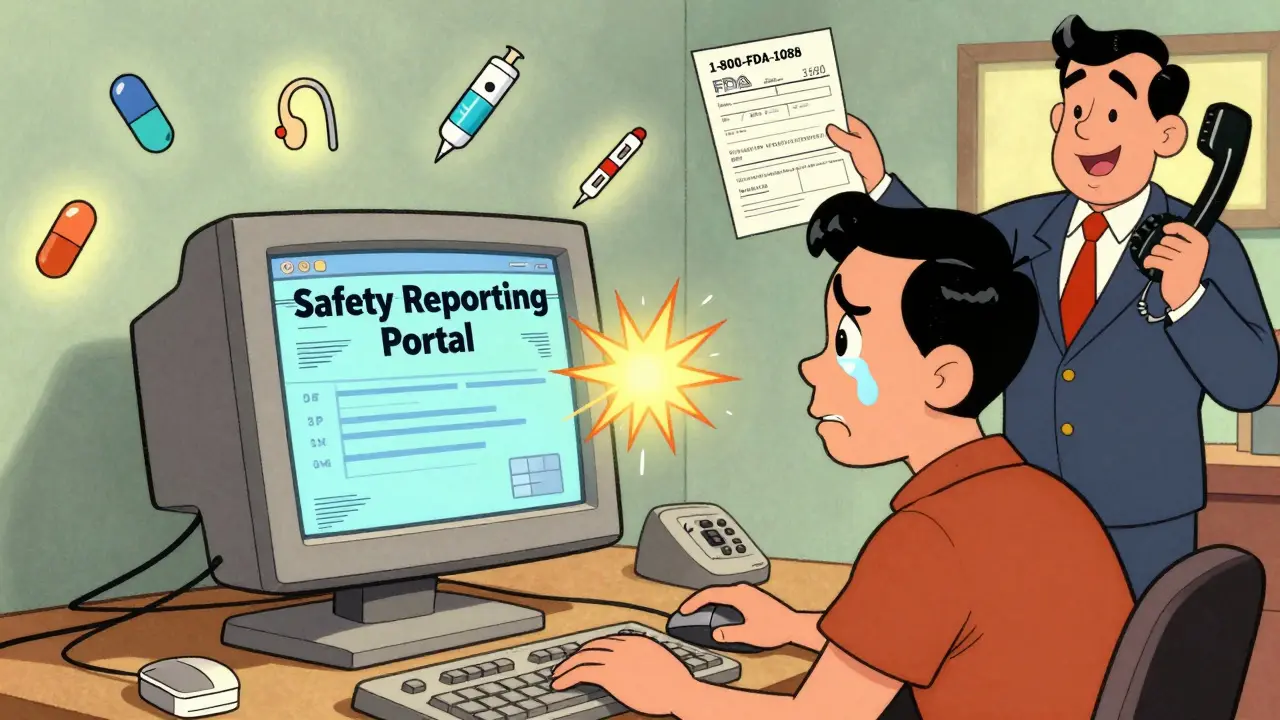
This is the fastest way. Go to fda.gov/medwatch and click "Report a Problem." You’ll fill out a form that asks for:
- Your name and contact info (optional - you can report anonymously)
- Patient details (age, sex, weight)
- Product name, lot number, expiration date
- When the problem started and what happened
- Any other medicines or supplements you were taking
- Outcome (did you go to the hospital? Did it resolve?)
It takes about 15-20 minutes. The form is designed for non-experts. The FDA added a symptom wizard in late 2024 to help you describe what happened without medical jargon. It cut reporting errors by 33% in testing.
But here’s the catch: the portal has been glitchy since August 2024. It crashes. Times out. Freezes. If you hit trouble, don’t give up. Use one of the other methods.
2. Paper Form: FDA Form 3500
Download the FDA Form 3500 (PDF). Print it. Fill it out by hand. Mail it to:
FDA MedWatch
5600 Fishers Lane
Rockville, MD 20852-9787
It’s the same form as the online version, just on paper. Takes longer - about 25-30 minutes - but it’s reliable. If you’re uncomfortable with tech, this is your best bet. You can also request a free copy by calling 1-800-FDA-1088.
There’s also a Spanish version: Form 3500B. The FDA made it available in 2023 after feedback from Hispanic patients.
3. Phone: Call 1-800-332-1088
If you’re overwhelmed, confused, or just want to talk it through, call. Trained staff answer Monday-Friday, 8 a.m. to 8 p.m. Eastern Time. They’ll ask you the same questions as the form and file the report for you. They even help you find lot numbers if you don’t have the packaging.
Callers report a 92% answer rate. No hold times. No bots.
What Happens After You Submit?
You won’t get a call back. But you should get a confirmation email within 5 business days - if you gave an email address. Most people don’t know this. Check your spam folder.
The report goes into the FDA Adverse Event Reporting System (FAERS). That’s a database with over 25 million reports since 1969. Each report is reviewed. If enough people report the same issue - say, 100 people saying a new antidepressant causes severe tremors - the FDA may:
- Update the drug label with new warnings
- Require a black box warning
- Ask the manufacturer to change the packaging or instructions
- Issue a public safety alert
- Even recall the product
Real examples? In early 2024, 287 patient reports about insulin pens being stored incorrectly led to a nationwide safety notice. Another report from a cancer patient about an immunotherapy reaction helped trigger a label change for a key drug.
Why Your Report Matters - Even If It’s "Just One"
Most people think: "One report won’t make a difference." But that’s exactly how the system works.
Think of it like a smoke alarm. One person hears a beep. They check the battery. They fix it. If no one reported it, the alarm stays broken - until someone dies. Patient reports are the early beeps.
A 2024 study in Drug Safety found patient reports included 37% more detail about when symptoms started than doctor reports. Patients noticed things doctors missed - like how a new pill made them dizzy only after eating breakfast. Or how a device failed only when used at high altitudes.
And while only about 15-20% of reports come from patients, they’re 2.3 times more likely to describe brand-new use errors. That’s because patients use products in ways manufacturers never tested - skipping doses, mixing with supplements, using them for off-label reasons.
What’s Missing? The Big Problems
Here’s the hard truth: most people never report.
A 2024 study in JAMA Internal Medicine found that 90-95% of adverse reactions go unreported. Why?
- People don’t know they can report
- They think it’s the doctor’s job
- They can’t find the lot number on the packaging
- The portal crashes
- They’re too sick or tired
Lot numbers? Only 62% of products have them clearly printed. If you don’t have the box, call the pharmacy. They can look it up.
And yes, patient reports often lack medical details. Only 62% of consumer reports include enough info for full review - compared to 89% from doctors. That’s why the FDA uses AI to help fill gaps. Since late 2024, AI triage cuts processing time from 22 days to 9.
But here’s the kicker: even incomplete reports are valuable. They flag patterns. Then the FDA goes back to doctors, hospitals, labs - and asks for more data.
What’s Changing? The Future of Patient Reporting
The FDA is upgrading. On January 15, 2025, they launched the Next Generation Safety Reporting System (NGSRS). It now:
- Automatically verifies lot numbers from barcodes
- Uses AI to code symptoms ("chest pain" → standardized medical term)
- Plans to support 5 new languages by 2027
- Will merge all reporting portals into one by 2028
Some companies are helping too. Medtronic added a direct reporting button in their heart device app in 2024. Patient-initiated reports jumped 27%.
But the biggest change? The FDA now says patient reports are irreplaceable. Commissioner Robert Califf told Congress in March 2025: "We cannot detect real-world harm without patients speaking up."
Your Next Steps
If you’ve had a bad reaction:
- Don’t wait. Report it within 15 days if it’s serious.
- Gather what you can: product name, lot number, expiration date, date of reaction, symptoms, other meds.
- Use the online portal if it works. If not, call 1-800-332-1088 or mail the paper form.
- Keep a copy. Save the confirmation email.
- Tell others. Most people don’t know this option exists.
You’re not just filing a complaint. You’re helping protect someone else - maybe your parent, your child, your friend. One report might not change the world. But 10,000? That’s how safety changes.
What If I Don’t Have All the Details?
You don’t need everything. If you don’t know the lot number, write "unknown" or call your pharmacy. If you’re not sure if it was the product, report it anyway. The FDA will investigate. Better to report and be wrong than to stay silent and risk someone else getting hurt.
Will My Name Be Made Public?
No. Under FDA rules (21 CFR 10.75), your identity is protected. The agency cannot release your name, address, or contact info without your written permission. Over two-thirds of patients don’t know this. You can report anonymously.

Can I Report for Someone Else?
Yes. Parents report for children. Caregivers report for elderly relatives. You can report for anyone you’re helping. Just indicate your relationship to the patient on the form.
Do I Need a Doctor’s Note?
No. You don’t need medical records, prescriptions, or a doctor’s signature. Your personal account of what happened is enough to start the process.
How Long Does It Take for the FDA to Act?
It varies. Some reports lead to quick warnings within weeks. Others take months or years if the pattern is rare. The FDA doesn’t notify you when they act - but you can check their public safety alerts on their website.
What If I’m Not Sure It Was the Product?
Report it anyway. The FDA’s job is to find the signal in the noise. If 5 people report the same weird reaction after using a new supplement, they’ll look into it. You don’t have to prove causation. Just describe what happened.


Comments
so i filed a report last year after my grandma’s glucose monitor started showing 300 when she was actually at 85… turns out 3 other people had the same glitch. FDA didn’t call, didn’t email, but the dang thing got recalled 4 months later. i still don’t know if they even read my report… but hey, at least i didn’t let it slide. 🤷♀️
i love that the FDA lets you report anonymously. my sister had a bad reaction to a supplement and was terrified to speak up-she thought they’d blame her. but once she submitted it online, she felt like she actually did something. small win for real people.
THIS. THIS IS HOW SYSTEMS CHANGE. 🚨
One report is a whisper. Ten thousand? That’s a roar.
Doctors don’t live in your skin. They don’t feel your dizziness after breakfast. They don’t watch their elderly parent’s hearing aid die after 30 days.
The FDA needs your voice-not because it’s convenient, but because it’s *necessary*. If you’ve ever felt something was off with a product? Report it. Not for the bureaucracy. For the next person. 💪❤️
It is imperative to underscore the significance of patient-initiated adverse event reporting as a cornerstone of pharmacovigilance. The MedWatch program, though under-resourced and occasionally technologically deficient, remains an indispensable conduit for real-world evidence. The statistical disparity between clinician-submitted and patient-submitted reports, as elucidated in the JAMA study, further substantiates the necessity of democratizing access to this reporting infrastructure. One must not underestimate the qualitative richness inherent in patient narratives, which often elucidate temporal, contextual, and behavioral variables absent from clinical documentation.
lol the FDA’s portal crashes but you still have to fill out a 20 minute form? classic. they want reports but won’t fix their website. also who has the lot number for their vitamin bottle from 6 months ago? if you didn’t save the box you’re SOL. and the ‘symptom wizard’? yeah right. i typed ‘felt like i was gonna die’ and it auto-corrected to ‘mild dizziness’. thanks, AI.
you people are so naive. you think your little report actually does anything? the FDA gets 500,000 reports a year. most are garbage. half don’t even have a product name. the system is designed to make you feel like you’re helping so you don’t sue. don’t be fooled. if it were truly urgent, they’d have a live chat, not a PDF form.
I reported my son’s reaction to a new ADHD medication after he developed severe tics. I didn’t have the lot number, so I called 1-800-FDA-1088. The woman on the line was calm, patient, and helped me find the info through the pharmacy. She filed it for me in 12 minutes. No portal glitches. No stress. Just human help. I wish more people knew this option existed.
the fact that you have to fight through a broken website just to tell them your child almost died is beyond disgusting. and then you get a confirmation email that says ‘thank you for your feedback’ like this is a survey for a new flavor of yogurt. i’m not giving feedback. i’m reporting a near-fatal reaction. the system is broken. and they know it.
My aunt reported a rash from a new face cream. Two months later, the FDA pulled it. She didn’t know she’d caused it. She just did the right thing. That’s the quiet power of this system.