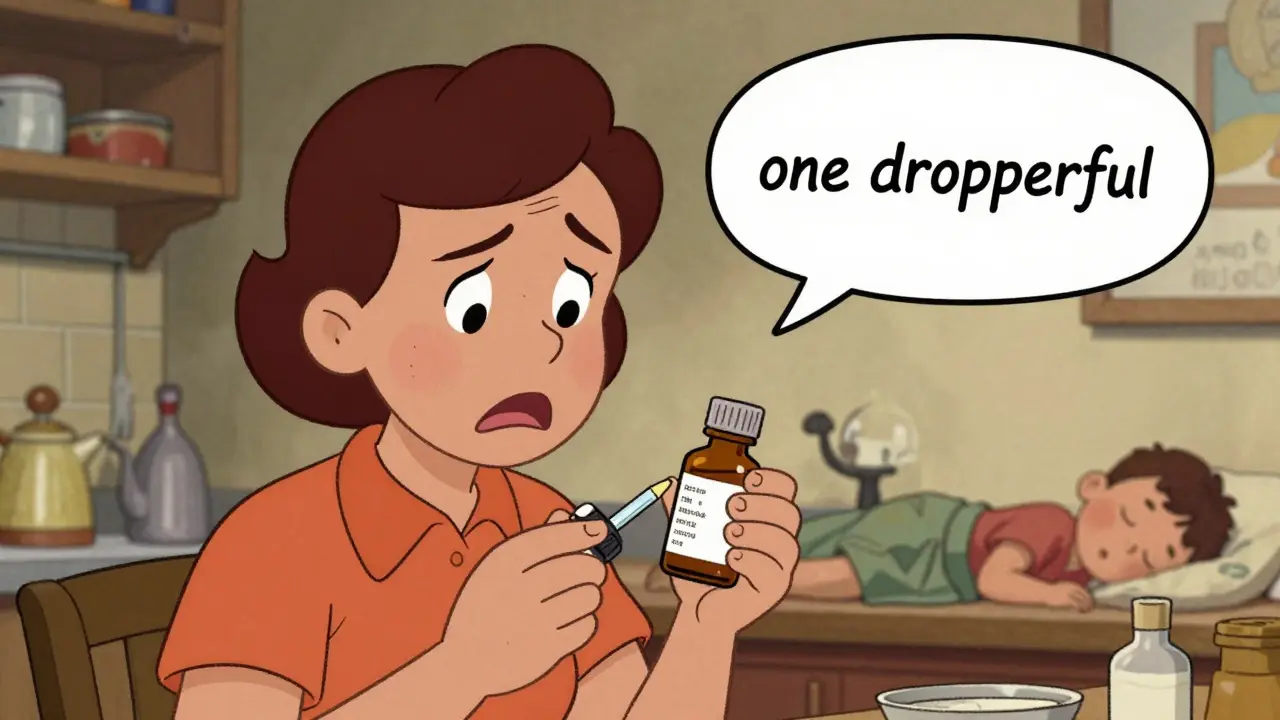
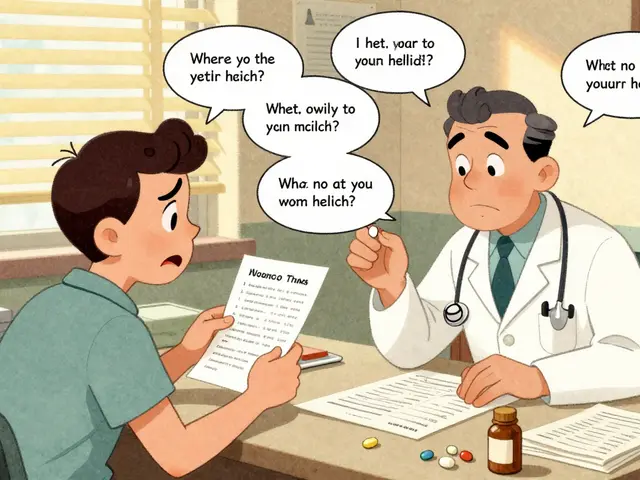
When you or a loved one is given a new medication, the instructions should be clear. But for millions of people in the U.S. who don’t speak English fluently, those instructions often aren’t clear at all. A Spanish-speaking parent might be told to give their child "one dropperful" of medicine, but not know what that means. A Vietnamese elder might receive a pill bottle with English-only labels and no one to explain when to take it. These aren’t rare mistakes-they’re common, dangerous, and preventable.
Studies show that patients with limited English proficiency (LEP) are twice as likely to have a medication error compared to English-speaking patients. In one 2022 study from Children’s Hospital of Philadelphia, 17.7% of families with LEP reported a medication mistake, compared to just 9.6% of English-speaking families. These errors aren’t just inconvenient-they lead to hospital visits, serious side effects, and sometimes death.
Why Language Barriers Cause Medication Errors
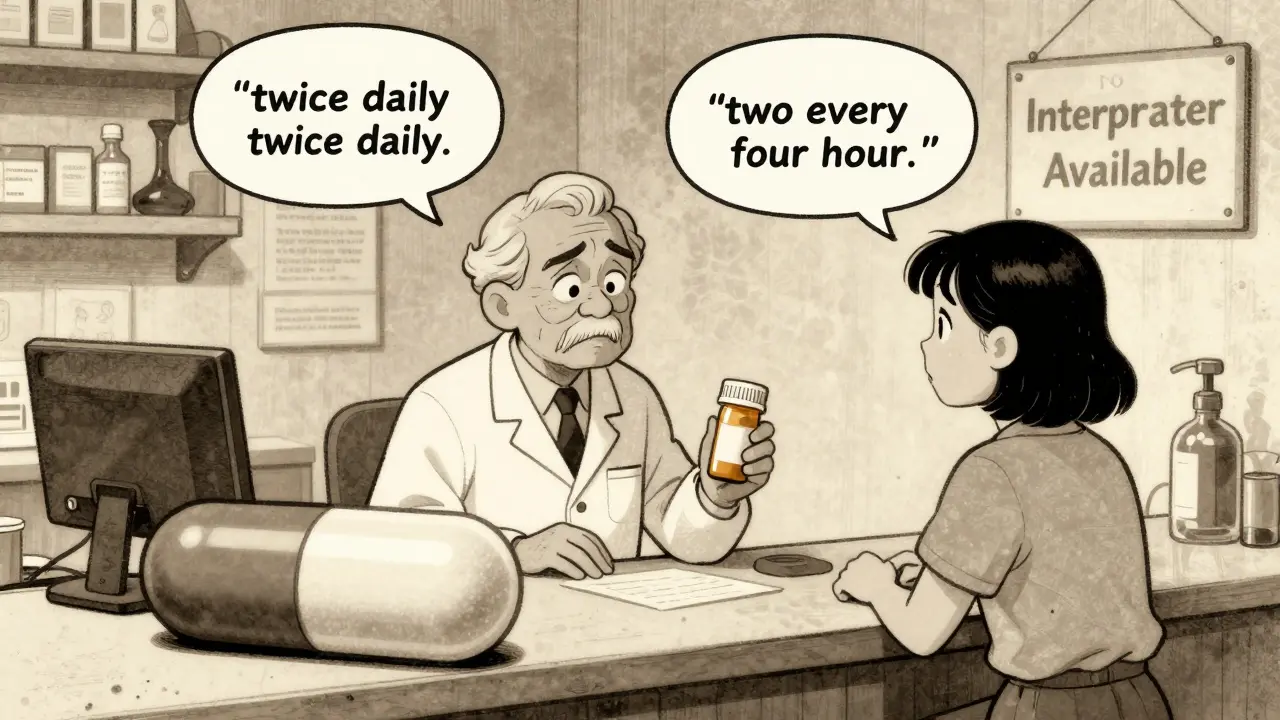
It’s not just about not understanding words. It’s about missing critical details. A pharmacist might say "take with food," but if the patient doesn’t know what "food" means in this context-does it mean a snack? A full meal?-they might take the pill on an empty stomach and get sick. Or they might be told to take "two tablets daily," but mishear it as "two tablets every four hours" because the interpreter mispronounced it.
Family members are often asked to interpret. But studies show that up to 25% of translations done by relatives or friends contain serious medical errors. A daughter translating for her mother might not know the difference between "hypertension" and "hypoglycemia." A teenager might skip technical terms to make things "easier." And in pharmacies, nearly half of all locations in high-LEP areas like the Bronx and Milwaukee admit they rarely or never provide prescription labels in languages other than English.
Even technology fails. Google Translate can’t handle medical terms like "as needed" or "for thirty days." One Reddit user shared how their Spanish-speaking mother was given insulin instructions translated by an app-"10 units" became "10 drops," and she ended up in the hospital.
What Actually Works: Proven Solutions
There are better ways. And they’ve been proven to work.
- Professional interpreters-in person, over the phone, or by video-are the gold standard. Hospitals and clinics that use them see medication errors drop by up to 50%. These aren’t just translators. They’re trained in medical terminology, cultural context, and patient safety protocols.
- Translated prescription labels-with clear icons and simple phrases like "Take once daily" or "Do not take with alcohol"-make a huge difference. Pharmacies that use bilingual staff or printed multilingual instructions reduce confusion by 40% or more.
- Directly observed dosing-where a nurse or pharmacist watches the patient take the medication and asks them to repeat the instructions in their own words-has been shown to prevent errors even when language is limited. It’s simple, low-tech, and incredibly effective.
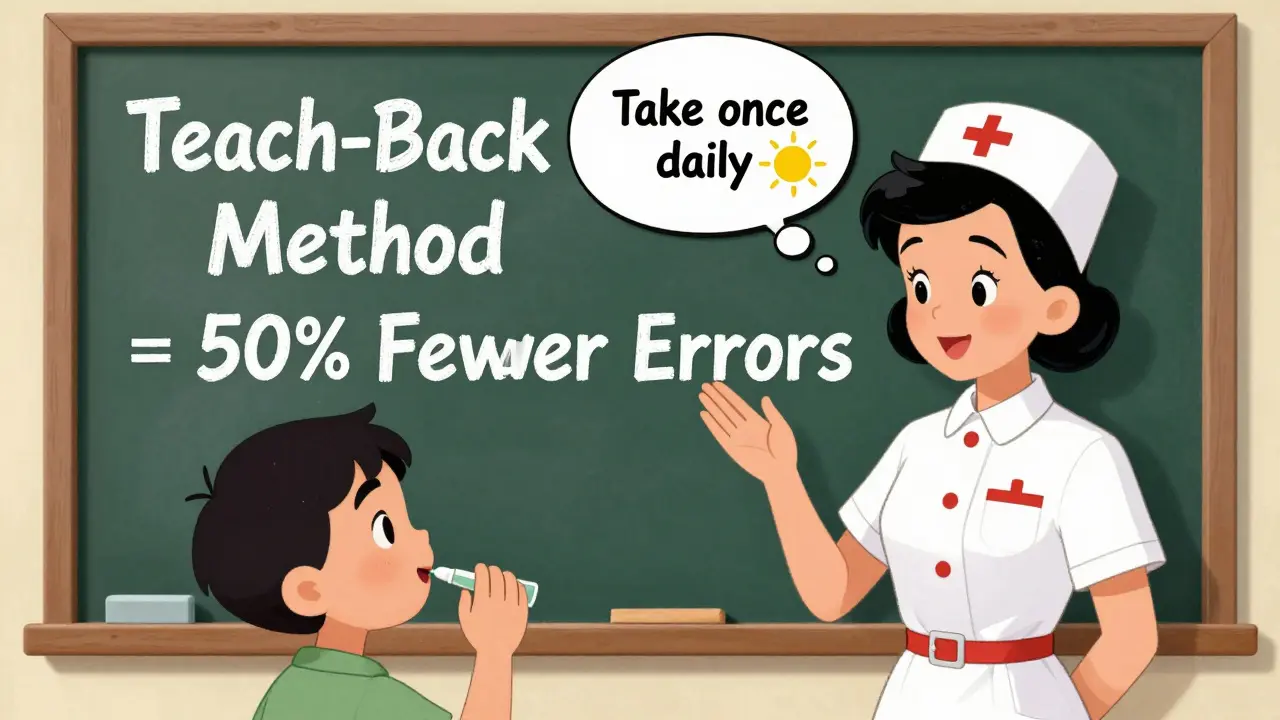
- Teach-back method-where the provider asks the patient to explain the instructions back to them-is the most reliable way to confirm understanding. If the patient can’t explain it, the provider tries again until they can.
A hospital in Michigan cut its LEP medication errors by 40% in just one year by training staff to use interpreters for every medication discussion and requiring teach-back for all high-risk drugs like insulin and blood thinners.
What’s Still Broken
Even though solutions exist, they’re not always used. Here’s why:
- Staff don’t ask. Nearly 70% of hospitals don’t consistently identify patients who need language help before they see a doctor or pharmacist. If no one asks, no one gets help.
- Interpreters aren’t always available. Especially for less common languages like Hmong, Karen, or Arabic. Some clinics only offer Spanish and Chinese-leaving others behind.
- Pharmacies still can’t print labels. A 2021 study found that 31% of pharmacies in the Bronx couldn’t print Spanish labels. Many pharmacy systems simply don’t support non-English text.
- Cost is a barrier. Hospitals spend millions on interpretation services, but most don’t get reimbursed by insurance. That makes it easy to cut corners.
And here’s the worst part: 4 in 10 LEP adults say fewer than half of their healthcare visits included a provider who spoke their language. For 15%, it was zero.
How to Get Help-Right Now
If you or someone you care for is struggling with medication instructions because of a language barrier, here’s what you can do:
- Ask for an interpreter. Say: "I need an interpreter to understand my medicine." You have a legal right to one under Title VI of the Civil Rights Act. Hospitals and pharmacies that take federal funds (which is almost all of them) must provide it.
- Request translated materials. Ask for printed instructions in your language. If they say no, ask to speak to a supervisor. Many pharmacies have access to translation services-they just need to be asked.
- Use teach-back. After the provider explains, say: "Can you show me how to take this?" Then repeat it back in your own words. If you’re unsure, say: "I’m not sure I got that right. Can you explain it again?"
- Bring someone who speaks both languages. A trusted friend, neighbor, or community health worker can help. Avoid children unless absolutely necessary-they often miss critical details.
- Check your pharmacy. If your pharmacy doesn’t offer multilingual labels, ask them to call a national interpreter service like LanguageLine or use a video interpreter app on their tablet. Many offer free or low-cost services.
What’s Changing-And What’s Coming
Change is happening, but slowly.
In 2022, Medicare started reimbursing telehealth interpretation services. In 2023, the FDA announced it will release new rules in 2024 requiring multilingual labeling for common prescription drugs. Epic and Cerner, the two biggest electronic health record systems, are adding language preference tools to their platforms in 2024. The National Institutes of Health is testing AI tools that can translate medication instructions in real time-though experts warn they still need human oversight.
But the real change will come when every patient, no matter their language, gets the same level of care. That means more than just translation. It means training staff, funding services, and holding institutions accountable.
Right now, the system is broken for millions. But it doesn’t have to be. The tools exist. The science is clear. What’s missing is consistent action.
Do I have the right to an interpreter at my pharmacy?
Yes. Under Title VI of the Civil Rights Act, any healthcare provider or pharmacy that receives federal funding-including Medicare, Medicaid, or grants-must provide free language assistance services. This includes interpreters and translated materials. You don’t have to ask twice. If they refuse, you can file a complaint with the Office for Civil Rights.
Can I use a family member as an interpreter?
You can, but it’s risky. Studies show family members miss medical terms, skip important details, or accidentally change instructions out of fear or confusion. Children should never be used as interpreters-it’s emotionally unfair and dangerous. If you must use a family member, ask the provider to confirm understanding using the teach-back method.
What if my pharmacy doesn’t have my language on their labels?
Ask them to print it using their interpreter service. Most pharmacies have contracts with services like LanguageLine or CyraCom that can generate translated labels on demand. If they say they can’t, ask to speak to a manager or contact the pharmacy’s corporate office. Many will make an exception if you explain it’s for medication safety.
Are there free interpreter services I can use at home?
Yes. Many hospitals and community health centers offer free phone or video interpretation. You can also call the National Council on Interpreting in Health Care (NCIHC) for referrals. Some apps, like Healthline’s interpreter service, connect you to trained interpreters for free. Always verify the interpreter is trained in medical terminology-not just a general translator.
How can I tell if I understood my medication instructions correctly?
Use the teach-back method. After the provider explains, say: "Can you show me how to take this?" Then repeat the instructions in your own words. If you can’t explain it clearly, ask them to try again. A good provider will not get frustrated-they’ll want to make sure you’re safe.
Next Steps: What to Do Today
If you’re a patient or caregiver: Ask for an interpreter the next time you get a new prescription. Don’t wait until something goes wrong.
If you’re a healthcare worker: Start asking every patient about language needs. Don’t assume. Use teach-back. Push for translated labels. Make language access part of your daily routine.
If you’re part of a clinic or pharmacy: Invest in professional interpreters. Train your staff. Track how many patients get help. Measure error rates before and after. The data will show you it’s worth it.
Medication safety isn’t about technology. It’s about respect. It’s about making sure no one is left behind because they don’t speak the same language. The tools are here. The knowledge is proven. What’s left is action.



Comments
Yo I just had to comment bc this hit home. My abuela got her insulin script and the pharmacy gave her a tiny paper with English words she couldn't read. She thought "10 units" meant 10 drops?? She nearly died. Thank god my cousin was home and caught it. We cried. But now? We always ask for an interpreter. No shame. Life matters more than pride.
Also, side note: if your pharmacy says "we don't have that language"? Tell them to call LanguageLine. It's free. They just don't wanna do the work. 🤦♂️
This is one of the most important pieces I've read all year. The statistics are alarming, yes-but what’s even more disturbing is how routinely we normalize this neglect. A child translating insulin dosages? A grandmother left to guess at pill instructions? This isn’t a gap in service-it’s a failure of moral imagination.
Professionally trained interpreters aren’t a luxury. They’re a baseline standard of care, equivalent to sterile needles or calibrated dosing. If we wouldn’t let a diabetic patient use a broken glucometer, why do we let them use a broken interpreter? The solutions exist. The will doesn’t. Let’s demand better.
The author presents a compelling case, yet fails to address the structural economic disincentives that prevent systemic adoption of professional interpretation services. One must interrogate the neoliberal framework wherein healthcare institutions prioritize cost containment over linguistic equity, despite Title VI mandates. The teach-back method, while empirically validated, remains a Band-Aid solution when the root pathology-underfunded public health infrastructure-remains unaddressed.
Moreover, the suggestion that patients "ask for an interpreter" presumes agency that is systematically eroded by socioeconomic marginalization. This is performative advocacy masquerading as policy.
Look, I get the emotional appeal. But let’s be real-why should American taxpayers fund translation services for people who chose to immigrate without learning English? We don’t give out free German interpreters in Germany. Why should we here?
And don’t even get me started on "teach-back." That’s just enabling dependency. People need to adapt. English is the language of medicine, science, and opportunity. If you can’t speak it, you’re choosing to be at a disadvantage. No one’s forcing you to come here.
Oh wow. Another feel-good article about how we’re all just one misunderstood pill away from death. Meanwhile, the real crisis is that 70% of these "LEP patients" are here illegally and the system is being gamed. You think they’re scared of taking medicine wrong? Nah. They’re scared of getting caught. And you? You’re the one who keeps handing out free interpreters like they’re free samples at Costco.
Next thing you know, we’ll be translating the Constitution into 50 languages. Because that’s what real progress looks like, right? 🙄
Y’all know the gov’t is using this to track people, right? They say "interpreter" but it’s really a biometric data collector. Every time you ask for one, your face gets scanned, your voice recorded, and your immigration status flagged. I saw it on a forum. Some guy said his cousin’s mom got an interpreter and 3 days later ICE showed up.
Also, Google Translate works fine. My uncle took his pills for 2 years using it. He’s still alive. Maybe the problem isn’t the language… it’s the fear.
Ugh. I just had to read this because my sister works at a clinic and she’s been begging them for years to hire interpreters. They keep saying "budget." But then they bought a new espresso machine. For. The. Staff.
And don’t even get me started on the pharmacy that refused to print Spanish labels because "they didn’t have the font." Like, what? You can’t download a font? You can’t call LanguageLine? You can’t use your brain?
I cried in the parking lot. Not because I’m dramatic. Because this is 2024. And we’re still letting people die because we’re too lazy to learn how to say "take with food" in another language.
Professional interpreters are a scam. The data is cherry-picked. Most "errors" are just non-compliance masked as language issues. Also, teach-back? That’s just surveillance dressed as care. And don’t get me started on the FDA’s "multilingual labeling"-it’s just more bureaucracy to feed the translation-industrial complex. Real solution? Learn English. Or stay home.
Language access is a Trojan horse for open borders. We’re not talking about medicine-we’re talking about eroding American standards. If you can’t communicate in English, you shouldn’t be here. Period. The fact that we’re even having this conversation is proof of systemic decay. We don’t need interpreters-we need assimilation. And we need to stop rewarding non-compliance with taxpayer-funded translation services.