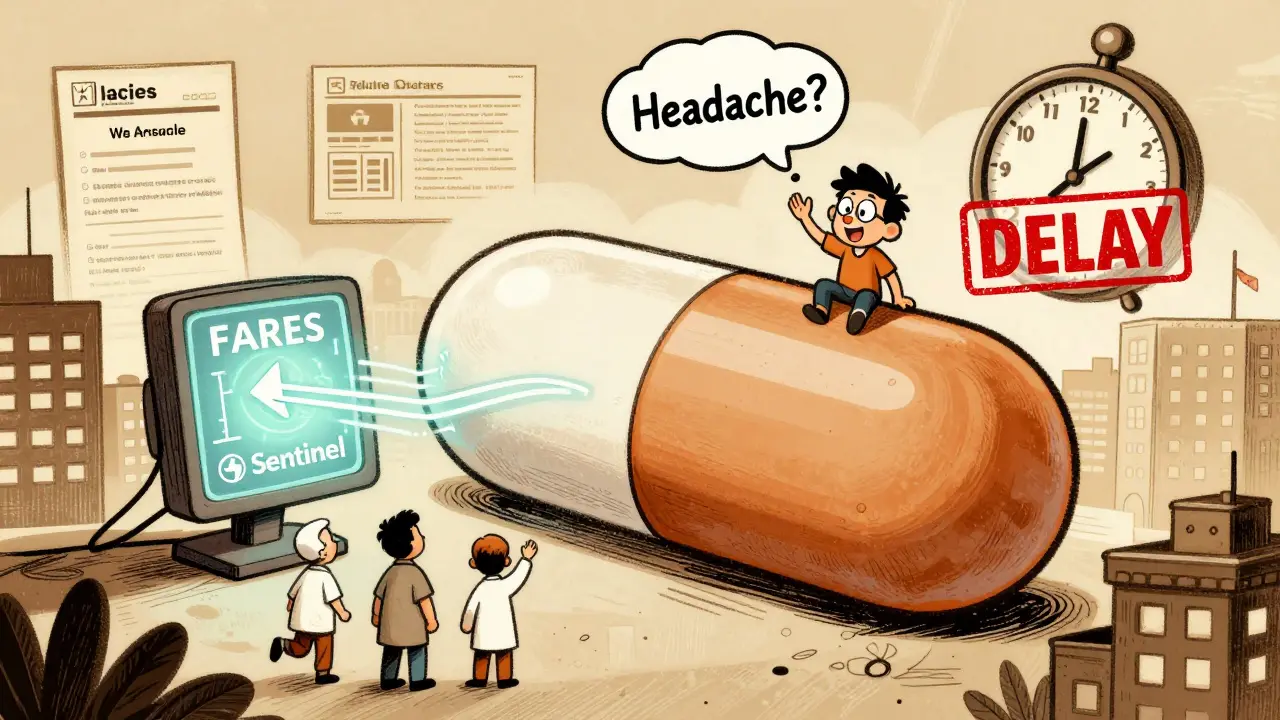
When a new drug hits the market, the work doesn’t stop at approval. In fact, the real test of safety begins after millions of people start taking it. Clinical trials before approval involve a few thousand patients under tightly controlled conditions. But once the drug is out there - used by older adults, pregnant women, people with multiple health conditions, and those on other medications - unexpected side effects can show up. That’s where post-marketing studies come in. These aren’t optional. They’re required by regulators to keep track of how drugs behave in the real world.
Why Post-Marketing Studies Matter
Before a drug gets approved, trials are too small and too short to catch rare or long-term side effects. A reaction that happens in 1 out of 10,000 patients won’t show up in a trial of 3,000 people. But once 500,000 people are taking it, that one-in-10,000 problem becomes 50 cases. And if those cases aren’t tracked, people get hurt. The U.S. Food and Drug Administration (FDA) requires companies to conduct post-marketing studies for many new drugs, especially those for serious conditions like cancer, heart disease, or autoimmune disorders. These studies help find:- Adverse reactions not seen in clinical trials
- Drug interactions with other medications
- Effects in underrepresented groups - like seniors, children, or pregnant women
- Long-term risks that only appear after years of use
Between 2018 and 2022, 87% of safety actions taken by the FDA - like updating warning labels or adding black box warnings - were triggered by data from post-marketing studies. Without them, dangerous side effects might go unnoticed for years.
How Post-Marketing Studies Are Tracked
Tracking these studies isn’t just about filing paperwork. It’s about building systems that collect, analyze, and act on real-world data. Here’s how it works in practice.The FDA uses three main tools to monitor drug safety after approval:
- FAERS (FDA Adverse Event Reporting System) - This is the oldest and most widely used system. It collects voluntary reports from doctors, pharmacists, patients, and drug companies. As of 2023, FAERS had over 30 million reports. While it’s a goldmine for spotting patterns, it’s also noisy - not every report is accurate, and many are incomplete.
- Sentinel System - This is the FDA’s modern, active surveillance network. Instead of waiting for reports, Sentinel pulls data from electronic health records and insurance claims of over 300 million Americans. It can track how many people were hospitalized after taking a drug, whether they had abnormal lab results, or if they stopped taking it because of side effects. In 2023, Sentinel added data from 24 million people across six health systems to get better clinical detail.
- Post-Marketing Clinical Studies - These are formal studies, often required by regulators, that follow specific groups of patients over time. For example, a drug for rheumatoid arthritis might need a 5-year study tracking liver function in 5,000 patients. These studies are expensive and slow, but they give the clearest picture of long-term safety.
Companies must submit regular safety reports - usually every 6 to 12 months - to show they’re meeting study requirements. Missing deadlines or failing to collect enough data can lead to regulatory action, including fines or restrictions on sales.
Common Challenges in Tracking
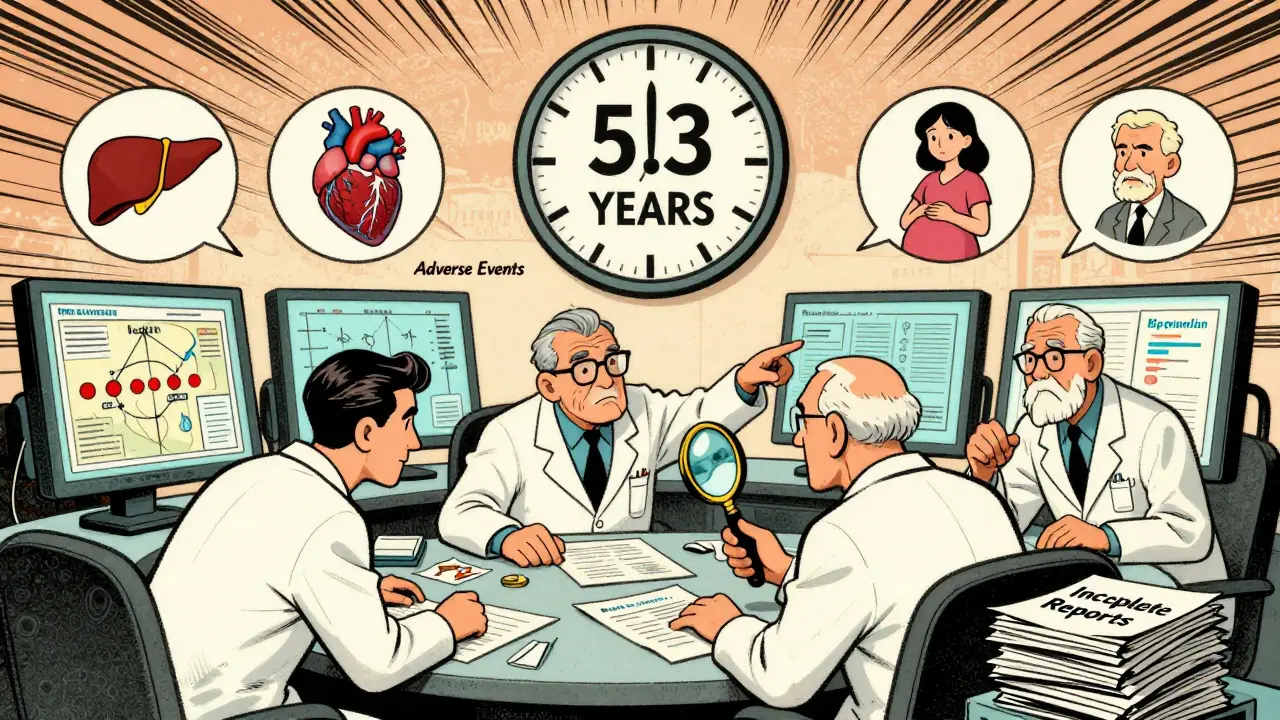
Even with these systems, tracking post-marketing studies is messy. Here are the biggest problems companies face:- Delays in starting studies - A 2023 National Academies report found that 72% of FDA-mandated studies took longer than required. The average study finished in 5.3 years instead of the 3-year deadline. Why? Recruiting patients is hard. Getting access to hospital records takes months. Data systems don’t talk to each other.
- Incomplete data - Insurance claims tell you if someone was prescribed a drug and if they went to the ER. But they don’t tell you why. Was the hospital visit because of the drug? Or because they fell down? Or had a heart attack unrelated to the medication? Without clinical notes, it’s guesswork.
- Global differences - The U.S. uses FAERS and Sentinel. The UK uses the Yellow Card system. Canada has the Canada Vigilance Program. The EU uses EudraVigilance. If a drug is sold in multiple countries, companies must track reports from all of them. That’s a nightmare without a unified system.
- Underreporting - Studies show only 1% to 10% of adverse events are reported. Many doctors don’t know how to report. Patients don’t realize their symptoms might be linked to a drug. That means the system is blind to a lot of problems.
Best Practices for Effective Tracking
If you’re responsible for tracking post-marketing studies - whether you work for a drug company, a contract research organization, or a regulatory body - here’s what actually works:- Use automated alerts - Set up software that flags missing data, late submissions, or unusual spikes in adverse event reports. Don’t rely on manual checks.
- Build cross-functional teams - Pharmacovigilance, data science, regulatory affairs, and clinical teams must work together daily. One specialist should be assigned for every $500 million in annual sales of the drug.
- Standardize metrics - Track the Post-Marketing Study Timeliness Index (PMSTI). That’s the percentage of studies completed on time. If your PMSTI is below 80%, you’re at risk.
- Partner with health systems - Work directly with hospitals and clinics to get access to electronic health records. Some companies now have formal agreements with major health networks to pull de-identified data in real time.
- Train staff on reporting - Make it easy for doctors and pharmacists to report side effects. Simple online forms, mobile apps, and automated prompts in electronic prescribing systems can boost reporting rates by 30% or more.
What’s Coming Next
The field is changing fast. By 2026, the FDA’s Sentinel Common Data Model Plus (SCDM+) will include genomic data for 50 million patients. That means researchers will be able to see if certain genetic markers make people more likely to have side effects from a drug.The European Union is launching an AI-powered signal detection system in 2025. It will scan millions of reports and flag patterns faster than humans can. And the World Health Organization is building a global data-sharing network to connect 100 countries by 2027. That could mean spotting a dangerous side effect in Brazil and acting on it before it spreads to Europe or North America.
Even artificial intelligence is helping - pilot studies with Large Language Models (LLMs) have improved signal detection accuracy by 42% when analyzing doctor’s notes and hospital records. But there’s a catch: these models also generate 23% more false alarms. So human experts still have the final say.
What Happens When a Problem Is Found
Finding a safety issue isn’t the end - it’s the beginning of action. The FDA doesn’t just file a report. It acts. Between 2020 and 2022, the agency issued 147 Drug Safety Communications. These aren’t gentle reminders. They’re public warnings.Actions taken include:
- Updating drug labels with stronger warnings (87% of cases)
- Adding “Dear Health Care Professional” letters (9%)
- Changing Risk Evaluation and Mitigation Strategies (REMS) - like requiring special training for prescribers (3%)
- Removing a drug from the market (less than 1%)
Each of these actions is based on data from multiple sources - FAERS, Sentinel, clinical studies, and even published medical literature. No single report triggers a major change. It takes a pattern.
What You Can Do
If you’re a patient, always report side effects. Even if you think it’s “just a headache” or “a bit of dizziness,” write it down. Tell your doctor. Submit it to your country’s reporting system. You might be the one who spots the next big safety issue.If you’re a healthcare provider, know your reporting system. In the U.S., it’s FAERS. In Canada, it’s Canada Vigilance. In the UK, it’s the Yellow Card. Make reporting part of your routine. Don’t wait for a patient to ask you.
If you’re in the industry, treat post-marketing studies like a core product feature - not a regulatory burden. The data you collect now will protect lives tomorrow.
What is the difference between FAERS and Sentinel?
FAERS is a passive system that collects voluntary reports of adverse events from doctors, patients, and drug companies. It’s useful for spotting unusual patterns but relies on people to report. Sentinel is an active surveillance system that automatically pulls data from electronic health records and insurance claims of over 300 million Americans. It can track outcomes like hospitalizations, lab results, and medication use over time - giving a much more detailed and reliable view of drug safety.
How long do post-marketing studies usually take?
The FDA typically requires post-marketing studies to be completed within 3 years. But in reality, most take much longer. A 2023 report from the National Academies found the median completion time was 5.3 years. Delays happen because of slow patient recruitment, difficulty accessing medical records, and complex data collection across multiple health systems.
Are post-marketing studies mandatory?
Yes, for many drugs - especially those approved under accelerated pathways or for serious conditions. The FDA and other global regulators require companies to submit detailed safety studies after approval. Failure to meet deadlines can result in regulatory penalties, restrictions on sales, or even removal of the drug from the market.
Why are elderly patients underrepresented in clinical trials?
Clinical trials often exclude older adults because they tend to have multiple health conditions, take many medications, and have declining organ function - all of which complicate the results. But seniors make up over 40% of drug users. This gap means side effects common in older people - like falls, kidney problems, or confusion - often go undetected until after the drug is widely used.
Can AI help detect drug safety issues faster?
Yes. Pilot programs using Large Language Models (LLMs) have improved signal detection accuracy by 42% by analyzing unstructured doctor’s notes and hospital records. But AI also generates more false alarms - about 23% higher than traditional methods. So while AI helps flag potential issues faster, human experts still review every alert to avoid unnecessary panic or regulatory action.


Comments
Let me get this straight - we're trusting a system where 90% of adverse events go unreported?
FAERS is a joke. It's basically a suggestion box for people who forgot to take their blood pressure meds.
And Sentinel? Oh, it's 'active surveillance'? Yeah, right. It's just a fancy name for scraping insurance claims while ignoring the fact that 60% of patients don't even know what drug they're on.
Meanwhile, the FDA approves drugs based on trials with 3,000 people and then acts shocked when 500,000 users start dropping like flies.
And don't get me started on AI. You're telling me a language model can detect a drug reaction better than a human? That's like asking a Roomba to diagnose a stroke.
They're flagging 23% more false alarms? That's not a feature - that's a liability.
Who's auditing the auditors? Who's checking if the 'required' post-marketing studies even get started?
72% are delayed? That's not incompetence - that's corporate negligence dressed up as compliance.
And the global systems? EudraVigilance, Yellow Card, Canada Vigilance - all siloed, all outdated, all underfunded.
It's not a safety net. It's a hammock made of duct tape. And we're all just lying in it, pretending we're safe.
I appreciate how thorough this is, but honestly? The biggest takeaway for me is that patients matter.
Not data points. Not reports. Real people who get dizzy, or feel off, or have a weird rash and think, 'Maybe it's the new pill?'
Too often, that voice gets drowned out by bureaucracy.
I’ve seen friends dismiss symptoms because 'it's probably just stress' - and then later, they found out it was the drug.
That’s why I always tell people: if something feels wrong, report it. Even if it's 'just a headache.'
It’s not dramatic. It’s not overreacting. It’s how we protect each other.
Doctors need to stop acting like reporting is a chore. It’s part of care.
And companies? Stop treating this like a box to check. It’s about lives.
So let me get this straight - the FDA requires studies to finish in 3 years… and they take 5.3 on average?
Wow.
That’s like ordering a pizza and getting it in 17 minutes instead of 15.
‘We’ll get to it soon.’
‘We’re working on it.’
‘The data systems don’t talk to each other.’
Oh, so we’re just waiting for the IT department to stop arguing about which cloud provider to use?
Meanwhile, people are getting liver damage because someone forgot to sync the EHR with the pharmacy database.
And you call this ‘science’?
It’s a glorified spreadsheet with a fancy name.
But hey - at least we have AI now.
Because nothing says ‘safety’ like a bot misreading a doctor’s scribble as 'liver failure' when it was just 'liver of lamb' from last night’s dinner.
I’ve worked in pharmacovigilance for 14 years.
What nobody talks about is the emotional toll.
Every report you read - even the vague ones - is someone’s life.
A 72-year-old woman who stopped taking her blood pressure med because she couldn’t walk without dizziness.
A teenager who developed seizures after starting an acne drug.
A dad who got kidney failure after a new antibiotic.
These aren’t statistics.
They’re names. They’re families.
And the system? It’s built to ignore them until it’s too late.
Yes, Sentinel is better. Yes, AI helps.
But until we stop treating this like a compliance exercise - and start treating it like a moral duty - people will keep getting hurt.
And we’ll keep pretending we didn’t see it coming.
Simple version: drugs are tested on healthy young adults. Real people? Old. Sick. On 5 other meds.
So yeah - side effects show up later.
FAERS is messy. Sentinel is better.
But you gotta report. Even if it’s just 'I feel weird.'
Doctors, make it easy.
Companies, don’t drag your feet.
Regulators, punish the ones who delay.
That’s it. No magic. Just do the work.
The systemic failure here is not merely procedural - it is existential.
Regulatory bodies are operating on antiquated frameworks that were designed for a pre-digital, pre-globalized, pre-AI world.
FAERS is a relic. Sentinel is a Band-Aid.
And the global fragmentation of vigilance systems - EudraVigilance, Yellow Card, Canada Vigilance - is not merely inconvenient; it is a catastrophic vulnerability.
When a drug is sold across borders, the lack of interoperability means that a lethal interaction in Brazil may not be detected in Canada until a dozen deaths have occurred.
Furthermore, the reliance on voluntary reporting is a fantasy.
Studies show 1% to 10% of adverse events are reported - which means 90% to 99% are invisible.
AI may increase signal detection - but it also introduces noise - and noise is indistinguishable from chaos.
Until we implement mandatory real-time data feeds from all electronic health records - and enforce global data-sharing treaties - this entire system is a house of cards.
So we’re supposed to believe that a 5-year delay in a safety study is just 'common'?
That’s not a delay - that’s a death sentence.
And they call this 'science'?
It’s corporate theater.
They get the drug approved, make billions, and then drag their feet for years while people die.
And the FDA? They’re just waiting for the body count to rise before they act.
Again.
Again.
Again.
It’s not incompetence. It’s intentional.
This is why I always tell my patients: if something feels off - even a little - speak up.
It’s not 'overreacting.'
It’s your body talking.
And if your doctor brushes you off? Find another one.
Reporting isn’t a burden - it’s power.
One report might not change anything.
But 10,000? That’s a movement.
Don’t wait for the system to protect you.
Protect yourself.
And if you’re a provider? Make reporting easy.
It’s not extra work - it’s part of the job.
I’ve been on both sides - patient and industry.
What matters isn’t the system.
It’s the people in it.
One nurse who takes 30 seconds to file a report.
One pharmacist who asks, 'Did you notice anything new?'
One researcher who pushes back on a delay.
That’s how change happens.
Not in meetings.
Not in AI models.
But in quiet moments.
Where someone chooses to care.
You think this is about safety?
No.
This is about liability.
Companies don’t delay studies because they’re incompetent - they delay because every day they wait, they make more money.
And regulators? They don’t punish them because they’re afraid of lawsuits.
So they let the clock run.
And the people? They’re collateral.
That’s not a flaw in the system.
That’s the system.