Statin Compatibility Checker
Not sure which statin type might work better for you? Answer these questions to get a personalized comparison based on the latest research.
Your Health Profile
Quick Facts
- Lipophilic Fat-soluble, enters tissues more easily
- Hydrophilic Water-soluble, stays mostly in liver
- Key Insight: Side effects depend more on individual biology than just solubility type
Lipophilic Statins
Atorvastatin, Simvastatin, LovastatinHydrophilic Statins
Rosuvastatin, PravastatinPersonalized Recommendation
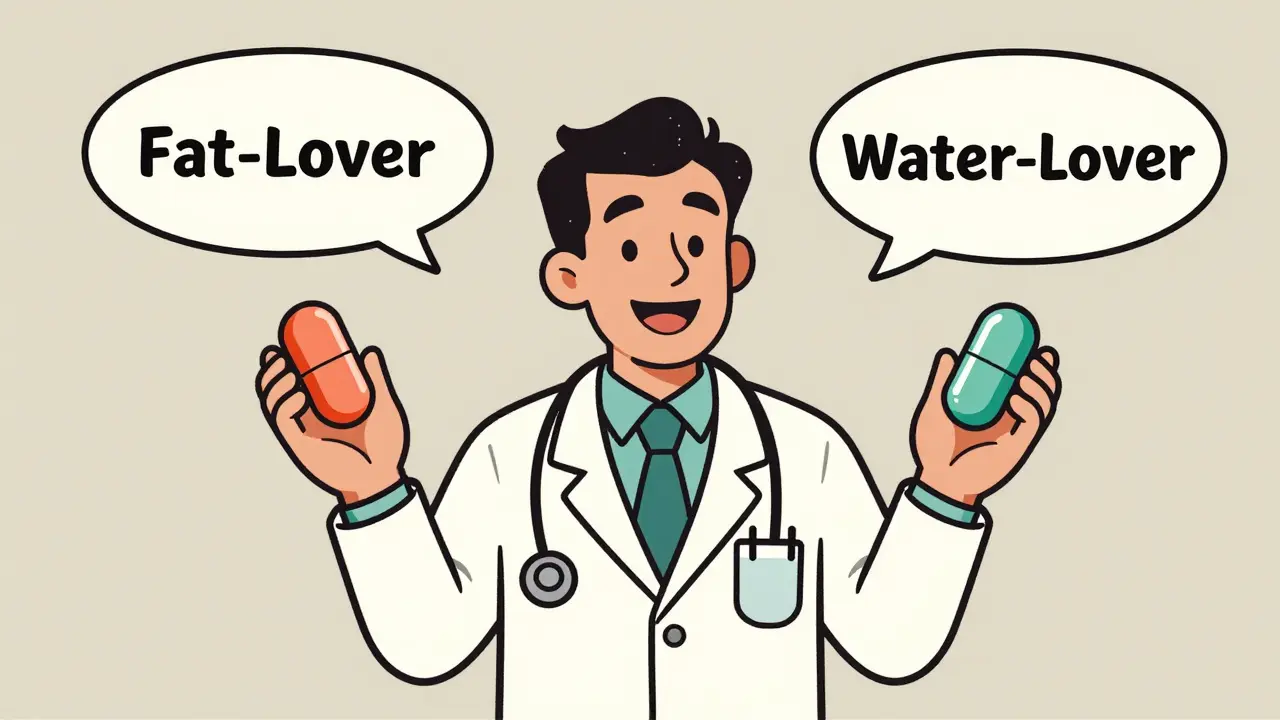
Does your body handle cholesterol medication better if it’s water-soluble or fat-soluble? If you’ve been prescribed a statin and are worried about muscle pain, brain fog, or other side effects, this question is likely on your mind. For years, doctors have classified statins into two camps based on how they travel through your body: lipophilic (fat-loving) and hydrophilic (water-loving). The traditional belief was simple-lipophilic statins penetrate tissues more deeply, leading to more side effects, while hydrophilic statins stay mostly in the liver, making them safer.
But recent research suggests the reality is far messier. Large-scale studies show that the type of solubility might not be the primary driver of side effects at all. In fact, some patients do worse on water-soluble options. So, which one should you take? The answer depends less on chemistry and more on your unique biology, age, and other medications.
Understanding the Chemistry: Fat-Loving vs. Water-Loving
To understand why these drugs behave differently, we need to look at basic pharmacology. Statins work by blocking an enzyme in the liver called HMG-CoA reductase, which stops your body from making cholesterol. However, getting to that enzyme requires traveling through cell membranes.
Lipophilic statins are fat-soluble medications that can passively diffuse through cell membranes into various tissues, including skeletal muscle and the central nervous system. This group includes popular drugs like atorvastatin (Lipitor), simvastatin (Zocor), lovastatin (Mevacor), fluvastatin (Lescol), and pitavastatin (Livalo). Because they love fat, they don’t just hang out in the blood; they slip easily into muscle cells and even cross the blood-brain barrier.
Hydrophilic statins are water-soluble medications that require active transport via specific proteins (OATPs) to enter liver cells, resulting in greater hepatoselectivity. The main players here are pravastatin (Pravachol) and rosuvastatin (Crestor). Since they repel fat, they struggle to cross cell membranes without help. This makes them "liver-specific," theoretically reducing their exposure to muscles and the brain.
| Feature | Lipophilic Statins | Hydrophilic Statins |
|---|---|---|
| Common Examples | Atorvastatin, Simvastatin, Lovastatin | Rosuvastatin, Pravastatin |
| Tissue Penetration | High (enters muscle & brain) | Low (stays primarily in liver) |
| Metabolism | Primarily CYP3A4 enzyme | Minimal CYP metabolism |
| Drug Interactions | Higher risk due to shared enzymes | Lower risk |
| Potency (LDL Reduction) | Variable (Simvastatin ~41% at 20mg) | High (Rosuvastatin ~52% at 20mg) |
The Muscle Pain Myth: What the Data Really Says
The biggest fear for anyone starting a statin is myopathy-muscle pain, weakness, or cramping. The logic seemed sound: if lipophilic statins enter muscle tissue more easily, they should cause more damage there. Early pharmacological theories supported this. Dr. Saro Arakelians, PharmD, noted in *Pharmacy Times* that lipophilic statins "penetrate muscle more easily... and are associated with a higher incidence of adverse effects."
However, real-world data tells a different story. A massive 2021 study published in the *Journal of General Internal Medicine*, analyzing over 15 million patients from UK clinical records, found no consistent safety advantage for hydrophilic statins. In fact, when comparing pravastatin (hydrophilic) to simvastatin (lipophilic), the relative risk of muscle effects was slightly lower for the fat-soluble option (0.86). When comparing rosuvastatin (hydrophilic) to atorvastatin (lipophilic), the risk was actually higher for the water-soluble drug (1.17).
Why the discrepancy? It comes down to potency. Rosuvastatin is incredibly potent. Even though it stays in the liver, its high concentration can still trigger systemic effects. Conversely, pravastatin is weaker. If you compare equivalent doses, the difference in side effects shrinks significantly. Dr. Lee from Johns Hopkins argues that the myopathy risk difference "is largely theoretical with limited clinical significance when equivalent doses are compared."
This means switching from a lipophilic to a hydrophilic statin isn't a guaranteed fix for muscle pain. Some patients report severe myalgia with rosuvastatin but feel fine on pravastatin, while others experience the opposite. Individual variability plays a huge role.
Beyond Muscles: Brain, Ears, and Drug Interactions
Muscle pain isn't the only side effect people worry about. Let's look at how solubility affects other systems.
Cognitive Effects
Because lipophilic statins cross the blood-brain barrier, there has been long-standing concern about memory loss or "brain fog." Hydrophilic statins, being unable to cross this barrier easily, were thought to be cognitively safer. While large trials haven't proven a direct causal link between statins and dementia, patients sensitive to CNS penetration often prefer hydrophilic options like pravastatin to avoid any potential cognitive side effects.
Hearing Loss Risk
A surprising finding emerged from a 2023 study in *Nature Scientific Reports*. Researchers found gender-specific differences in hearing protection. Hydrophilic statins showed a protective effect against hearing loss in men (HR 0.40) but paradoxically increased the risk in women (HR 1.81). This highlights that "safer" is not a universal label-it depends on your sex and genetics.
Drug Interactions
This is where the chemistry matters most. Lipophilic statins like simvastatin and atorvastatin are metabolized by the CYP3A4 enzyme in the liver. Many common drugs-from grapefruit juice to certain antibiotics and antifungals-also use this pathway. Taking them together can cause statin levels to spike, increasing toxicity risk.
Hydrophilic statins like pravastatin undergo minimal CYP metabolism (<10%). Rosuvastatin also avoids major CYP pathways. If you take multiple medications, a hydrophilic statin is often the safer choice simply because it won't clash with your other prescriptions.
Who Should Choose Which Type?
So, how do you decide? There is no single "best" statin, but there are clear guidelines based on patient profiles.
- Choose Lipophilic Statins if: You need aggressive LDL lowering and have no history of muscle issues. Atorvastatin and simvastatin are cost-effective and widely available. They are ideal for younger, healthier patients who tolerate them well.
- Choose Hydrophilic Statins if: You are taking many other medications (to avoid interactions), have concerns about cognitive side effects, or have renal impairment. The *Journal of the American Heart Association* recommends hydrophilic statins for patients with kidney disease (eGFR <60 mL/min/1.73m²), showing a 31% greater reduction in major adverse cardiovascular events in this group.
- Consider Pravastatin specifically if: You are elderly, have a low body mass index (<25 kg/m²), or are female. These factors increase the risk of statin-associated muscle symptoms regardless of type, but pravastatin’s gentler profile often helps.
If you are experiencing side effects, don't just quit. Talk to your doctor about strategies like intermittent dosing (every other day), adding Coenzyme Q10 (200mg daily), or switching types. According to *JAMA Network Open*, 68% of patients find relief through these adjustments rather than stopping therapy entirely.
The Future of Statin Therapy
The debate over lipophilicity is evolving. With the 2023 FDA approval of bempedoic acid (Nexletol), which acts upstream of statins and has minimal muscle penetration, patients who cannot tolerate any statin now have alternatives. Additionally, new research points toward personalized medicine. Instead of guessing based on solubility, future guidelines may rely on polygenic risk scores to predict individual tolerance.
For now, statins remain the cornerstone of heart health, protecting millions from heart attacks and strokes. Whether your prescription is fat-loving or water-loving, the key is staying on the medication that works for your body with the fewest side effects. Regular monitoring of creatine kinase levels and open communication with your healthcare provider are your best tools for success.
Do hydrophilic statins really cause fewer side effects?
Not necessarily. While theory suggests they should due to less tissue penetration, large studies show mixed results. Some patients do better on hydrophilic statins, but others experience similar or even higher rates of muscle pain, particularly with potent options like rosuvastatin. Individual response varies widely.
Which statin is best for someone with kidney problems?
Hydrophilic statins, such as pravastatin and rosuvastatin, are generally preferred for patients with renal impairment. Studies indicate they provide better cardiovascular protection with potentially fewer complications in this population compared to lipophilic statins.
Can I take grapefruit juice with my statin?
It depends on the type. Grapefruit juice inhibits the CYP3A4 enzyme, which metabolizes lipophilic statins like simvastatin and atorvastatin. This can lead to dangerous spikes in drug levels. Hydrophilic statins like pravastatin and rosuvastatin are not affected by grapefruit juice, making them safer choices if you enjoy the fruit.
What should I do if I get muscle pain on a statin?
Don't stop abruptly. Contact your doctor. Common solutions include switching to a different statin (e.g., from lipophilic to hydrophilic), lowering the dose, trying intermittent dosing, or supplementing with Coenzyme Q10. Most patients find a regimen that manages symptoms effectively.
Are there non-statin alternatives for people who can't tolerate statins?
Yes. Bempedoic acid (Nexletol) was approved in 2023 and works similarly to statins but does not affect muscle tissue, making it a good option for those with statin intolerance. Ezetimibe and PCSK9 inhibitors are other effective alternatives.





Comments
Oh, please! Another article trying to confuse people with 'nuance' when the answer is obvious. The pharmaceutical industry just wants you to keep taking whatever pill they push hardest. Lipophilic means it goes everywhere, including your brain and muscles, so of course it causes more damage. It's basic biology, not some 'messy reality'. They just don't want to admit that Crestor is a sledgehammer compared to the scalpel of Pravachol. Don't let them gaslight you into thinking all statins are equal. They aren't. And anyone who says otherwise is either paid off or clueless!!
The dichotomy between water and fat solubility mirrors the ancient philosophical struggle between the material and the ethereal. We seek to anchor our health in the tangible liver, yet our bodies demand a holistic integration that transcends simple chemical classification. Perhaps the side effects we fear are not merely biological reactions but manifestations of our resistance to the artificial separation of mind and body. When we force a substance to stay in one place, we deny the interconnectedness of our being. Is it possible that the 'brain fog' is actually a heightened awareness of this disconnection?
I really appreciate how this breaks down the chemistry without being too scary :) My dad has been on Lipitor for years and he always complains about his legs hurting at night. He’s terrified of switching because he thinks the new one will be worse, but reading this makes me think maybe a hydrophilic one like Pravastatin could help him feel better. It’s nice to know there’s no one-size-fits-all answer, so he doesn’t have to suffer if he doesn’t have to :)
This is typical American medical confusion. In Europe, they understand that natural remedies work better than these synthetic chemicals that mess with your enzymes. But here, you have doctors pushing big pharma drugs that cause muscle pain and hearing loss because they don't care about your long-term health. They just want the insurance money. If you want real health, stop taking these poison pills and eat real food. This article is just spinning lies to keep you dependent on the system.
This is such an important discussion! I’ve seen so many friends give up on their cholesterol meds because of muscle pain, not realizing that switching types might solve the problem entirely. It’s empowering to know that potency matters more than solubility sometimes. Rosuvastatin is strong, yes, but if your doctor monitors you closely, you can manage the side effects. Let’s not throw the baby out with the bathwater-statins save lives, and finding the right fit is key. Keep advocating for personalized medicine!
In Ayurveda, we often speak of Agni, or digestive fire, and how different substances affect the body’s balance. While modern science focuses on CYP3A4 enzymes, the principle remains similar: what works for one constitution may harm another. The mention of gender-specific hearing risks is fascinating; it reminds us that biology is not monolithic. We must honor the individuality of each patient. A holistic approach would consider diet, lifestyle, and genetics alongside pharmacology. 🙏✨
I’ve been quietly observing this debate for a while. It’s interesting how the data contradicts the traditional teaching. I switched from Simvastatin to Pravastatin a few years ago after developing mild myalgia, and honestly, I didn’t notice a huge difference initially. But then my doctor lowered the dose, and suddenly everything felt better. Maybe it wasn’t the solubility but the dosage? Just something to think about. I’m still cautious about crossing the blood-brain barrier though.
Oh my goodness!!! This article is so confusing but also so helpful!!! I never knew that grapefruit juice could interact with some statins but not others!!! That’s terrifying!!! I love orange juice every morning with breakfast!!! Does that mean I’m safe??? Or do I need to check which type I’m on first??? Please tell me I don’t have to give up my citrus fruits!!! It’s such a small thing but it feels like a big deal when you’re trying to be healthy!!! 😱😱
They are hiding the truth. The FDA knows that lipophilic statins are causing neurological damage but they won't say it because of the profits. The 'brain fog' is just the beginning. I read somewhere that these drugs deplete CoQ10 which leads to heart failure later on. They want you weak and dependent. Don't trust the studies funded by Big Pharma. Switch to natural supplements immediately before it's too late. Wake up people!!
You're all missing the point. It's not about the drug, it's about your mitochondrial function. If your mitochondria are already compromised due to poor diet or environmental toxins, any statin will trigger myopathy. The solubility is a red herring designed to distract you from the root cause. Stop blaming the medication and start analyzing your own cellular health. You're letting them off the hook by focusing on minor pharmacokinetic details instead of your own negligence.