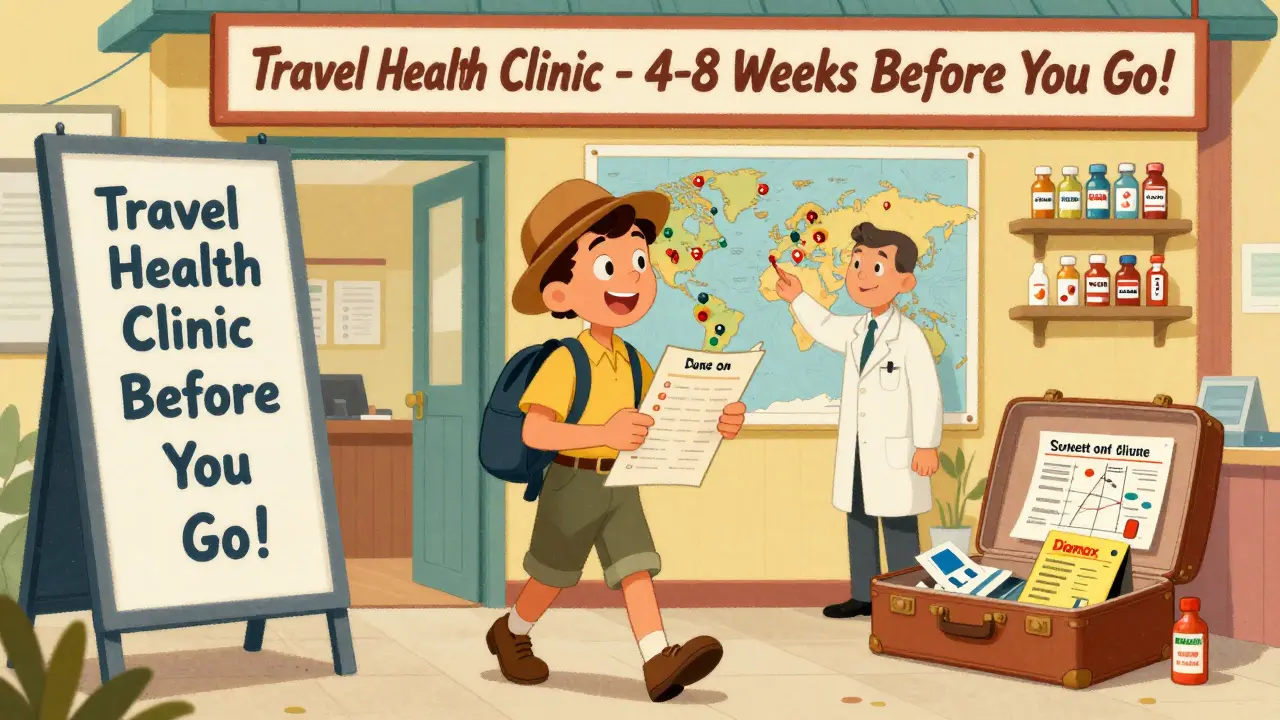
Planning a trip abroad? You’ve got your passport, your itinerary, and your packing list. But have you thought about what you need to take with you to stay healthy? Many travelers assume their regular doctor can handle everything - but when it comes to international travel, that’s often not enough. Travel health clinics exist for one reason: to make sure you don’t get sick because of something preventable. And the best time to visit one? Four to eight weeks before you leave.
Why a Travel Health Clinic Is Different From Your Regular Doctor
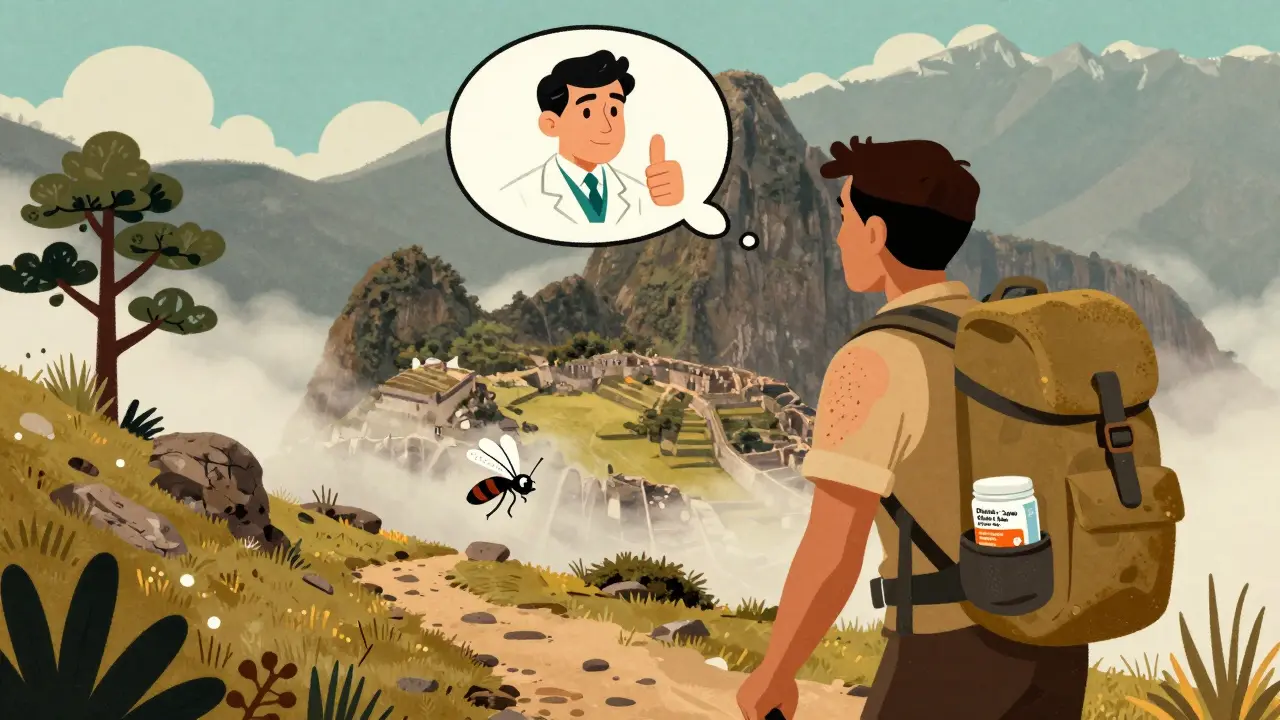
Your primary care provider knows your medical history. But they might not know that atovaquone-proguanil (Malarone) is the preferred anti-malarial in parts of Ghana because of drug resistance, or that the yellow fever vaccine must be given at least 10 days before entry into certain countries. Travel health clinics specialize in this. They track disease outbreaks, vaccine requirements, and local health risks in real time. According to the CDC, these clinics identify 37% more destination-specific risks than general practitioners. For example, if you’re going to Peru and plan to hike Machu Picchu, your regular doctor might say, “Watch your food and water.” A travel clinic will prescribe acetazolamide (Diamox) to prevent altitude sickness, tell you exactly when to start taking it (24-48 hours before ascent), and warn you about interactions with your blood pressure meds. They don’t just hand you a prescription - they build a plan.What Happens During a Travel Clinic Visit
A typical appointment lasts 30 to 45 minutes. You won’t be rushed. The provider will ask detailed questions:- Which countries are you visiting? (Even layovers matter - some vaccines are required for transit.)
- How long will you be there?
- What kind of activities? (Hiking, camping, visiting rural villages, eating street food?)
- Do you have chronic conditions? (Diabetes, asthma, weakened immune system?)
- Are you pregnant or breastfeeding?
- What medications are you already taking?
- Vaccines (like typhoid, hepatitis A, or Japanese encephalitis)
- Prescription medications (malaria pills, antibiotics for traveler’s diarrhea)
- Over-the-counter supplies (oral rehydration salts, insect repellent with DEET, hand sanitizer)
- Advice on food and water safety
Common Medications You Might Get
Here’s what’s actually prescribed, based on real clinic protocols:- Malaria prevention: Malarone (atovaquone-proguanil) - start 1-2 days before travel, take daily, continue for 7 days after leaving. Doxycycline - start 1-2 days before, take daily, continue for 4 weeks after. Mefloquine - start 2-3 weeks before, take weekly.
- Traveler’s diarrhea: Azithromycin (500 mg once daily for 3 days) or rifaximin. These aren’t for prevention - they’re for treatment. You carry them and use them only if you have watery diarrhea with cramps or fever.
- Altitude sickness: Acetazolamide (Diamox) - 125 mg twice daily, starting 1-2 days before ascending above 8,000 feet.
- Yellow fever vaccine: Required for entry into parts of Africa and South America. Must be given at a CDC-registered clinic. You’ll get an official International Certificate of Vaccination - a small yellow card - that stays valid for life.
Where to Find a Travel Health Clinic
There are over 1,200 certified travel health clinics in the U.S. as of 2024. Here’s how to find one:- University hospitals: UCLA, UC Davis, Stanford, and Mayo Clinic all have dedicated travel clinics. These are ideal if you have complex medical needs.
- Retail clinics: CVS MinuteClinic and Walgreens Health Clinic offer pre-travel visits for around $129. Good for basic needs - vaccines and simple prescriptions.
- Private travel medicine clinics: Often staffed by infectious disease specialists. May cost $150-$250 but offer more personalized care.
- Hospital systems: Kaiser Permanente offers services to members only, with appointments required 6-8 weeks ahead.
Timing Is Everything
You can’t cram this into the week before you leave. Some vaccines need weeks to work. Malaria pills need to be started before you’re exposed. Here’s your timeline:- 8-12 weeks out: Book your appointment. Ideal for complex trips, kids, chronic illnesses, or multiple vaccines.
- 4-6 weeks out: Standard window. Most vaccines and medications can be completed on time.
- 2-3 weeks out: Still possible - but you’ll miss some vaccines (like hepatitis A if you haven’t started the series), and some malaria meds won’t have time to build up.
- Less than 2 weeks: Only get what’s urgent. Yellow fever can still be given. Some malaria pills can be started last-minute, but they’re less effective.
What to Bring to Your Appointment
Show up prepared. The more info you give, the better your plan will be:- Full itinerary - dates, cities, accommodations
- List of all current medications (including supplements)
- Immunization records (even old ones - some vaccines can be combined)
- Insurance card (some clinics accept insurance for vaccines, but not always for the consult)
- Questions - write them down. “What if I vomit after taking my malaria pill?” is a common one.
Costs and Insurance
Most travel clinics don’t bill insurance for the consultation itself. You’ll pay out-of-pocket for the visit: $150-$250 at university clinics, $129 at CVS. But vaccines? Those are often covered. Medicare Part B covers some travel vaccines like hepatitis A and typhoid. Private insurers vary - call ahead. Prescriptions for medications like azithromycin or acetazolamide are usually covered by insurance if you have a valid prescription. Ask the clinic to send it to your pharmacy ahead of time. Some clinics even ship medications directly.What Travel Clinics Don’t Do
They’re not emergency rooms. They don’t treat illnesses you already have. If you’re sick before your trip, reschedule. They also don’t replace your regular doctor. You still need to see them for ongoing care. Retail clinics like CVS are great for standard trips - but if you’re going to remote areas, have a complex medical history, or are traveling with a baby, go to a specialized clinic. Mayo Clinic says they refer 1 in 5 patients from retail clinics to specialists because the case was too complicated.
What Happens After Your Visit
You’ll get a packet: vaccination record, medication instructions, emergency contacts, and a list of local clinics abroad. Many clinics now offer digital access through patient portals - Stanford and Mayo both let you download your records and refill prescriptions online. Set phone reminders for when to start each medication. Mark your calendar for when to take your last dose after returning. Keep your prescriptions in your carry-on, not checked luggage. Bring extra - in case your bag gets lost.Why This Matters - Real Numbers
A 2022 study in the Journal of Travel Medicine found travelers who used a travel clinic had a 72% lower chance of getting sick abroad. The CDC says 30-50% of travelers get sick - and most of those illnesses are preventable. Malaria, dengue, typhoid, hepatitis A - all of these can be avoided with the right planning. And it’s not just about pills. Travel clinics also teach you how to avoid bugs, how to treat diarrhea safely, and when to seek help overseas. That knowledge can be more valuable than any medication.What’s New in 2025
Travel medicine is evolving. Some clinics now use AI tools that cross-reference your health profile with real-time outbreak data. Stanford is testing genetic tests to see how your body metabolizes malaria drugs - so you get the right one the first time. CVS now offers “Fit to Fly” clearance letters for travelers recovering from COVID-19. But the core hasn’t changed: know your destination. Plan ahead. Take your meds correctly.Final Checklist Before You Go
- ☐ All vaccines completed (check your record)
- ☐ Malaria pills started on time
- ☐ Antibiotics for diarrhea packed in carry-on
- ☐ Acetazolamide if going high altitude
- ☐ Yellow fever certificate (if required)
- ☐ List of medications and dosages printed and digital
- ☐ Emergency contact info for your clinic and local U.S. embassy
Do I need a travel health clinic if I’m only going to Mexico or the Caribbean?
Yes - especially if you’re staying in rural areas, eating street food, or planning outdoor activities. Hepatitis A and typhoid are common in parts of Mexico and the Caribbean, and both are preventable with vaccines. Some areas also have dengue or Zika outbreaks. A travel clinic will check your vaccination history and recommend what’s needed based on your exact itinerary - not just the country.
Can I get malaria pills without a prescription?
No. All malaria prophylaxis drugs - including Malarone, doxycycline, and mefloquine - require a prescription in the U.S. This is because they can have serious side effects, interact with other medications, and must be taken correctly to be effective. Never buy them online without a doctor’s approval - counterfeit or expired pills are common.
What if I forget to take my malaria pill one day?
If you miss a dose, take it as soon as you remember - but never double up. If you miss more than one dose, contact your travel clinic immediately. In high-risk areas like sub-Saharan Africa, even one missed dose can increase your risk of malaria. Some clinics give you a backup supply of emergency treatment (like artemether-lumefantrine) to carry just in case.
Are travel clinic visits covered by insurance?
Usually not the consultation fee - but many insurance plans cover the cost of vaccines like hepatitis A, typhoid, and rabies. Medicare Part B covers some. Private insurers vary. Always call your insurance provider before your visit to ask what’s covered. The clinic can often give you a superbill to submit for reimbursement.
How long do travel vaccines last?
It varies. Yellow fever vaccine lasts for life. Hepatitis A needs two doses, with protection lasting 20+ years. Typhoid vaccine (injectable) lasts 2 years; the oral version lasts 5 years. Tetanus-diphtheria boosters last 10 years. Your clinic will give you a record with expiration dates. Keep it with your passport.
Can children go to travel clinics?
Absolutely. Pediatric travel clinics are common at university hospitals and major health systems. Children need different doses of vaccines and medications. For example, malaria prevention for kids uses weight-based dosing for Malarone. Make sure the clinic has experience with children - not all do.
What if I’m traveling last minute?
It’s not ideal, but it’s better than nothing. You can still get vaccines like yellow fever, hepatitis A, and typhoid even a week before departure. Malaria pills can be started right before travel - though they’re less effective if taken less than 24 hours before exposure. Bring emergency meds for diarrhea. And avoid risky foods and water. Some clinics offer same-day or next-day appointments for urgent cases.


Comments
I just got back from Bali and I didn’t go to a travel clinic. I took some random pills I found online. Guess what? I got diarrhea, fever, and a rash that looked like a Jackson Pollock painting. Now I’m on a $3,000 medical bill and a 3-week quarantine in a Thai hotel. Don’t be me. Go to the clinic. Seriously. Just go.
OMG YES 😭 I went last year to Peru and I wish I’d listened to this sooner! The clinic gave me Diamox, azithromycin, and even a little pouch of hand sanitizer with a cute sticker. I didn’t get sick once, and I ate EVERYTHING from street vendors 🙌 You’re not just getting shots-you’re getting a superhero toolkit for your trip! 🦸♀️✈️
I live in Delhi and I’ve seen too many tourists get sick because they think 'it won’t happen to me'. Travel clinics aren’t luxury-they’re insurance. I took my nephew to one before his trip to Kenya. He didn’t get sick. He came back with stories, not a hospital bill. Just do it. No drama. Just prepare.
It’s not merely a prophylactic intervention-it’s a systems-level risk mitigation strategy grounded in epidemiological intelligence. The CDC’s 37% higher detection rate isn’t anecdotal-it’s a statistically significant divergence in exposure vector identification. Moreover, the pharmacokinetic window for doxycycline requires pre-exposure pharmacodynamic priming-otherwise you’re engaging in pharmacological roulette with a 28% loss rate. And don’t get me started on counterfeit antimalarials-they’re a black market parasitic ecosystem.
Let’s be real-this whole thing is a money grab. Your regular doctor can give you the same vaccines. CDC? Propaganda. They push these clinics because they get kickbacks from pharma. And why do you need a 'printed plan'? Just Google it. I’ve been to 12 countries. Never used a clinic. Never got sick. Coincidence? Or proof that this is all fearmongering?
You got this! 🙌 I used to skip travel clinics too-until I got food poisoning in Vietnam and spent 3 days in a dirty clinic with no AC. Now I go every time. Even for Mexico. It’s like a pre-flight safety check for your body. Worth every penny. And yes, you CAN get the meds in time-even if you’re last minute. Just don’t wait till the airport.
I’m a nurse and I send all my patients to travel clinics. Not because I’m scared-but because I’ve seen what happens when people wing it. One woman took mefloquine and had hallucinations. Another missed her typhoid booster and ended up in ICU. It’s not about fear. It’s about care. And the fact that they give you a printed plan? That’s the golden ticket. Keep it in your wallet. Always.
They don’t want you to know this-but travel clinics are part of a global pharmaceutical surveillance network. The 'yellow card'? It’s a tracker. The 'personalized plan'? It’s a data profile. The CDC? Controlled by WHO, which is funded by Gates and Big Pharma. They want you dependent on their meds. The real solution? Herbal remedies, fasting, and avoiding all foreign food. You don’t need a clinic-you need to wake up.
Wow. So we’re supposed to trust a system that’s been proven to overprescribe antibiotics, push unnecessary vaccines, and profit off fear? I’ve been to 17 countries. I’ve never been sick. I just drink bottled water and avoid raw meat. You call that 'preparation'? I call it common sense. This article reads like a pharmaceutical sales pitch dressed up as public health.
I used to think this was overkill too. Then I went to Cambodia with my sister. She got sick. I didn’t. Why? I went to the clinic. They told me to take azithromycin only if I had cramps and fever-not every day. I did. She didn’t. She ended up in a hospital. I ate the street food and lived. It’s not about being paranoid. It’s about knowing what to do. Simple.
Just a quick note: if you’re traveling with a chronic condition, bring a letter from your primary doctor. Clinics will coordinate with them. Also-always check if your insurance covers the vaccines. Medicare Part B covers hepatitis A and typhoid. Don’t assume. Call ahead. And keep your vaccination record with your passport. Always.
Travel clinics are a waste of time. You don’t need a specialist to tell you to drink bottled water. If you’re going to a country with poor sanitation, use common sense. The rest is marketing. I’ve been to 20 countries. I’ve never paid for a travel consultation. I’m still here. You don’t need a plan. You need awareness.
Wow. So the guy who said 'just Google it' is right... but also wrong. And the conspiracy guy? Probably watched one too many YouTube documentaries. The truth? It’s somewhere in the middle. Go to the clinic if you’re going somewhere complex. Skip it if you’re doing a resort stay in Cancun. But don’t mock people who do it. They’re not idiots-they’re just trying not to die in a foreign hospital. And honestly? I’m glad they exist.