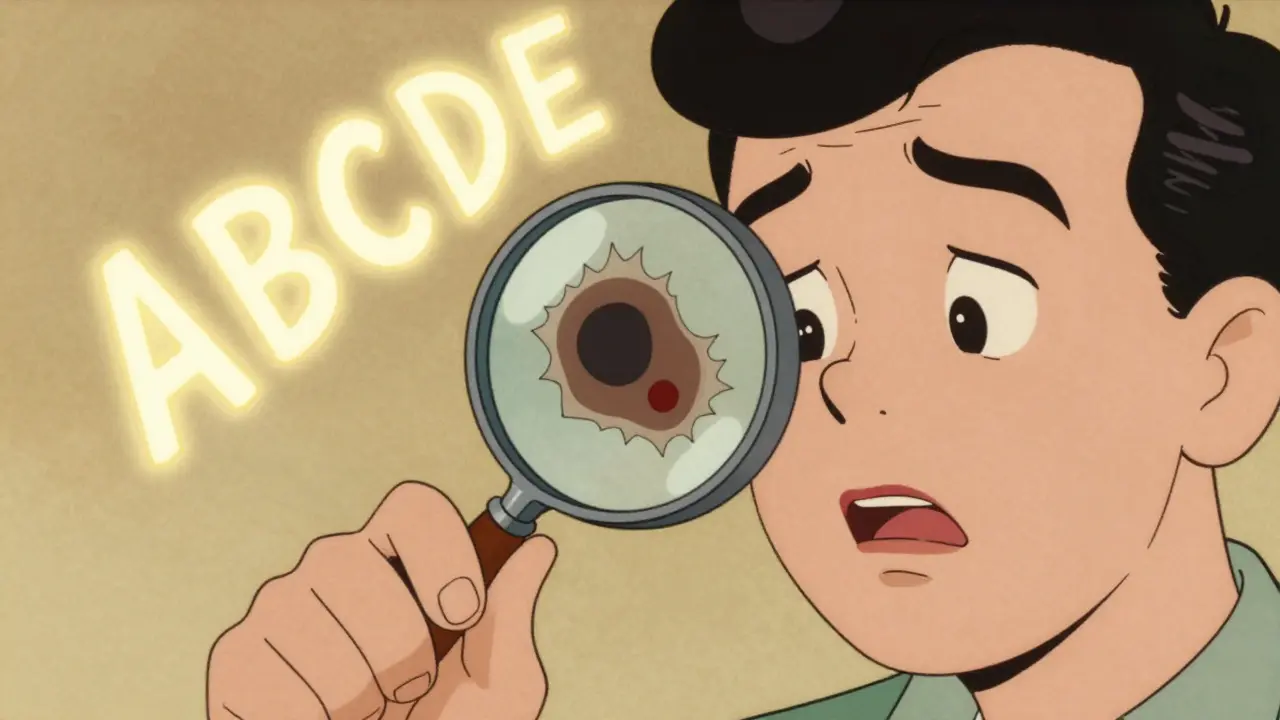
Most people have moles. Some are harmless, others aren’t. The difference can mean the difference between catching melanoma early-when it’s nearly 100% curable-or waiting too long, when it spreads and becomes deadly. That’s why knowing the ABCDE rule matters. It’s not a diagnosis. It’s a warning system. And if you ignore it, you might miss the early signs of skin cancer.
What the ABCDE Rule Actually Means
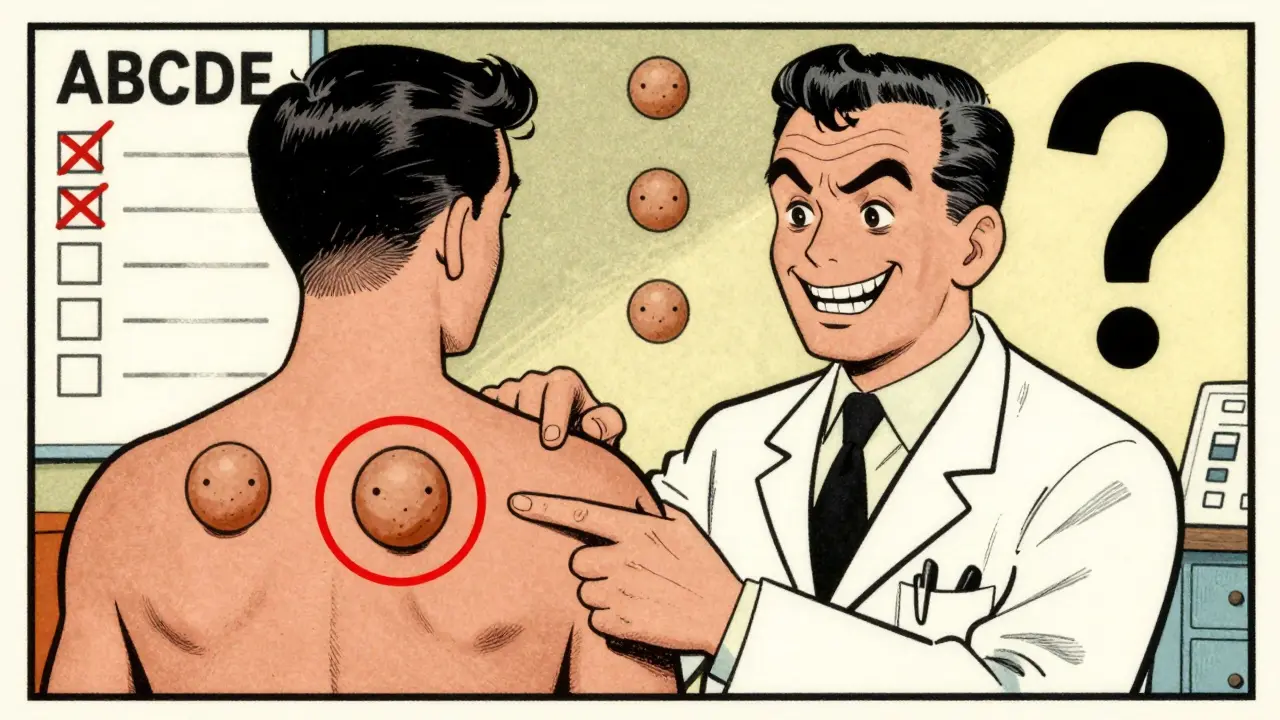
The ABCDE rule is a simple checklist doctors and patients use to spot potentially dangerous moles. It stands for:
- A - Asymmetry: One half doesn’t match the other. Draw an imaginary line through the middle. If the two sides look different, that’s a red flag.
- B - Border irregularity: The edges are ragged, notched, or blurry. Healthy moles have smooth, even borders.
- C - Color variation: A mole with multiple colors-black, brown, red, white, or blue-is suspicious. Melanomas often look like a mix of shades, not a single uniform color.
- D - Diameter: Traditionally, moles larger than 6 millimeters (about the size of a pencil eraser) are flagged. But here’s the catch: 30% of melanomas are smaller than that. Some experts now say ‘D’ also means Dark. If a mole is darker than your other moles, even if it’s tiny, get it checked.
- E - Evolving: This is the most important one. Any change over time-growing, changing color, starting to itch, bleed, or crust-should be taken seriously. Melanomas don’t sit still. They evolve.
These signs were developed in the 1980s to help non-specialists recognize danger. But they’re not perfect. A 2022 study found that 36% of melanomas detected were in situ (stage 0), meaning they hadn’t spread yet. And in nearly a third of those early cases, the ‘E’ sign-evolving-was missing. That means you can’t wait for a mole to change before acting.
Why the ABCDE Rule Misses So Many Melanomas
Here’s the uncomfortable truth: not all melanomas look like the textbook examples. Some are perfectly round. Some are the same color. Some are smaller than a pencil eraser. And they’re still cancer.
Desmoplastic melanoma-a rare but aggressive type-only shows ABCDE features in 15% of cases. Childhood melanomas? Only 18% fit the pattern. And a 2019 study in the British Journal of Dermatology found that the ‘ugly duckling’ sign-where one mole looks completely different from all the others on your body-caught 73% of melanomas that ABCDE missed.
That’s why dermatologists don’t rely on ABCDE alone. They look at the whole picture. If you have 20 moles and one stands out-like a black sheep in a white flock-that’s a red flag. It doesn’t need to meet all five criteria. It just needs to look wrong.
When Should You Get a Biopsy?
A biopsy is the only way to know for sure if a mole is cancerous. But not every weird-looking mole needs one. Dermatologists use three main triggers:
- Three or more ABCDE features: This has an 85% sensitivity rate. If your mole ticks off asymmetry, irregular border, and changing color, you’re likely getting a biopsy.
- Documented change over 3-6 months: Even if it looks normal, if you’ve noticed it getting bigger, darker, or starting to bleed, that’s enough. A 2022 study showed this single factor has a 92% sensitivity rate.
- The ugly duckling sign: If one mole looks out of place compared to the rest, it gets biopsied-even if it doesn’t meet ABCDE criteria.
Here’s the problem: most people don’t have photos of their moles from a year ago. Only 19% of patients bring baseline images to their appointment. That makes it hard to prove evolution. That’s why dermatologists recommend taking monthly selfies of your skin-especially if you have a lot of moles or a family history of melanoma.
What Happens After a Biopsy?
If your dermatologist removes a mole, it goes to a lab. Pathologists examine it under a microscope to see if cancer cells are present. Results usually take 7-10 days.
If it’s benign, you’re done. But if it’s melanoma, the next steps depend on thickness:
- Stage 0 (in situ): Cancer is only in the top layer of skin. Removal is usually enough. Five-year survival: 99%.
- Stage I or II: Cancer has gone deeper but hasn’t spread. A wider excision and possible lymph node check are needed. Survival rate: 70-90%.
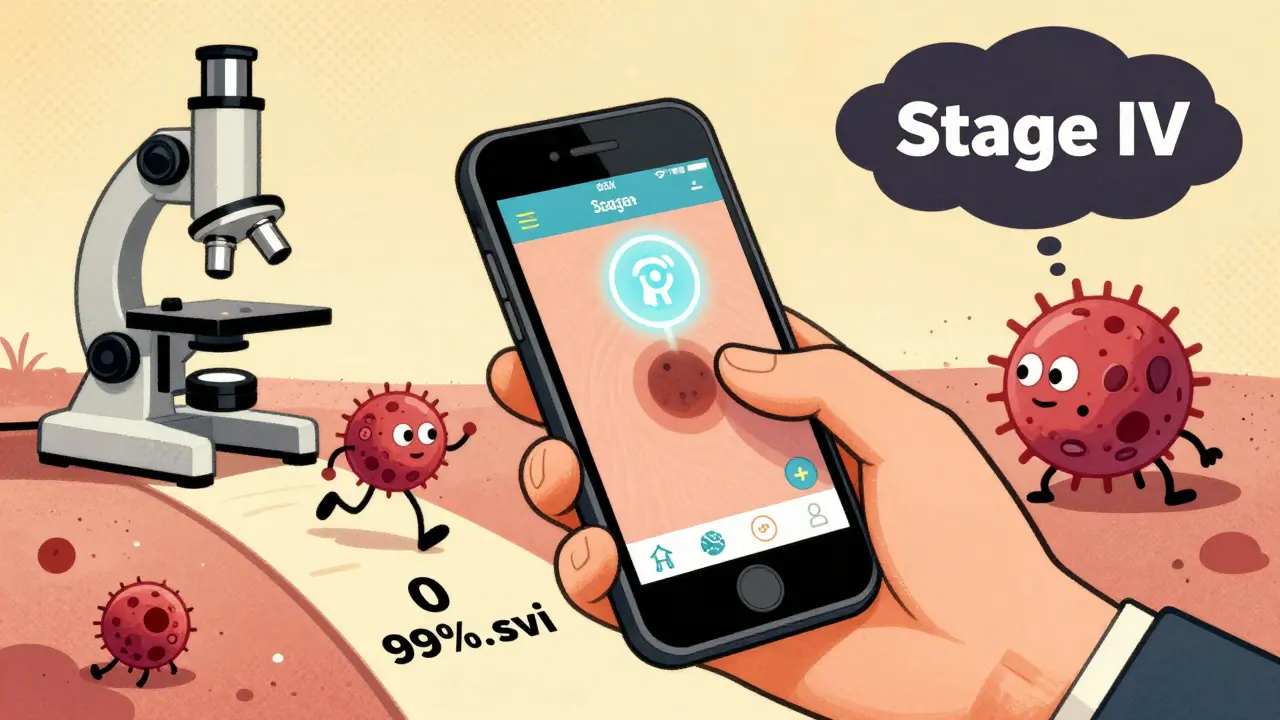
- Stage III or IV: Cancer has spread to lymph nodes or organs. Treatment gets complex-immunotherapy, targeted therapy, or chemotherapy may be needed. Survival drops to 32.6% for stage IV.
That’s why early detection saves lives. A mole you ignore for six months could turn from stage 0 to stage I. And stage I is harder to treat than stage 0.
The New Tools Changing the Game
Technology is catching up. Digital dermoscopy-a handheld device that magnifies and analyzes moles-boosts diagnostic accuracy from 75% to 92%. It’s now used in 85% of U.S. dermatology practices. But it’s not something you can buy for home use.
Then there’s AI. The FDA approved SkinVision in 2022, an app that uses ABCDE criteria plus machine learning trained on 12 million images. It has 95% sensitivity. It’s not perfect, but it’s better than guessing. And it’s helping people in rural areas without easy access to dermatologists.
Even more promising? Molecular tests like DecisionDx-Melanoma. It analyzes 23 genes in a biopsy sample to predict how likely a melanoma is to spread. It’s used in 68% of academic centers and can reduce unnecessary surgeries by 31%. These tools aren’t replacing the ABCDE rule-they’re enhancing it.
Real Stories: When the Rule Worked-and When It Didn’t
On Reddit, u/MoleWatcher99 wrote: “I noticed my mole was asymmetrical and had multiple colors. I went to the dermatologist. It was stage 0. I’m alive because I used ABCDE.”
But u/SkinCancerSurvivor shared: “My melanoma was perfectly symmetrical, one color, only 3mm. ABCDE didn’t flag it. It was stage IIB. I had a lymph node removed.”
A 2022 American Academy of Dermatology survey found 42% of people delayed seeing a doctor because their mole didn’t meet enough ABCDE criteria. The average delay? Over seven months.
That’s the danger of treating the ABCDE rule like a pass/fail test. It’s not. It’s a starting point.
What You Should Do Right Now
You don’t need a dermatology degree to protect yourself. Here’s what to do:
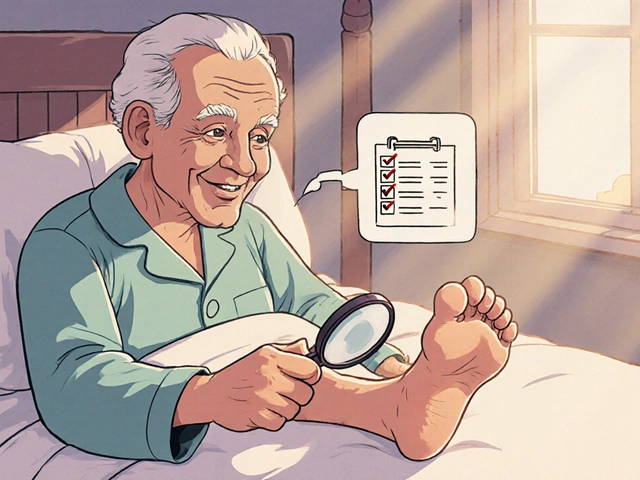
- Check your skin monthly. Use a mirror. Take photos. Look for anything new, changing, or different.
- Know your ugly ducklings. If one mole looks off compared to the rest, get it checked-even if it’s small.
- Don’t wait for all five ABCDE signs. One or two, plus change over time? That’s enough.
- See a dermatologist if you have a family history of melanoma, more than 50 moles, or fair skin that burns easily.
- Don’t rely on apps to replace a doctor. They’re helpful, but not diagnostic.
The goal isn’t to panic over every spot. It’s to be aware. Melanoma is one of the most preventable cancers-if you catch it early. And you don’t need to be a doctor to spot the warning signs.
What’s Next for Melanoma Detection?
The U.S. Preventive Services Task Force is updating its guidelines as of late 2023. They’re moving away from universal screening and toward risk-based approaches. That means people with high risk-like those with many moles or a family history-will get more frequent checks.
By 2027, experts predict ABCDE will still be the first thing you learn, but it won’t be the last. It’ll be the beginning of a layered approach: visual exam, dermoscopy, AI analysis, and sometimes molecular testing.
The message hasn’t changed: know your skin. Spot changes. Act fast. The tools are getting better. But the most powerful tool is still you.
Can a mole be cancerous even if it doesn’t match the ABCDE rule?
Yes. About 20-30% of melanomas don’t show classic ABCDE features. Desmoplastic melanoma and childhood melanoma often look normal under this rule. The ‘ugly duckling’ sign-where one mole looks different from all others-is often a better clue. Any mole that changes, bleeds, or feels odd should be checked, even if it doesn’t fit the checklist.
Is a 5mm mole too small to be melanoma?
No. While the traditional cutoff is 6mm, 30% of melanomas are smaller than that. Some are as small as 2-3mm. Dermatologists now focus more on color variation and evolution than size alone. A dark, changing mole-even if tiny-should be evaluated. The key isn’t size, it’s change.
Do I need a biopsy if my mole has two ABCDE features?
Possibly. Dermatologists don’t use ABCDE as a strict pass/fail test. If a mole has two features and is evolving-or looks different from your other moles-a biopsy is often recommended. The strongest predictor of melanoma is change over time. Even one feature plus documented change is enough to warrant removal.
How accurate is the ABCDE rule at catching melanoma early?
It’s good, but not perfect. Studies show it catches about 85% of invasive melanomas, but only about 60% of early, in situ melanomas. The ‘E’ for evolving is the most sensitive single feature, but even that misses 30-40% of cases. That’s why combining it with the ugly duckling sign and regular monitoring improves detection rates significantly.
Should I use a skin cancer app to check my moles?
Apps like SkinVision can help you track changes and flag potential issues, especially if you don’t have easy access to a dermatologist. They’re not diagnostic tools. They can miss cancers or give false reassurance. Use them as a reminder to see a professional-not as a replacement. Always follow up with a doctor if an app flags a mole or if you’re worried.
How often should I get my moles checked by a dermatologist?
If you have no risk factors, a full-body check every 1-2 years is fine. If you have more than 50 moles, a family history of melanoma, fair skin, or a history of sunburns, you should be seen annually. If you’ve had melanoma before, you’ll need checks every 3-6 months. Monthly self-exams are essential no matter your risk level.
What to Do If You’re Still Unsure
If you’re looking at a mole and can’t decide, here’s a simple rule: when in doubt, get it checked. Don’t wait for all five ABCDE signs. Don’t wait for it to hurt or bleed. Don’t wait for your annual checkup if you’re worried. A quick 15-minute visit to a dermatologist can save your life.
Most biopsies are simple, quick, and done in the office with local numbing. The scar is usually small. The peace of mind? Priceless.


Comments
This is why I take monthly selfies of my skin now 📸😭 I had a mole that looked totally normal but it was changing - turned out stage 0. Don’t wait for it to look "scary". Just act.
ABCDE is for people who dont know what melanoma looks like. Real dermatologists use dermoscopy and AI. If you're still using a pencil eraser as a measuring tool you're living in 1998
In Nigeria we dont have dermatologists in every town so we use apps and our eyes. ABCDE is better than nothing. You people act like you got magic glasses but we just want to live
I appreciate the detailed breakdown. However, I must note that the phrase 'it’s not a diagnosis' appears twice in the original text - a minor redundancy. Still, the information is invaluable and well-structured.
I used to ignore my moles until my cousin died at 28 from melanoma. Now I check every Sunday after my shower. Took a pic of one last month - looked weird. Went in. Biopsy. Turned out benign. But I’m glad I went. Don’t be like me before.
The ugly duckling sign is the real MVP. I have 47 moles. One looked like it was wearing a tiny black hat while the rest were just brown blobs. Got it checked. Turned out to be melanoma. ABCDE missed it. My gut didn’t.
The assertion that 30% of melanomas are smaller than 6mm is statistically significant and corroborated by multiple peer-reviewed studies. However, the reliance on patient-reported evolution remains a critical confounder due to recall bias.
So let me get this straight... we’re supposed to take selfies of our moles like we’re doing a TikTok trend? And then pay $300 for a biopsy because one looked "off"? I’m just here for the memes and now I’m terrified.
We are all just stardust trying not to die from a dot on our skin 🌌🫀 The universe gave us moles and then gave us the ABCDE rule to scare us into awareness. Maybe the real cancer is ignoring our own bodies
I never knew what "evolving" meant until my sister said her mole started itching. We went right away. It was nothing. But now I check my skin every week. It’s just one habit. Easy. Worth it.
Get checked if you have a mole that changes. Period. No need to overthink it. Dermatologists aren’t trying to scare you. They’re trying to keep you alive.
I read this whole thing and now I’m convinced every freckle on my back is secretly plotting my demise. I spent two hours tonight taking photos of my legs with my phone flashlight. I’ve never felt more like a science experiment. Also I think my birthmark just blinked at me. I’m not okay.
The ABCDE rule is a kindergarten safety net for people who refuse to learn. Real medicine uses AI, gene panels, and dermoscopic algorithms. If you’re still using a ruler to measure a mole, you’re not being cautious - you’re being performative.
I’m from Indonesia. We don’t have dermatologists everywhere. My mom uses a flashlight and her eyes. She said my mole looked "too dark" so I went. It was melanoma. They cut it out. I’m alive. ABCDE didn’t save me. My mom did.
I’m not a doctor, but I’ve been tracking my moles for 7 years with a journal and photos. I’ve had three biopsies. Two were benign. One was stage 0. I didn’t wait for all five signs. I waited for one: it looked wrong. That’s all you need.