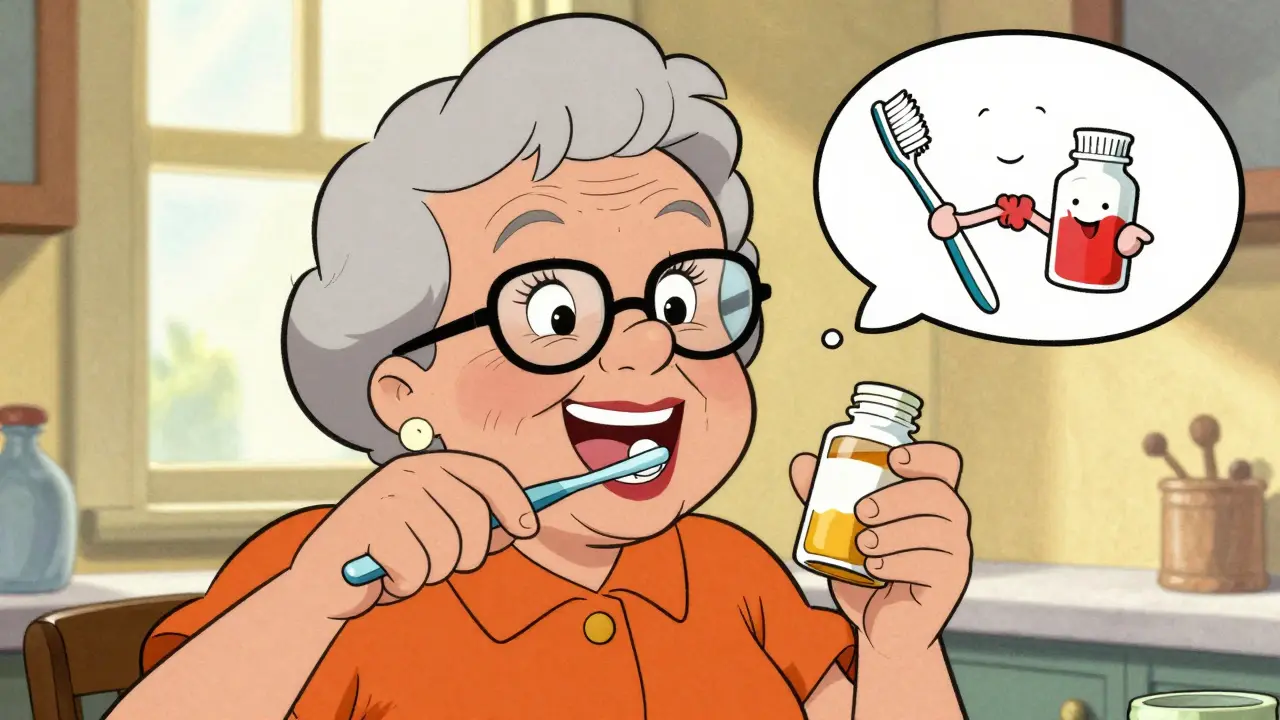
Every year, half of the people taking medication for chronic conditions miss doses-sometimes often, sometimes just once in a while. It’s not laziness. It’s not forgetfulness alone. It’s because taking pills every day feels like a chore, not a routine. Your brain doesn’t naturally treat a pill like brushing your teeth or drinking coffee. But it can. And when it does, your health improves. Not because you’re trying harder. Because you’re doing it automatically.
Why Willpower Fails (And What Works Instead)
Trying to remember your meds by sheer willpower is like trying to keep a balloon in the air by blowing on it constantly. Eventually, you get tired. You miss a day. Then another. The cycle starts. Research shows that people who rely on willpower alone stick to their medication about 50% of the time. That’s not failure. That’s how human brains work. But there’s a better way: behavioral tricks. These aren’t magic. They’re science-backed habits that turn medication-taking into something your brain does without thinking. The key? Make it easy, make it visible, and make it part of something you already do.Pair Your Meds With an Existing Habit (Habit Stacking)
Your brain loves routines. It doesn’t care if the routine is good or bad-it just wants consistency. So use that. Pick one daily habit you never skip: brushing your teeth, pouring your morning coffee, sitting down for lunch, or turning off the lights before bed. Now, do your medication right after it. This is called habit stacking. It works because your brain links the new behavior (taking pills) to an existing one (brushing teeth). No extra effort needed. Just trigger → action. A 2020 study in Patient Preference and Adherence found that people who paired their meds with a daily routine improved adherence by 15.8%. That’s not a small bump-it’s the difference between missing a dose every other week and missing one every two months. Try this: If you take your blood pressure pill every morning, do it right after you spit out the toothpaste. No thinking. No alarms. Just the habit.Use a Pill Organizer-But Make It Smart
A basic pill organizer helps. A visible one helps more. Buy a weekly pill box with clear compartments. Fill it every Sunday. Place it where you’ll see it-next to your coffee maker, on your bathroom counter, or beside your bed. Why does this work? Out of sight, out of mind. Out of sight, also out of guilt. If you can’t see your pills, your brain forgets they exist. But if they’re right there, you can’t pretend they’re not. A 2021 study in the Journal of the American Geriatrics Society showed elderly patients using pill organizers missed 27% fewer doses. Even better? Use one with alarms built in. Some cost under $20 and buzz or light up when it’s time. Don’t just store your pills. Make them part of your environment.Set Reminders That Actually Work
Phone alarms? Most people turn them off. Generic notifications? Easily ignored. The most effective reminders are personalized, specific, and tied to a moment in your day. Use your phone’s reminder app-not just to say “Take meds,” but to say: “Take your statin after breakfast, right after you wash your coffee cup.” Add a photo of your pill bottle. Make the message feel personal. A 2021 meta-analysis in JMIR mHealth and uHealth found that smartphone reminders improved adherence by 28.7%. But here’s the catch: reminders that were customized (not just “Take meds at 8 AM”) worked 3.2 times better than generic ones. Apps like Medisafe, MyTherapy, or even Google Keep with location-based alerts (“Remind me to take my pill when I get home”) are powerful. Use them. And don’t just set one-set two. One in the morning, one in the evening. Redundancy saves lives.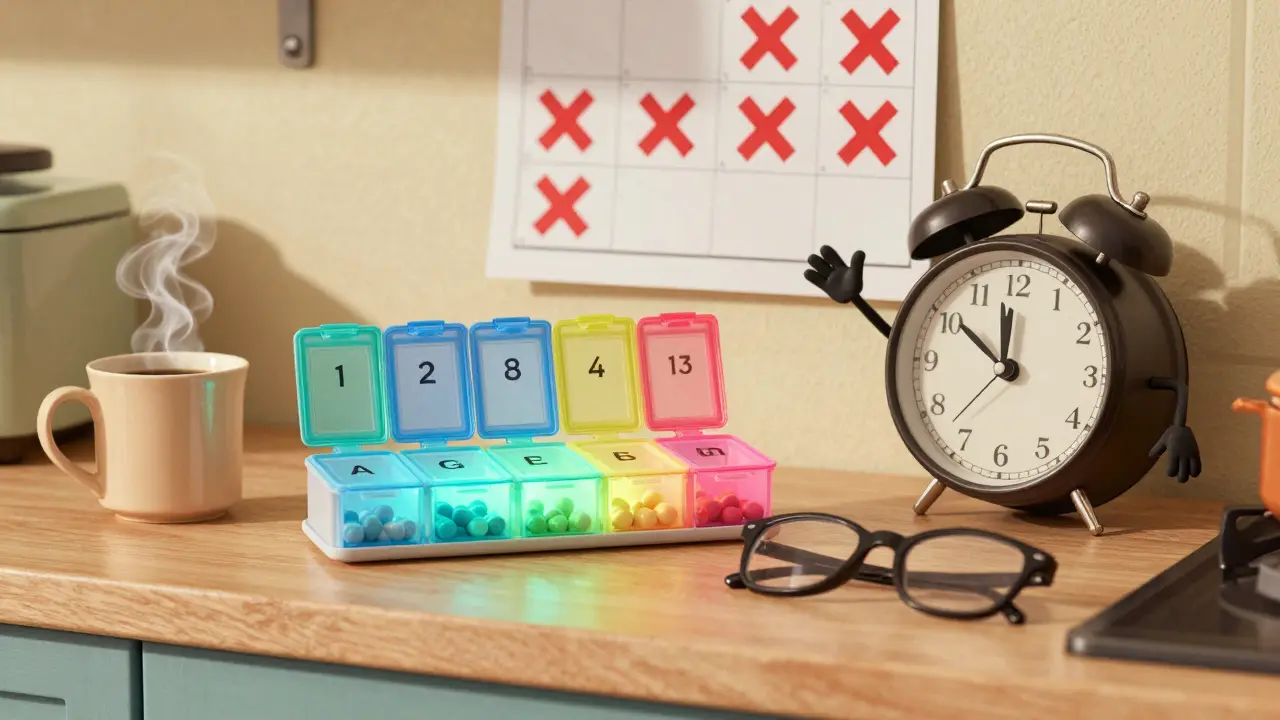
Track It-Even Just a Little
You don’t need a fancy journal. Just a calendar. Mark an X every day you take your meds. Visual tracking creates accountability-not to a doctor, but to yourself. Seeing a streak of X’s builds momentum. Breaking the streak feels bad. And that’s good. A 2005 study by Cochran showed that bipolar patients who tracked their medication daily improved adherence by 19.3%. That’s because tracking turns an invisible task into something real. Try this: Put a small calendar on your fridge. Each morning, after you take your pill, grab a red pen and make a big X. Don’t skip a day. Not even one. Your brain will start to crave that X.Simplify Your Regimen
If you’re taking five different pills at three different times a day, it’s no wonder you forget. Complexity kills adherence. Talk to your doctor or pharmacist. Ask: Can I switch to a combination pill? Can my doses be aligned to morning and night only? Is there a long-acting version? A 2011 meta-analysis of over 21,000 patients found that switching to a single-pill combination increased adherence by 26%. That’s not a small win-it’s life-changing for people managing diabetes, high blood pressure, or heart disease. Even small changes help. If you’re supposed to take a pill with food but you rarely eat breakfast, ask if you can take it with dinner instead. A regimen that fits your life works better than one that demands you change your life.Use Financial Incentives (Yes, Really)
Money talks-even when it comes to your health. Some pharmacies and insurers offer programs that give you gift cards, discounts, or cash back when you refill on time. Others use apps that reward you with points for logging doses. A 2022 study in Health Affairs showed that low-income patients who received small financial incentives (like $5 gift cards for each refill) improved medication persistence by 34.2%. It’s not about greed. It’s about motivation. Your brain responds to rewards-even small ones. If you’re struggling, ask your pharmacist: “Do you have a loyalty or adherence program?”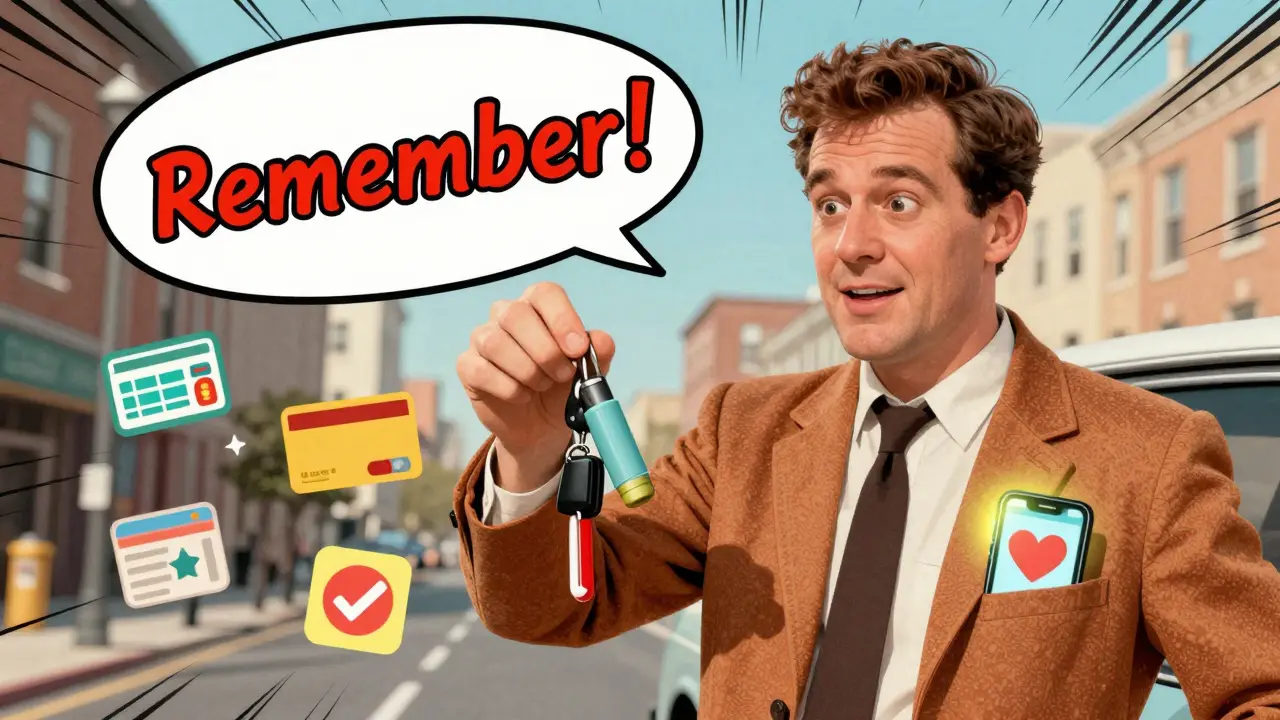
Get Help From Your Pharmacy
Your pharmacist isn’t just the person who hands you the bottle. They’re a hidden ally. Many pharmacies offer free auto-refill programs. You never have to remember to call in a refill. It happens automatically. You get a text when it’s ready. A 2022 study in Medical Care found that auto-refill programs improved medication continuity by 33.4%. That means fewer gaps. Fewer missed days. Fewer ER visits. Also, ask for a “medication review.” Pharmacists can spot interactions, simplify regimens, and even help you set up pill organizers. They do this for free. You just have to ask.What If You Still Miss Doses?
It happens. Even with all the tricks, you’ll miss one. Maybe you’re sick. Maybe you traveled. Maybe you just didn’t feel like it. Don’t punish yourself. Don’t give up. Instead, ask: “What made this happen?” Was it a change in routine? A new schedule? A side effect you didn’t tell your doctor about? Use that insight to adjust. If you missed your pill because you were at work, move the reminder to your lunch break. If you skipped because you felt fine, remind yourself: “I’m not taking this because I feel bad. I’m taking it so I don’t feel bad later.” Behavioral change isn’t about perfection. It’s about progress. One day at a time.Real People, Real Results
Maria, 68, took six pills a day for diabetes, high blood pressure, and arthritis. She missed doses almost every week. Then she started stacking: her pills went right after she brushed her teeth. She used a weekly pill box on her kitchen counter. She signed up for auto-refill. Six months later, she hadn’t missed a single dose. Jamal, 42, had asthma and hated his inhaler. He forgot it constantly. He started using a smartphone app that reminded him after he got home from work. He also set a visual cue: his inhaler sat on his car keys. Now, every time he grabs his keys, he remembers. His emergency room visits dropped by 80%. These aren’t lucky breaks. They’re behavioral wins.Final Thought: You Don’t Need to Be Perfect
You don’t need to be a model patient. You don’t need to memorize every side effect or recite your doctor’s advice. You just need to make taking your meds easy enough that your brain doesn’t fight it. Start with one trick. One habit stack. One reminder. One pill organizer. Do that for 21 days. Then add another. Your body doesn’t care how smart you are. It just cares if you show up. And with these tricks, you’ll show up-every time.What’s the most effective behavioral trick for medication adherence?
The most effective trick is habit stacking-pairing your medication with an existing daily routine like brushing your teeth or having coffee. Studies show this improves adherence by up to 15.8%. When the action is tied to something you already do automatically, you don’t need to rely on memory or willpower.
Can apps really help me take my meds on time?
Yes. Smartphone apps with customizable reminders, visual progress trackers, and integration with your health records improve adherence by up to 28.7%. The key is personalization: generic alerts don’t work as well as ones that say, “Take your blood pressure pill after breakfast.”
What if I can’t afford my medication?
Cost is one of the biggest reasons people skip doses. Talk to your pharmacist about generic alternatives, patient assistance programs, or mail-order options. Some pharmacies offer discount cards or coupons. Financial incentives-like $5 gift cards for refills-have been shown to boost adherence by 34.2% in low-income patients.
Is it better to take all my meds at once or spread them out?
Simpler is better. If your doctor can combine multiple pills into one daily dose, adherence increases by 26%. Even aligning doses to just morning and night reduces confusion. Ask your pharmacist: “Can my regimen be simplified?”
How long does it take to build a medication habit?
Most people start seeing automatic behavior after 21 days of consistent action. But it varies. Some take 30 to 60 days. The goal isn’t perfection-it’s consistency. Focus on doing it every day for three weeks, then add another trick. Progress beats perfection.
What should I do if I miss a dose?
Don’t panic or guilt-trip yourself. Check your medication’s instructions or call your pharmacist. Then, ask yourself: “What caused this?” Was it a change in routine? A side effect? A busy day? Use that insight to adjust your system-move your reminder, change your pill box location, or add a visual cue. Missing once doesn’t ruin progress. Stopping does.



Comments
Let me guess-you think this is some revolutionary breakthrough? People have been doing habit stacking since the 80s. The real issue is that pharma companies and doctors don’t give a damn about making meds easy. They want you dependent, not compliant. This whole post is just corporate wellness fluff wrapped in research citations.
And don’t get me started on those $20 pill organizers. Most people can’t even afford the meds, let alone the gadgets to remind them to take them. You’re preaching to the privileged.
Also, ‘21 days’? That’s a myth. It takes 66 on average. Where’d you get your data, TikTok?
OMG I did the toothpaste thing and it WORKED?? I used to forget my blood pressure pill every other day. Now I literally can’t brush my teeth without popping it. I feel like a genius. Also I put my pill box on my coffee maker and now my cat sits next to it like it’s a shrine. I’m not even kidding. She’s my medication accountability partner now 😅
Also who else uses Medisafe? It sends me little confetti animations when I log a dose. I know I’m pathetic but it makes me happy.
Yeah right. ‘Behavioral tricks’? What you’re really saying is ‘stop being lazy.’
My grandma took 17 pills a day. She died because her body gave out. Not because she forgot. You think a pill box fixes systemic neglect? You think a reminder app fixes poverty? This is just blaming the patient for a broken system.
Also, ‘financial incentives’? So now we’re bribing people to not die? That’s the health care system in a nutshell.
Bro. You’re telling people to tie meds to brushing teeth? That’s the most American thing I’ve ever read.
Meanwhile in India, my cousin takes his insulin after he scratches his ass in the morning. No alarms. No apps. Just instinct. We don’t need productivity hacks to stay alive-we need access.
Also, why are you recommending apps? My phone dies at 2 PM. My meds don’t.
It’s funny how we treat medication like it’s a moral failing. Like if you forget a pill, you’re weak. But we don’t do that with sleep. Or water. Or breathing.
Maybe the problem isn’t the person. Maybe it’s that we’re asking human beings to behave like machines.
I used to track my meds with a red X on the fridge. Then I realized I was doing it for the same reason I post selfies-because I wanted to feel seen. Not because it helped me take the pill.
Now I just leave it in my sock drawer. Weirdly, that works better. 🤷♀️
THIS. I’ve been on statins for 7 years and I used to miss doses constantly. Then I started pairing it with my morning tea. Now I can’t even pour the tea without grabbing the bottle. It’s automatic. No thinking. No guilt.
Also, I use a pill organizer with a little flower sticker on the Monday slot. It’s dumb, but it makes me smile. And honestly? That’s half the battle.
Thank you for writing this. It felt like someone finally saw me.
❤️
Interesting. But have you considered that these behavioral hacks are just another form of neoliberal self-optimization? The state outsources healthcare responsibility to the individual under the guise of ‘empowerment.’
Meanwhile, Medicare Part D still has a doughnut hole. The CDC still doesn’t mandate pill dispensers in low-income housing. And yet, we’re being told to ‘stack habits’ like it’s a personal failure if we don’t.
Also, the ‘21-day myth’ originates from a 1960s plastic surgeon’s anecdote. Please cite peer-reviewed meta-analyses, not blog posts.
in india we dont have pill organizer. we just keep tablet in plastic bag and put it in shirt pocket. when we feel stomach pain we take it. if no pain no take. simple.
also no one care if you take medicine or not. doctor give you 30 tablet and say come back in 1 month. if you alive good. if not ok.
your trick is for rich people with time to waste.
You call this ‘science-backed’? You’re glorifying compliance over autonomy. What about people who don’t want to take these drugs? What about those who’ve been poisoned by Big Pharma? You’re not helping-you’re conditioning.
And why are we normalizing lifelong pill dependence as the only acceptable outcome? What if the real solution is diet? Movement? Healing trauma?
These ‘tricks’ are just chemical slavery with a pretty sticker on it.
Also, your ‘real people’ stories? They’re curated. No one talks about the ones who said NO and got better.
Wait so if I put my pill next to my toothbrush… does that mean I have to brush my teeth twice a day just to take my meds? 😅
Also-can I use a sticky note on my mirror? I tried the app but it kept asking me to ‘celebrate’ my streaks and I felt like I was being gaslit by an algorithm.
you westerners think everything can be fixed with apps and boxes
in india we take medicine with chai and pray
no alarm no box no app
just faith and hunger
you think you're smart
we survive
Look, I get it. I used to be the guy who missed doses because I ‘didn’t feel sick.’ Then I started getting chest pains. Turns out, not feeling sick doesn’t mean you’re not dying.
I did the coffee + pill thing. It’s dumb. It’s simple. It works.
And yeah, I still miss sometimes. But now I don’t beat myself up. I just do it tomorrow. No guilt. No drama. Just… do it.
That’s all this is. Not magic. Not science. Just showing up.
so i tried the pill organizer thing and i put it on my fridge but then i spilled juice on it and now the lid is stuck and my pills are in there with like 3 different kinds of cheese
also i think my dog ate one
but i still do the toothpaste thing and it works?? idk
im not smart but i try
ps my phone died and i forgot my pill and now i feel like a bad person but also like maybe it's ok??
pls don't judge me
thanks for reading
love
mimi
Okay, here’s the truth nobody wants to admit: We’re not supposed to take pills for life. That’s not health-that’s maintenance. We’ve turned medicine into a religion and doctors into priests.
What if the real trick isn’t stacking habits… but questioning why you need the habit in the first place?
What if your body is screaming and you’re just silencing it with a pill?
Yeah, I took my meds for 10 years. Then I healed my gut. Stopped the statins. Got off the blood pressure stuff.
My doctor said I was ‘lucky.’ I said I was awake.
These tricks? They’re bandaids on a bullet wound.
Wake up.
Don’t just take the pill.
Ask why you need it.