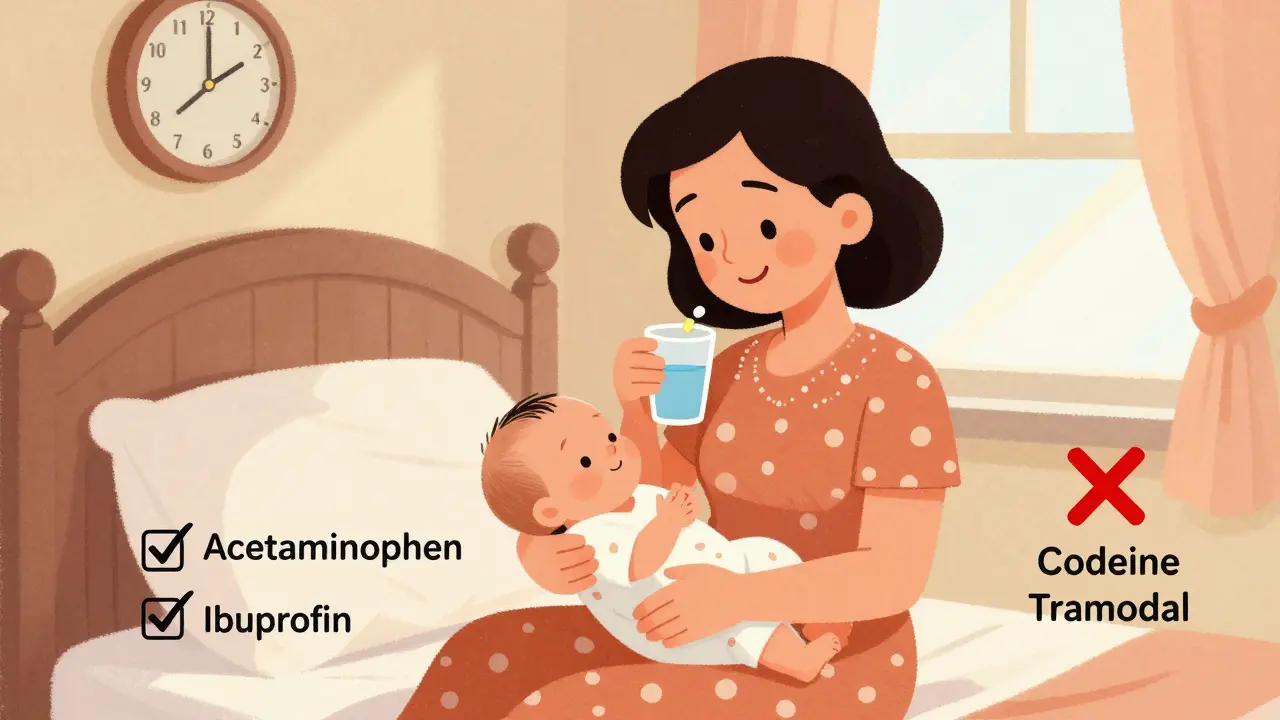
After giving birth, pain is normal-whether you had a vaginal delivery or a C-section. But if you're breastfeeding, choosing the right pain medication isn't just about feeling better. It’s about keeping your baby safe. Many new parents still hear outdated advice like "pump and dump" after taking any medication. That’s no longer necessary-and in some cases, it’s harmful. The key is knowing which drugs are safe, which to avoid, and how to time them right.
Start with the Safest Options: Acetaminophen and Ibuprofen
The first line of defense for postpartum pain should be acetaminophen and ibuprofen. Both are considered safe during breastfeeding, with very little passing into breast milk. Acetaminophen transfers at just 0.1-1.0% of the maternal dose, and ibuprofen at 0.6-0.7%. These levels are so low that they rarely, if ever, affect the baby. The American College of Obstetricians and Gynecologists (ACOG) and the Academy of Breastfeeding Medicine both list these as first-choice pain relievers for nursing mothers.
You can take them together. In fact, alternating them every 3 hours gives better pain control than using one alone. For example: take acetaminophen at 8 a.m., ibuprofen at 11 a.m., acetaminophen at 2 p.m., and so on. This keeps pain managed without overloading your system or your baby’s. Michigan OPEN’s 2022 guidelines even suggest replacing the first three oral NSAID doses after a C-section with IV Toradol (ketorolac) for faster, more effective relief-without compromising safety.
Avoid Codeine and Tramadol Completely
These two opioids are not safe for breastfeeding. The FDA issued strong warnings in 2017 for codeine and 2018 for tramadol, stating that breastfeeding is not recommended during treatment with either. Why? Because some mothers are "ultra-rapid metabolizers." Their bodies convert codeine into morphine-and tramadol into its active form, M1-much faster than normal. About 1 in 100 Caucasian women fall into this group, and they have no way of knowing unless they’ve had genetic testing.
The results can be deadly. In multiple documented cases, infants developed extreme drowsiness, trouble breathing, or even died after their mothers took standard doses of codeine or tramadol. One 2012 FDA report linked codeine to infant deaths after mothers took just 30 mg. Tramadol has similar risks. Even a single dose can be dangerous. The American Society of Health-System Pharmacists now advises against codeine for breastfeeding mothers regardless of pain level. There’s no safe workaround. Skip them entirely.
If You Need an Opioid, Choose Morphine
Not all opioids are created equal. If acetaminophen and ibuprofen aren’t enough, and you need something stronger, morphine is the safest option. It transfers into breast milk at low levels, and infants absorb less than 1% of what’s passed through milk. That’s because morphine doesn’t get absorbed well in a baby’s gut. Other opioids like hydrocodone, oxycodone, and fentanyl do transfer more and carry risks of infant drowsiness or breathing problems.
Studies show morphine has a relative infant dose (RID) of 8-10%, which is considered low-risk. Oxycodone’s RID is similar but comes with more reported cases of infant sedation. Fentanyl is also used in hospitals right after delivery, but it’s only recommended for short-term use because it can cause temporary breathing suppression in newborns. Always use the lowest effective dose for the shortest time-no more than 4-6 days.
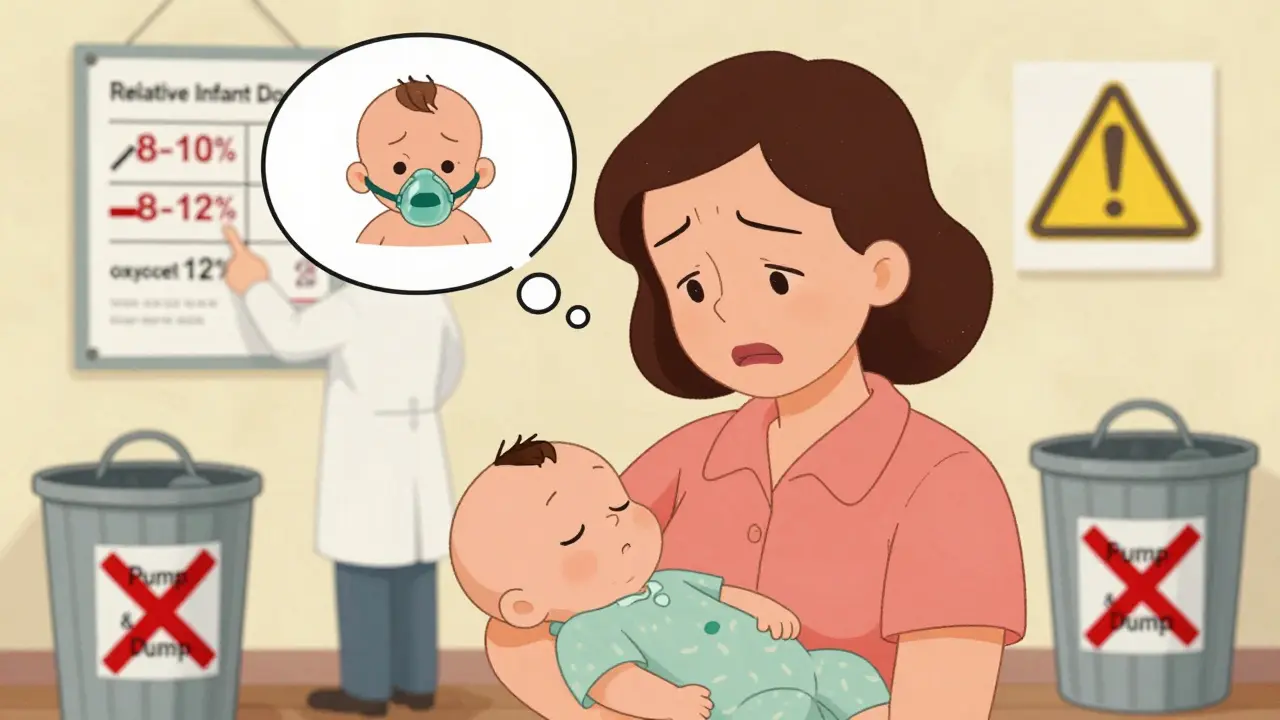
Timing Matters: Take Medication After Feeding
Even safe medications can build up if you take them at the wrong time. For any opioid, take it right after you finish breastfeeding-not before. That gives your body time to break down the drug before the next feeding. Peak levels in breast milk happen 1-2 hours after you take the pill. If you take it before a feed, your baby gets the highest dose.
For example: if you feed at 7 p.m., take your pain pill at 8 p.m. Then wait until 11 p.m. or midnight for the next feed. This simple timing trick cuts your baby’s exposure by more than half. Intermountain Health recommends this approach for all opioid use during breastfeeding. Don’t guess-plan ahead.
Watch for Warning Signs in Your Baby
Even with safe medications, you need to stay alert. Monitor your baby for signs of oversedation:
- Excessive sleepiness (hard to wake for feeds)
- Difficulty latching or sucking
- Weak cry
- Slow or shallow breathing
- Constipation or poor feeding
These signs can appear within hours-or be delayed for up to 24 hours. If you notice any of these, stop the medication and call your doctor. The Breastfeeding Network advises keeping a close watch for at least 24 hours after each dose. Babies under two months are especially vulnerable because their livers and kidneys can’t process drugs as efficiently.

What About Naproxen or Indomethacin?
These are NSAIDs like ibuprofen, but they’re not recommended for breastfeeding. Naproxen stays in your system longer and builds up in breast milk over time. At 24-hour concentrations, it can reach 1.5-2.0% of the maternal dose-higher than ibuprofen. Indomethacin has been linked to kidney issues and bleeding in newborns. Stick with ibuprofen. It clears faster, transfers less, and has decades of safety data.
Don’t Panic About Anesthesia or Short-Term Use
Some mothers still worry that anesthesia or a single dose of pain medicine means they must stop breastfeeding. That’s outdated. The Academy of Breastfeeding Medicine updated its guidelines in 2021 to remove all "pump and dump" recommendations after anesthesia. Studies show that less than 1% of most anesthetics enter breast milk. You can nurse right after waking up. No need to wait 24 hours. The same goes for short-term opioid use-if you’re using morphine or oxycodone correctly, your baby is not at risk.
What’s Next? Genetic Testing and Better Tools
In the future, we might see routine genetic testing for CYP2D6 metabolism before prescribing opioids. Mayo Clinic researchers published a 2023 study showing it’s possible to identify ultra-rapid metabolizers before they’re given codeine. But right now, it’s not standard practice. Until then, the safest rule is simple: avoid codeine and tramadol. Use acetaminophen and ibuprofen first. If you need more, choose morphine, time it right, and watch your baby closely.
Can I take ibuprofen while breastfeeding?
Yes. Ibuprofen is one of the safest pain medications for breastfeeding mothers. Only 0.6-0.7% of the dose passes into breast milk, and it’s cleared quickly from your system. It’s recommended as a first-line option by ACOG and the Academy of Breastfeeding Medicine. You can take it regularly without harming your baby.
Is acetaminophen safe for breastfeeding moms?
Yes. Acetaminophen transfers into breast milk at levels of 0.1-1.0% of the maternal dose. It’s considered safe by the FDA, ACOG, and the InfantRisk Center. You can use it as needed for headaches, cramps, or general pain. It’s often combined with ibuprofen for better pain control.
Why is codeine dangerous while breastfeeding?
Codeine is converted into morphine in the body. Some mothers are "ultra-rapid metabolizers"-they turn codeine into morphine too quickly. This leads to dangerously high levels in breast milk. Infants exposed to this can develop life-threatening breathing problems or extreme sleepiness. The FDA has issued strong warnings, and multiple infant deaths have been linked to codeine use during breastfeeding.
Can I take tramadol while breastfeeding?
No. Tramadol is not safe for breastfeeding mothers. Its active metabolite, M1, can build up in breast milk and cause serious breathing problems in infants. The FDA explicitly advises against breastfeeding while taking tramadol. Even standard doses have led to infant deaths. Avoid it completely.
What should I do if my baby seems too sleepy after I take pain meds?
If your baby is unusually sleepy, has trouble latching, or shows shallow breathing, stop the medication immediately. Call your pediatrician or go to the nearest emergency room. Keep your baby awake enough to feed every 2-3 hours. Monitor them closely for 24 hours after any dose of an opioid. Early signs of overdose can be subtle but life-threatening.
Do I need to pump and dump after taking pain medication?
No. Pumping and dumping is no longer recommended after anesthesia or most pain medications. Studies show that very little medicine enters breast milk, and it clears quickly. For acetaminophen, ibuprofen, or even morphine, you can continue breastfeeding normally. Only pump and dump if your doctor specifically tells you to-for rare cases like radioactive drugs or chemotherapy.
Is morphine the best opioid for breastfeeding moms?
Yes. Among opioids, morphine is the safest for breastfeeding because it transfers poorly into milk and babies absorb very little of it-less than 1%. It’s recommended by the InfantRisk Center and the Academy of Breastfeeding Medicine. Other opioids like oxycodone or hydrocodone carry higher risks of infant sedation. Use morphine only if needed, for short periods, and always time it after feeding.


Comments
Finally someone lays it out without the fluff. Acetaminophen and ibuprofen? Yeah, they’re the gold standard. I’ve been giving both to my wife since day one after our C-section. No issues. Baby’s alert, feeding like a champ. No pump and dump nonsense. Just science. And yeah, alternating every 3 hours? Game changer. We went from screaming to sleeping in 48 hours.
OMG YES. 🙌 I was so scared after my delivery, thought I had to quit breastfeeding. Then I found this guide. Now I’m rocking my baby with ibuprofen like a boss. No drama. Just milk and cuddles. You’re a lifesaver, OP. 🤗
Man I wish I had this 2 years ago. My girl was 3 weeks old when I took tramadol for my C-section. She went limp. Like, completely unresponsive. We rushed to the ER. Turns out she had a mild overdose. Scared the crap outta me. Since then? Only ibuprofen and tylenol. And I time it after feeds. Never again. If you’re reading this and thinking "it won’t happen to me" - trust me. It can.
So let me get this straight - you’re telling me the FDA, ACOG, and a bunch of "experts" are all in on this? Meanwhile, Big Pharma is still pushing codeine like it’s 2005? Sounds like a cover-up. Who funds these guidelines? Who’s getting paid? And why are we still using morphine? Isn’t that just a step away from heroin? I’m not buying it.
This isn’t just about pain management - it’s about reclaiming motherhood on your own terms. Too many moms are told to sacrifice their comfort for a myth. You’re not just giving advice here. You’re giving permission. Permission to heal. Permission to rest. Permission to be a whole person again. Thank you. This is the kind of info that changes lives - not just feeds.
I CAN’T BELIEVE THIS IS STILL A THING. MY SISTER TOOK CODEINE. HER BABY DIED. SHE’S STILL NOT OVER IT. SHE BLAMES HERSELF. SHE BLAMES THE DOCTOR. SHE BLAMES THE HOSPITAL. SHE BLAMES THE FDA. SHE BLAMES THE PHARMACY. SHE BLAMES THE BABY’S FATHER. SHE BLAMES THE SUN. SHE BLAMES THE MOON. SHE BLAMES THE STARS. SHE BLAMES THE UNIVERSE. SHE BLAMES ME FOR NOT TELLING HER. I’M STILL SCARED TO EVEN TAKE IBUPROFEN NOW. WHAT IF I’M AN ULTRA-RAPID METABOLIZER TOO? WHAT IF I’M KILLING MY BABY IN SLEEP? I CAN’T SLEEP. I CAN’T EAT. I CAN’T BREATHE. I JUST WANT TO HOLD MY BABY AND NOT BE AFRAID.
In India, we don’t have this luxury. Pain meds are either too expensive or too restricted. My wife took paracetamol only. No ibuprofen. No morphine. She cried through the night. We didn’t know what was safe. We didn’t have access to guidelines. Why is this information only for the West? Why don’t we have global standards? This is not equity. This is privilege.
Just wanted to say thank you for this. I’ve been a doula for 12 years and I’ve seen too many moms panic over pain meds. You’ve cut through the noise. Clear. Practical. No fear-mongering. Just facts. I’m sharing this with every new mom I meet. You’re doing the work that needs to be done. Keep going.
Timing after feeding makes so much sense. I never thought about that. My wife was taking oxycodone after our son’s birth and I just assumed it was fine. Turns out she was dosing right before nursing. We’ve been switching to morphine and timing it right since. Baby’s been way more alert. Simple fix. Huge difference.
While the guidance is largely sound, I would urge caution in generalizing across all populations. Pharmacokinetics vary significantly by ethnicity, BMI, and hepatic function. The 1 in 100 ultra-rapid metabolizer statistic is based on Caucasian cohorts. For South Asian and African populations, metabolic profiles differ. Without genetic testing, blanket avoidance may be overly cautious - or insufficient. A nuanced approach is needed.
YES YES YES. I took ibuprofen like candy after my twins. No issues. One of them even slept through a whole feed once. I thought I was a monster. Turns out I was just smart. Also - alternating with tylenol? Genius. I wish I’d known this before. Now I’m telling every new mom I know. This is the stuff they don’t teach you in prenatal class.
So I took tramadol once. Just once. After my c-section. Baby was fine. But now I’m paranoid. Like… every time she yawns I check her breathing. Every time she sleeps longer than 2 hours I wake her up. I’ve been pumping and dumping for 3 weeks. I know it’s not needed. But I can’t stop. Is this normal? Am I crazy? I need to know I’m not alone.
Just a little heads up - if you’re using IV Toradol after a C-section, watch for GI bleeding. I had a friend who got it and ended up with a stomach ulcer. It’s not in the guidelines, but it’s real. Also, don’t forget hydration. Ibuprofen + dehydration = kidney stress. Drink water. Eat soup. Take a nap. Your body’s doing a marathon. Don’t skimp on the fuel.
As someone who’s lived in both the UK and the US, I’m stunned how much better the info is here. In the NHS, they still hand out codeine like candy. I had to fight to get my wife ibuprofen. She was told "it’s fine" until she found this article. We’re lucky. But not everyone is. This needs to be translated. Shared. Printed. Posted in every hospital. It’s not just advice - it’s a lifeline.