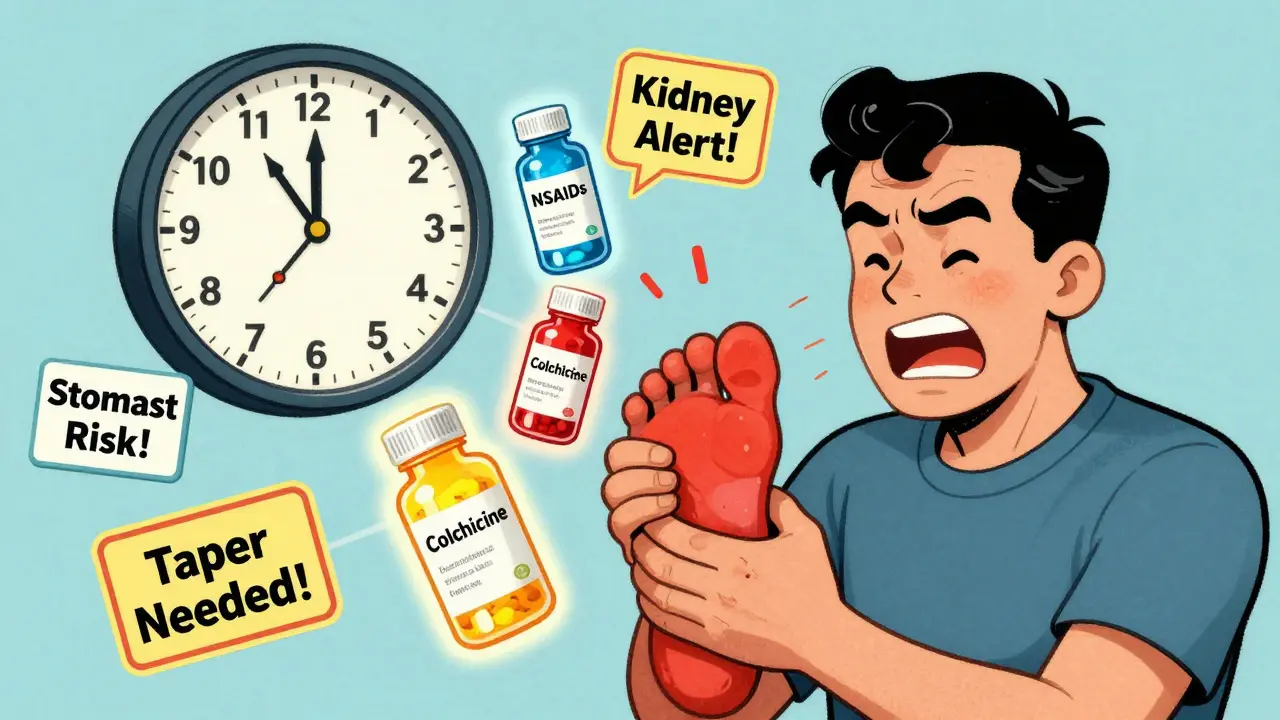
When a gout flare hits, it doesn’t ask for permission. The pain comes fast - sharp, burning, and often centered in the big toe, but sometimes in the ankle, knee, or finger. You can’t ignore it. And when you’re in that kind of pain, you need to act fast. Not tomorrow. Not later. Now.
Three drugs are used most often to stop a gout flare in its tracks: colchicine, NSAIDs, and corticosteroids. Each works differently. Each has pros and cons. And none of them are one-size-fits-all. The best choice isn’t about which one is "strongest." It’s about which one is safest for you.
How Fast Do You Need to Act?
Time matters. Studies show that if you start treatment within 24 hours of the first sign of pain - swelling, redness, heat - you’re far more likely to shorten the flare and reduce the pain. Some doctors even say: "Start within 24 seconds." That’s not a joke. The inflammation kicks in hard and fast. The sooner you hit it with medication, the less damage it does.
Waiting even a day can mean the difference between three days of pain and a week. That’s why keeping a small supply of your prescribed flare medication on hand isn’t optional. It’s essential.
NSAIDs: The Go-To, But Not for Everyone
NSAIDs - like naproxen, ibuprofen, and indomethacin - are the most common first choice for gout flares. They work by blocking the body’s inflammatory signals. They’re cheap, widely available, and work fast.
But here’s the catch: you need high doses to make them work for gout. That means:
- Naproxen: 500 mg twice a day
- Ibuprofen: 800 mg three times a day
- Indomethacin: 50 mg three times a day
These aren’t your regular painkiller doses. These are full anti-inflammatory doses. And they come with risks - especially if you’re over 60, have kidney problems, high blood pressure, or a history of stomach ulcers.
Only three NSAIDs have FDA approval specifically for gout: indomethacin, naproxen, and sulindac. But doctors often use others like diclofenac or celecoxib if they think the patient can tolerate them. The problem? NSAIDs can cause stomach bleeding, kidney damage, and worsen heart failure. In older adults, these side effects aren’t rare. They’re common.
Colchicine: Low Dose, Big Difference
Colchicine used to be given in high doses - six pills over six hours. That meant vomiting, diarrhea, and sometimes hospital visits. But research changed everything.
Now, the standard is a single 1.8 mg dose taken within an hour of flare onset. That’s it. Studies show this low-dose approach works just as well as the old high-dose method - but with 70% fewer side effects.
It’s not magic. Colchicine doesn’t reduce inflammation like NSAIDs do. It blocks the immune cells that trigger the gout flare. That’s why it’s so specific to gout. But it’s also why it’s dangerous if you take too much.
Colchicine has a razor-thin safety margin. Too much, and you risk rhabdomyolysis (muscle breakdown), liver damage, or even death. This is especially risky if you’re on statins, have kidney disease, or take certain antibiotics. Always check with your doctor before starting it - even if you’ve used it before.
Steroids: The Quiet Winner
Corticosteroids - like prednisone - are often overlooked. But they might be the smartest choice for many people.
Here’s why: a 5- to 7-day course of oral prednisone (40-60 mg at first, then tapered down) works just as well as NSAIDs at reducing pain. And in some cases, better. A 2017 meta-analysis of six trials with over 800 patients found both NSAIDs and steroids cut pain by about 73%. Placebo? Only 27%.
But steroids don’t wreck your stomach. They don’t strain your kidneys the same way NSAIDs do. And they’re safe for people with heart disease or high blood pressure - as long as you taper them properly.
There’s one big catch: rebound flares. If you stop steroids too fast, the gout can come back harder. That’s why tapering is non-negotiable. A typical schedule looks like this:
- Day 1: 40-60 mg
- Day 2-3: 30-40 mg
- Day 4-5: 20-30 mg
- Day 6-7: 10 mg
And if you only have one joint affected - say, your big toe - an injection right into the joint can be even better. No pills. No system-wide effects. Just targeted relief.
Who Gets Which Treatment?
There’s no universal answer. Your best option depends on your health history.
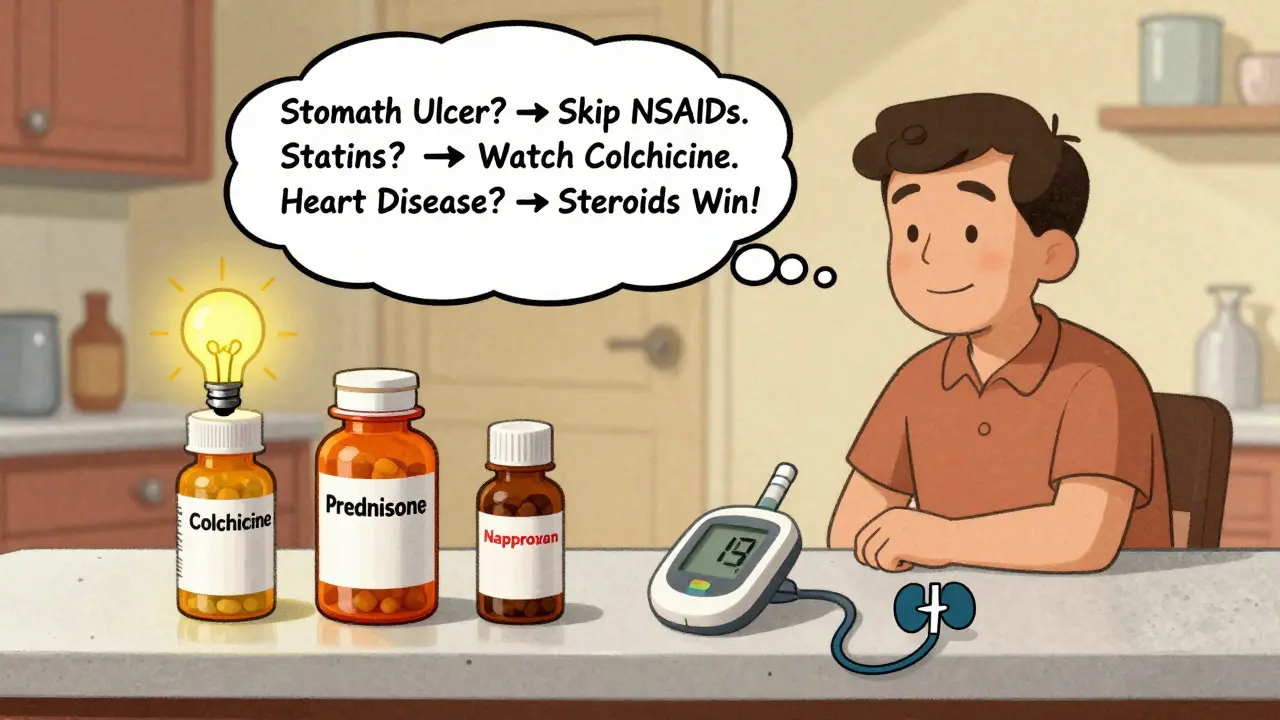
- If you have stomach ulcers, kidney disease, or heart failure → Avoid NSAIDs. Colchicine might be risky too. Steroids are often the safest pick.
- If you’re on statins or have liver disease → Colchicine can be dangerous. Stick with steroids or NSAIDs (if kidneys are okay).
- If you’re diabetic → Steroids can spike blood sugar. You’ll need to monitor closely, but they’re still often the best option if NSAIDs and colchicine aren’t safe.
- If you’ve had a flare before → Keep a small supply of your best-tolerated option on hand. Don’t wait for your doctor’s appointment.
Some people need combinations. If one drug doesn’t fully control the pain, adding a second - like a steroid with low-dose colchicine - can help. This isn’t risky if done under supervision. In fact, it’s often necessary.
What About Cost and Access?
All three options are cheap. Generic naproxen costs less than $5 a month. Colchicine? Under $10. Prednisone? Often under $10 for a short course.
Insurance rarely blocks these. The real barrier isn’t cost - it’s awareness. Many patients don’t know steroids are an option. Or they think they’re "too strong." They’re not. A short course is a controlled, safe tool - not a long-term habit.
What Happens After the Flare?
Stopping treatment after the pain fades is a mistake. Gout isn’t just about flares. It’s about the long-term buildup of uric acid crystals. If you don’t address that, you’ll have another flare - and another after that.
Doctors recommend starting or continuing urate-lowering therapy (like allopurinol or febuxostat) after the first flare. But here’s the key: you need to protect yourself while your body adjusts.
For at least three months after starting urate-lowering meds - or six months if you’ve had tophi (those lumpy deposits under the skin) - you should take a low-dose preventive: either colchicine (0.6 mg daily) or a low-dose NSAID. This stops new flares from happening while your body clears out old crystals.
Bottom Line: It’s Not About the Drug. It’s About You.
Colchicine, NSAIDs, and steroids all work. But none of them work well if you ignore your health history.
Don’t just take what your friend uses. Don’t assume the "strongest" drug is best. Your body is unique. Your kidneys, your stomach, your heart - they all matter.
If you’re unsure, ask your doctor: "Which of these three is safest for me, given my other conditions?" And if they don’t have an answer, ask for a referral to a rheumatologist. Gout isn’t just a foot problem. It’s a whole-body condition.
And remember: don’t wait. Start treatment within 24 hours. The sooner, the better.