Imagine leaving the hospital after a major heart event, feeling relieved to be alive but terrified that one wrong move could send you right back. You are not alone in this fear. For decades, patients were told to stay in bed and avoid exertion at all costs. Today, medical science has flipped that script entirely. Cardiac rehabilitation is a medically supervised program designed to restore physical function and reduce future heart risks through structured exercise, education, and counseling. It is no longer optional; it is one of the most effective tools we have for saving lives.
The data is striking. Research shows that participating in these programs can cut your risk of dying from heart disease by up to 30%. That is a benefit comparable to taking powerful medications like statins or beta-blockers. Yet, despite this evidence, less than 40% of eligible patients actually sign up. Why? Often, it is simply a lack of understanding about what the process involves. This guide breaks down exactly how cardiac rehab works, who qualifies, and why it is the safest way to get your life back.
What Is Cardiac Rehabilitation?
At its core, cardiac rehabilitation is a comprehensive care model. It is not just a gym membership with extra steps. It is a coordinated effort involving cardiologists, nurses, physical therapists, dietitians, and mental health professionals. The goal is twofold: help you return to an active life and prevent another cardiac event.
The modern approach was established in the 1970s when researchers proved that early movement was safer than prolonged rest. Since then, guidelines from organizations like the American Heart Association (AHA) have refined the standards. Today, a proper program must include four pillars:
- Physician-prescribed exercise: Tailored physical activity based on your specific heart condition.
- Risk factor modification: Managing blood pressure, cholesterol, and diabetes.
- Psychosocial assessment: Addressing anxiety, depression, and stress, which are common after a heart scare.
- Outcomes assessment: Regular testing to ensure you are improving safely.
Think of it as rebuilding your body’s foundation. You are not just healing the injury; you are upgrading the structure to handle future stress better than before.
The Three Phases of Recovery
Recovery is not a single event; it is a journey divided into three distinct clinical phases. Each phase has specific goals, intensity levels, and safety protocols.
Phase I: Inpatient Care
This phase begins while you are still in the hospital, typically within 24 to 48 hours after your heart attack or surgery. The primary goal here is early mobilization. Nurses and therapists will help you sit up, stand, and walk short distances several times a day.
The sessions are brief-often just 3 to 5 minutes of activity followed by rest periods. The total daily exercise might only add up to 20 minutes. The intensity is kept low, ensuring your heart rate stays below 120 beats per minute or roughly 20 beats above your resting rate. The focus is on proving that movement is safe and building confidence.
Phase II: Outpatient Supervision
Once you are discharged, usually 1 to 3 weeks later, you transition to Phase II. This is the most critical part of the program. It typically consists of 36 supervised sessions over 12 weeks, attended 3 to 5 days a week.
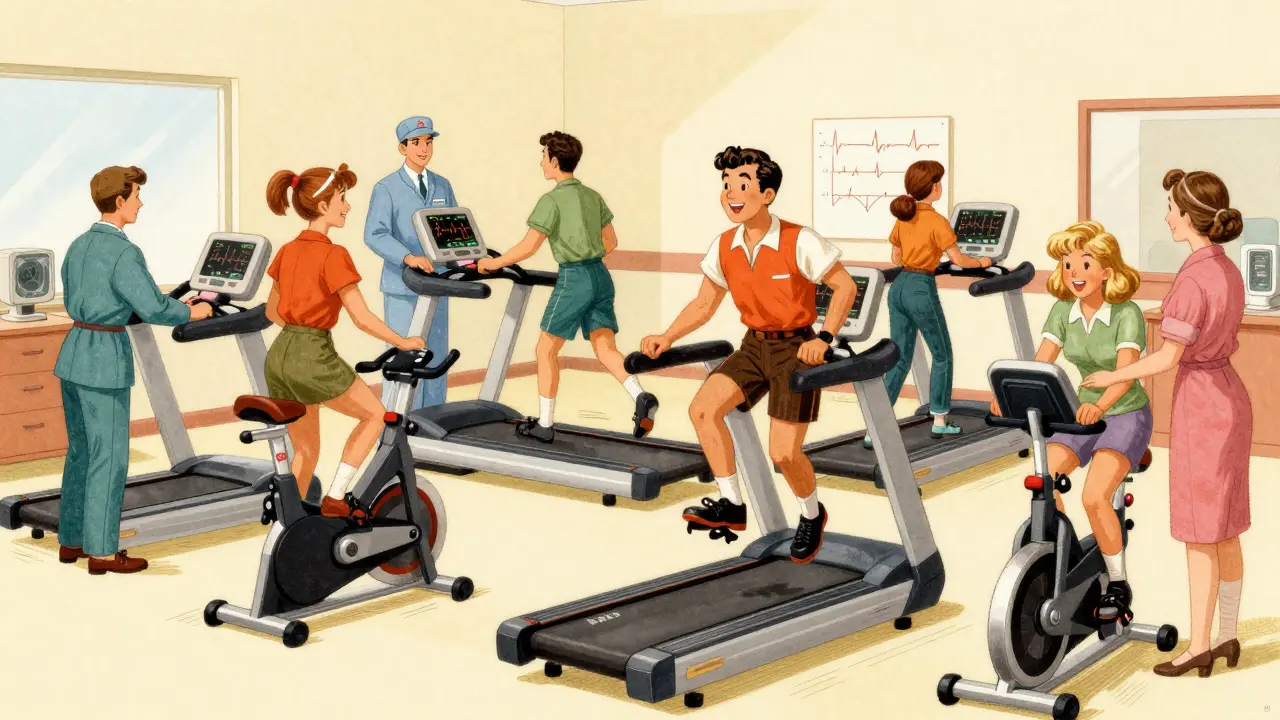
During these sessions, you exercise under continuous monitoring. Technicians watch your ECG, blood pressure, and oxygen levels. The workouts start gently, aiming for moderate intensity (40-59% of your heart rate reserve). As you progress, the intensity increases. You will also begin strength training, using light weights for 10-15 repetitions. This helps rebuild muscle mass without straining the heart.
| Feature | Phase I (Inpatient) | Phase II (Outpatient) | Phase III (Maintenance) |
|---|---|---|---|
| Timing | Within 24-48 hours of event | 1-3 weeks post-discharge | Ongoing after Phase II |
| Duration | Days to weeks | Typically 12 weeks | Lifelong |
| Supervision | Nurses/Therapists in hospital | Certified specialists with ECG monitoring | Self-guided with periodic check-ins |
| Intensity | Very Low (Light walking) | Moderate to Vigorous (Progressive) | Moderate (150 mins/week target) |
Phase III: Long-Term Maintenance
After completing the formal outpatient program, you enter Phase III. This is where the real work happens. The goal is to maintain the fitness gains you made and integrate healthy habits into your daily life. The World Health Organization recommends aiming for 150 minutes of moderate-intensity aerobic activity per week. This might look like brisk walking, swimming, or cycling. The key is consistency and self-monitoring.
Who Qualifies for Cardiac Rehab?
You do not need to have had a massive heart attack to benefit. Guidelines define several qualifying conditions. If you have experienced any of the following, you should ask your doctor for a referral:
- Acute myocardial infarction (heart attack) within the past 12 months.
- Coronary artery bypass graft (CABG) surgery.
- Angioplasty or stent placement.
- Heart valve repair or replacement.
- Heart or heart-lung transplantation.
- Stable angina (chest pain during activity).
- Chronic heart failure.
Conversely, there are situations where rehab might be delayed or modified. These include unstable angina, uncontrolled arrhythmias, or severe acute heart failure. Your cardiologist will determine if you are stable enough to begin.

Is Cardiac Rehab Safe?
Safety is the number one concern for most patients. Many worry that exercising too hard will trigger another heart attack. The statistics say otherwise. Cardiac rehabilitation is incredibly safe. Studies show a complication rate of only 1 in 100,000 patient-hours of exercise. To put that in perspective, it is safer than many routine daily activities like climbing stairs or carrying groceries.
Dr. Ross Arena, a leading expert in the field, notes that major complications are extremely rare, with only five reported across over 1.3 million hours of monitored exercise in various studies. The environment is controlled. If your heart rate spikes or you feel dizzy, the team stops the session immediately. This level of oversight provides a safety net that home workouts cannot match.
How to Start and Overcome Barriers
Despite the benefits, participation rates remain low. Only about 37% of Medicare beneficiaries enroll in these programs. Why? Common barriers include lack of physician referral, transportation issues, and cost concerns.
To overcome these hurdles, take proactive steps:
- Ask for a referral: Do not wait for your doctor to bring it up. Ask specifically, "Am I a candidate for cardiac rehabilitation?" during your discharge planning.
- Check insurance coverage: Medicare covers 36 sessions with a 20% coinsurance. Most private insurers also cover it. Verify your benefits beforehand.
- Consider telehealth options: Recent studies show that remote cardiac rehab programs offer similar improvements in fitness compared to center-based ones. If travel is difficult, ask about hybrid or fully remote models.
- Start small: While waiting for your first session, begin with gentle walks around your home. Aim for 5-10 minutes initially, increasing gradually as tolerated.
Remember, the goal is not to become an athlete overnight. It is to regain independence and peace of mind. Every step you take in a supervised setting builds the foundation for a healthier future.
How long does cardiac rehabilitation last?
The standard outpatient program (Phase II) typically lasts 12 weeks, consisting of 36 sessions attended 3 to 5 days per week. However, recovery is a lifelong process. Phase III maintenance continues indefinitely, focusing on sustaining the healthy habits formed during the initial program.
Does Medicare pay for cardiac rehab?
Yes, Medicare Part B covers up to 36 cardiac rehabilitation sessions following a qualifying event such as a heart attack, bypass surgery, or angioplasty. Patients are responsible for 20% of the Medicare-approved amount after meeting their annual deductible. Some cases may qualify for extended sessions beyond 36 with prior authorization.
Can I do cardiac rehab at home?
While some components can be done at home, the core Phase II program requires professional supervision and monitoring. However, telehealth cardiac rehabilitation is an emerging option that allows patients to exercise at home with remote monitoring via wearable devices. Studies show these remote programs can achieve similar fitness improvements to traditional center-based care.
What exercises are included in cardiac rehab?
Programs include aerobic exercises like walking on a treadmill, stationary cycling, or arm ergometry. Strength training is also incorporated, using light weights or resistance bands for major muscle groups. Sessions always include warm-up and cool-down periods. Intensity is carefully monitored using heart rate and perceived exertion scales to ensure safety.
Is cardiac rehab painful?
Cardiac rehabilitation should not be painful. You may experience mild muscle soreness from new physical activity, which is normal. However, chest pain, severe shortness of breath, or dizziness are warning signs that require immediate attention. The staff monitors you closely to keep discomfort minimal and ensure you stay within safe limits.