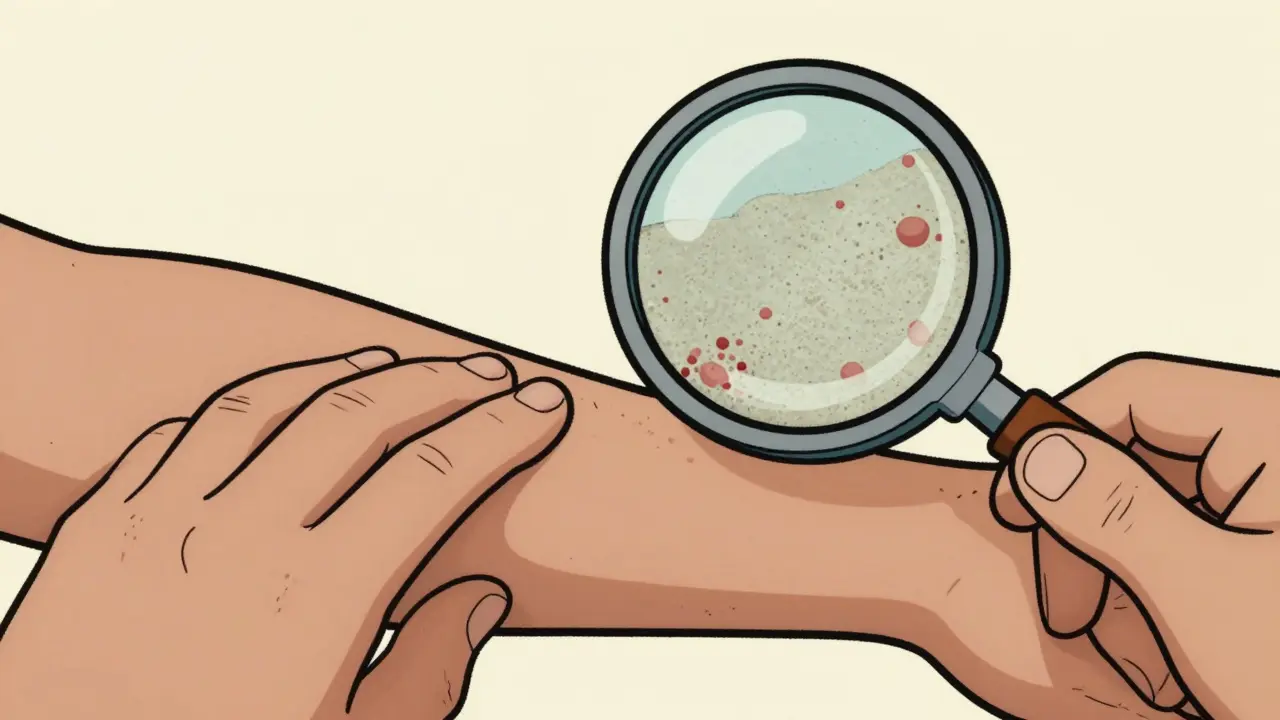
Imagine running your hand over your forearm or scalp and feeling something that feels exactly like coarse sandpaper, even though the skin looks mostly normal. That gritty texture is often the first warning sign of actinic keratoses is a precancerous skin condition characterized by rough, scaly patches that develop on sun-exposed skin due to cumulative ultraviolet (UV) radiation damage. While they aren't cancer yet, ignoring these spots is a gamble. About 10-15% of people with more than ten of these lesions will eventually develop a more serious form of skin cancer if they leave them alone. The good news? If you catch them early, you can stop that progression almost entirely.
What Exactly are Actinic Keratoses?
Often called solar keratoses, these spots are the result of years of sun exposure. Your skin absorbs UV rays over decades, and eventually, the cells in the epidermis start to mutate. This isn't just a "sun spot" or a freckle; it's a cellular change that puts you on a path toward cutaneous squamous cell carcinoma (SCC), a type of skin cancer. In fact, about 90% of these cancers start as an untreated actinic keratosis.
You'll most commonly find them in the "high-exposure" zones: the face, scalp, ears, and the backs of the hands. They can appear in various colors-pink, red, brown, or even silvery. For people with darker skin tones, they might look more like age spots. The most telling sign isn't actually how they look, but how they feel. Because they are often "felt more than seen," many people only discover them during a routine skin check or by accident while washing their face.
The Danger of Field Cancerization
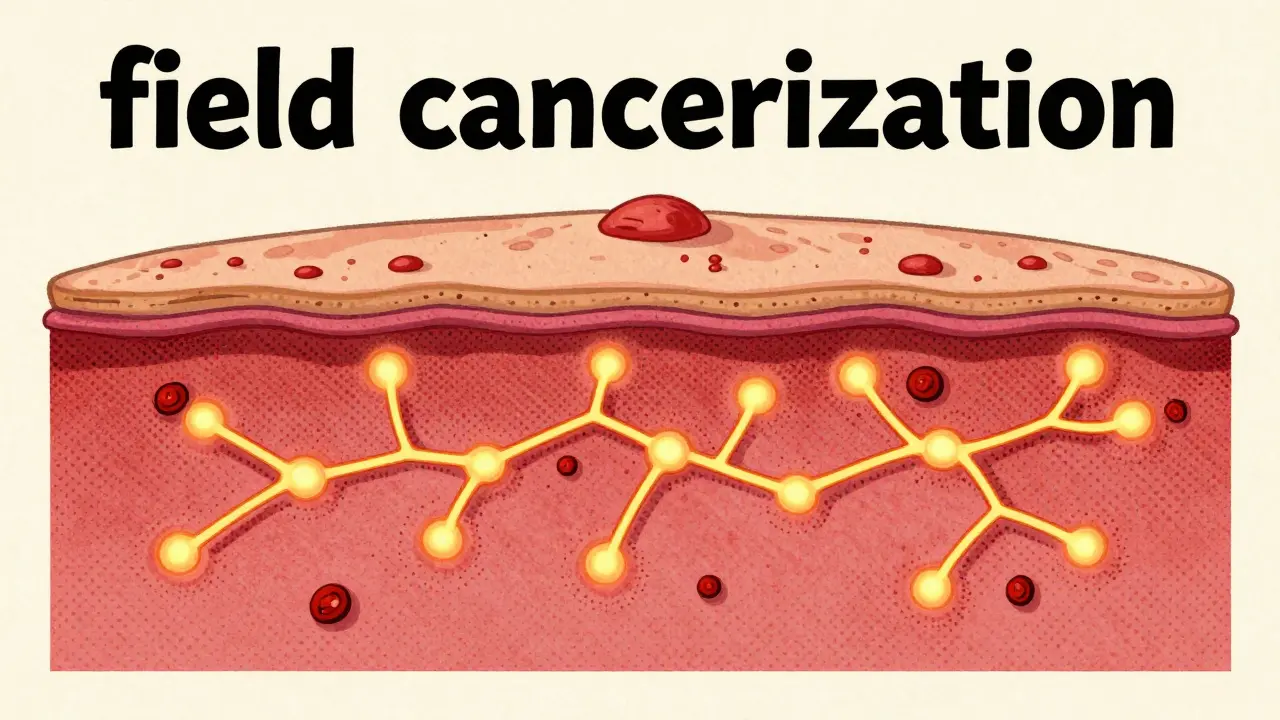
When a doctor talks about "field treatment," they aren't just talking about the one spot you can see. They are addressing a concept called field cancerization, which refers to a wide area of skin that has been damaged by the sun. Even if you only see three rough patches on your forehead, the skin around them is likely riddled with subclinical damage-meaning the cells are already mutating, but they haven't formed a visible bump yet.
If you only treat the visible spots (like freezing a single lesion with liquid nitrogen), you're playing a game of whack-a-mole. New spots will just keep popping up in the same area because the underlying "field" is still damaged. This is why dermatologists now push for field-directed therapies that treat the entire area at once, wiping out both the visible precancers and the invisible ones.
Comparing Modern Field Treatment Options
Not every treatment is a good fit for every person. Some are fast but expensive, while others are cheap but leave your skin looking like a bad sunburn for a month. Choosing the right one depends on how many lesions you have and how much downtime you can afford.
| Treatment Type | Typical Duration | Efficacy (Clearance Rate) | Key Trade-off |
|---|---|---|---|
| 5-Fluorouracil (Efudex) | 2-4 weeks | 75-85% | Very effective but causes significant redness/crusting. |
| Imiquimod (Aldara) | 16 weeks | 54-75% | Longer treatment course; slower results. |
| Tirbanibulin (Klisyri) | 5 days | 44% | Fast and convenient, but significantly more expensive. |
| Photodynamic Therapy (PDT) | 1-2 sessions | 44-75% | Professional clinic visit required; high immediate intensity. |
Navigating the Treatment Process
If you decide to go with a topical field treatment, be prepared for the "inflammatory phase." This is where many people get spooked. When you apply creams like 5-Fluorouracil, your skin doesn't just get better immediately-it actually looks worse first. You'll likely see intense redness, peeling, and some crusting. This is actually a sign that the medication is working; it's identifying and killing the precancerous cells.
To make the process smoother, keep these tips in mind:
- Don't skip days: Consistency is key to clearing the field.
- Moisturize: Use a gentle, fragrance-free moisturizer to manage the dryness.
- Strict Sun Avoidance: Your skin will be incredibly sensitive to UV rays during treatment. If you go out in the sun without protection, you risk permanent discoloration or severe burns.
- Track your progress: Take photos on day 1, day 14, and day 30. It's hard to see the improvement when you look in the mirror every day, but the photos will show the truth.

When to Worry: AK vs. Squamous Cell Carcinoma
While most actinic keratoses can be managed with creams, some turn into squamous cell carcinoma. You need to call your doctor immediately if a spot changes in a way that suggests it has become invasive. A simple rough patch is one thing, but a lesion that is actively evolving is another.
Watch for these specific red flags:
- Rapid Growth: If a spot grows significantly in a few weeks.
- Thickness: If the lesion becomes thicker than 0.5 cm or starts to feel like a hard knot.
- Ulceration: If the spot breaks open, bleeds, or develops an open sore that won't heal.
- Pain: While some treatments burn, a lesion that is spontaneously tender or painful is a warning sign.
Preventing the Next Round of Patches
Treatment is great, but if you don't change your habits, the spots will return. Since AK is caused by cumulative damage, the "clock" never really resets. You can't undo the damage from twenty years ago, but you can stop adding to it. People who follow a structured sun protection plan can reduce the development of new AKs by about 37% over two years.
This means more than just applying sunscreen on a beach day. It involves wearing wide-brimmed hats, using UV-protective clothing, and avoiding the sun during peak hours (usually 10 am to 4 pm). If you have fair skin or a history of bad sunburns, annual skin exams are non-negotiable. Many clinics now use total body photography to track every single spot on your body, making it much easier to spot a new precancer before it becomes a problem.
Does the "sandpaper feel" always mean I have precancer?
Not always, but it's the hallmark sign of actinic keratosis. Other conditions, like severe eczema or simple dry skin, can feel rough, but if the texture is localized to sun-exposed areas and feels gritty, it's highly likely to be AK. You should have a dermatologist confirm this using a dermatoscope.
Will freezing (cryotherapy) work as well as field creams?
Freezing is excellent for a single, isolated spot. However, for people with many lesions, cryotherapy only treats the "tip of the iceberg." It doesn't address the field cancerization. Field creams are generally preferred for widespread damage because they treat the invisible precancers around the visible ones.
How long does it take for the redness from creams to go away?
Depending on the medication, the inflammatory phase usually lasts from 2 to 4 weeks. After the treatment course ends, your skin typically returns to its normal color within another 2 to 4 weeks, though it may remain slightly pink for a while.
Is there a risk of permanent scarring from field treatments?
Permanent scarring is rare with topical creams like fluorouracil or imiquimod, as they work on the superficial layers of the skin. However, intense inflammation can lead to temporary pigment changes (darker or lighter spots). Following strict sun protection during and after treatment is the best way to prevent this.
Do I need a biopsy for every rough patch?
Usually, no. Board-certified dermatologists can diagnose AKs with about 95% accuracy just by looking and feeling. Biopsies are typically reserved for "atypical" lesions-those that are unusually thick, bleeding, or not responding to standard treatment-to rule out invasive squamous cell carcinoma.


Comments
The systemic failure to appreciate the nuances of field cancerization in primary care is staggering. Most GPs just hit it with liquid nitrogen and call it a day, completely ignoring the subclinical epidermal mutations and the precarious nature of the cellular microenvironment. It's a total lack of dermatologic rigor.
Oh my god, I cannot even imagine the horror of that 'inflammatory phase' on a public timeline!
I'm definitely opting for whatever the most expensive fast treatment is because I simply cannot be seen in public looking like a crusty tomato. Some of us actually have a social life to maintain, you know?
It is truly wild how much we take our skin for granted until it starts acting up like this!
Seeing the breakdown of the different creams is actually super helpful for anyone feeling overwhelmed by the options. Just remember to breathe and take it one day at a time!
Totally agree on the sunscreen part, it's such a game changer once you actually start using it daily.
The sheer inefficiency of the 16-week Imiquimod protocol is an absolute tragedy of modern medicine. To expect a patient to maintain such a rigorous regimen for four months is not only delusional but borderline sadistic. The lack of streamlined pharmaceutical delivery in this sector is an embarrassment to the entire industry.
Please remember to be gentle with your skin... really gentle!!! Using a fragrance-free moisturizer is a total life-saver during the peeling phase... trust me on this one!!!
I hve tried the cremes and they r honestly such a rollercoaster of emmotions.
One day you feel like you're healing and the next day your skin is just peeling off in sheets! It's absolutly terrifing but you just have to push through the pain for the sake of your health!
For those wondering about the 'sandpaper' feel, try checking your skin under a strong LED light.
Sometimes the redness is barely visible but the texture is obvious. It's always better to get a professional to look at it with a dermatoscope rather than guessing at home.
The emphasis on total body photography is an excellent point. It allows for a baseline comparison that is far superior to memory-based tracking. Consistent monitoring is the most effective way to ensure that early-stage lesions are addressed before they require more invasive surgical intervention.
It is a wonderful thing to see such helpful laod of information shared here. :)
We must remember that our bodies are gifts and taking care of them is a path to a happy life. Just stay positive and follow the doctor's advice!
Peace and light to all of you! :)
I am truly moved by the stories here and it makes me wonder if there are natrual ways to support the skin during this process?
The thought of the skin becoming so sensitive to the sun is quite distressing, and I would be very grateful to know how others managed the psychological stress of looking 'worse' before getting better. It's such a struggle to stay patient when the mirror shows something so alarming, especially when you're already worried about cancer. I believe that sharing these emotional hurdles is just as important as the medical facts. We must hold each other up during these treatments because the isolation of feeling 'unattractive' can be just as hard as the physical irritation. I hope everyone finds the strength to complete their treatment courses regardless of the temporary redness. It is a journey of healing and we are all in this together, fighting for a healthier future for our skin.
I concur with the necessity of annual examinations.
What a breathtakingly comprehensive guide to such a distressing topic!
It is absolutely vital that we foster an inclusive environment where people of all skin tones feel seen and understood in their struggle against UV damage. Let us embrace the journey toward healing with grace and unwavering support for one another!