TCA Therapeutic Range Checker
TCA Blood Level Check
Enter your TCA blood level and select the drug to check if it's within the safe therapeutic range.
Important Note
Therapeutic ranges are approximate and should always be interpreted by a healthcare professional in conjunction with your symptoms, ECG results, and medication history.
Tricyclic antidepressants (TCAs) like amitriptyline, nortriptyline, and desipramine aren’t used as often as they once were. But for some people-especially those with treatment-resistant depression, chronic nerve pain, or severe insomnia-they’re still the best option. The problem? These drugs have a razor-thin margin between helping and harming. A single extra pill can send someone to the ICU. That’s why therapeutic drug monitoring isn’t just a good idea-it’s a lifesaver.
Why TCAs Are So Dangerous
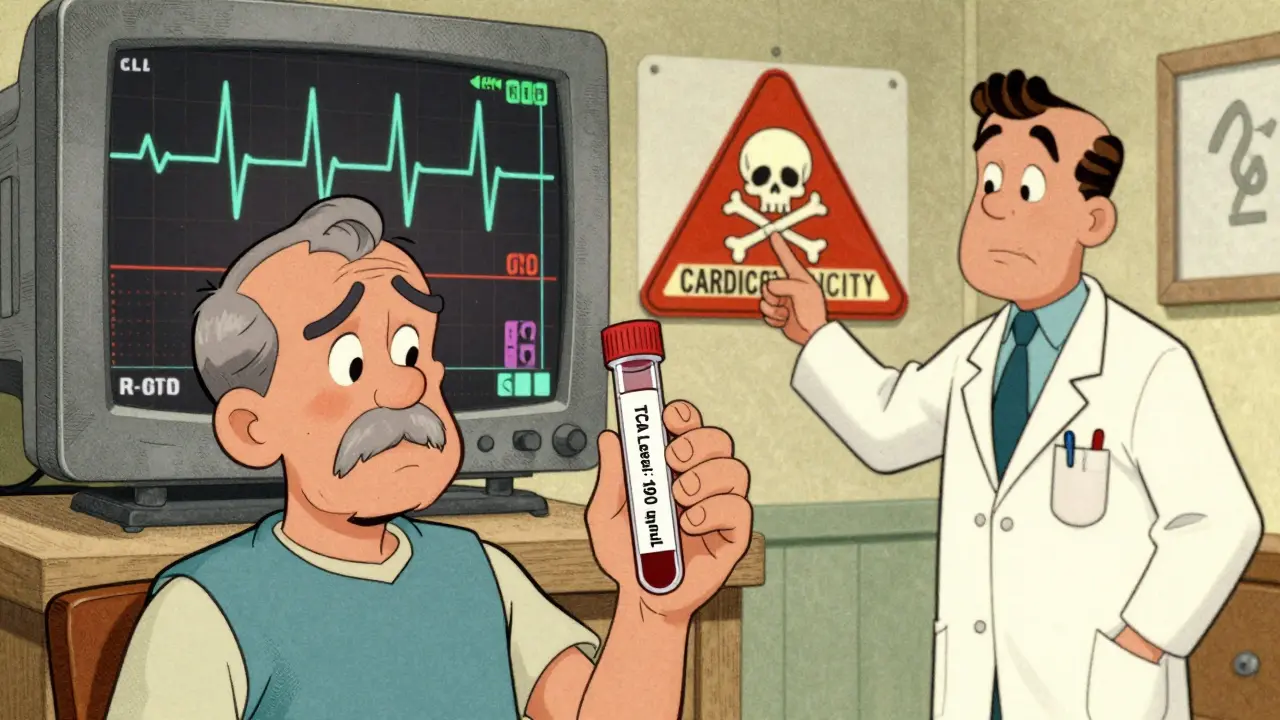
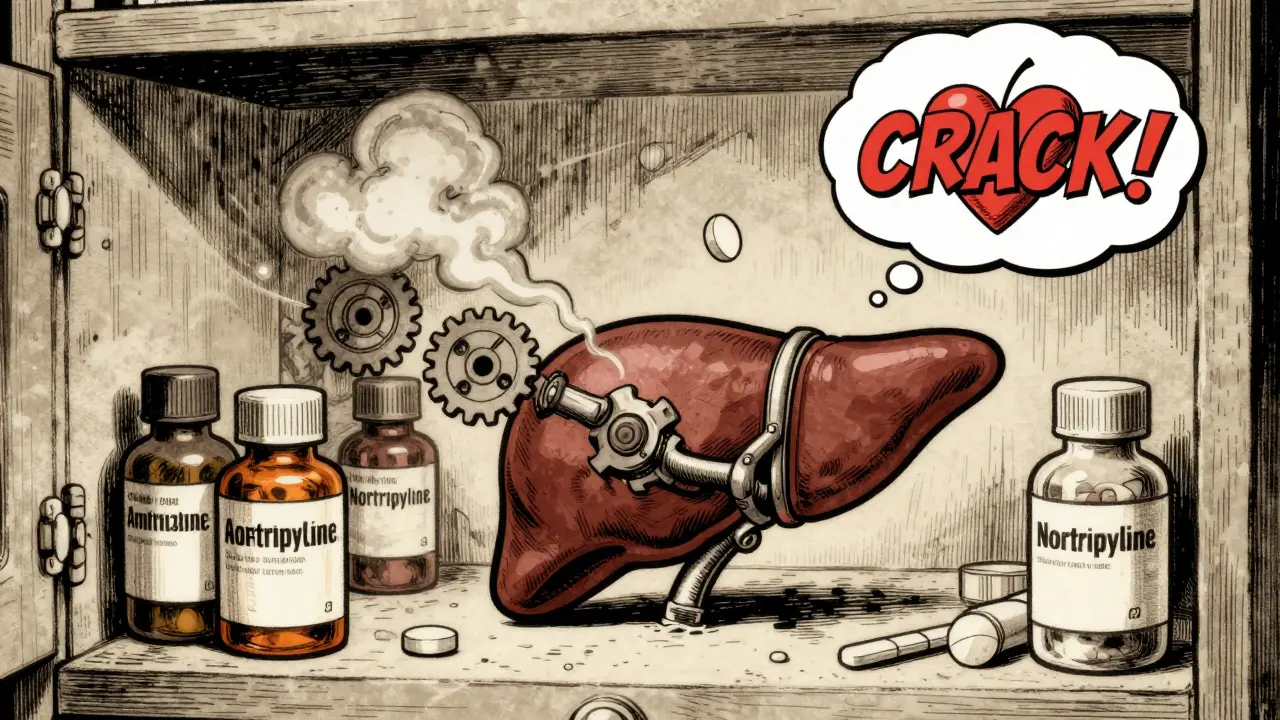
TCAs work by boosting serotonin and norepinephrine in the brain. But they don’t stop there. They also block receptors all over your body: in your heart, your gut, your eyes, your salivary glands. That’s why side effects like dry mouth, constipation, blurred vision, and dizziness are so common. But the real danger isn’t just discomfort-it’s what happens when levels creep too high. At concentrations above 500 ng/mL, TCAs can shut down your heart’s electrical system. They slow down the QRS complex on an ECG, which can lead to dangerous rhythms like torsades de pointes. Even worse, they can cause seizures, coma, or sudden cardiac arrest. And here’s the scary part: you don’t need to overdose to get there. A patient taking 150 mg of amitriptyline daily-exactly what their doctor prescribed-can hit toxic levels if they’re a slow metabolizer, take another medication that interferes, or just have older liver function. The Royal Children’s Hospital in Melbourne documented cases where a single tablet killed a child. Adults aren’t immune. Studies show TCAs cause 15-20% of fatal prescription overdoses, even though they’re only prescribed in about 3.5% of antidepressant cases today. That’s a huge risk for such a small group.What Therapeutic Drug Monitoring Actually Means
Therapeutic drug monitoring (TDM) means checking the exact amount of the drug in your blood. For TCAs, that’s not optional. The therapeutic range for amitriptyline is 80-200 ng/mL. Below 80, it’s probably not working. Above 200, you’re flirting with danger. And above 500? That’s a medical emergency. But it’s not just about the total amount. Your body breaks down TCAs into metabolites-like nortriptyline from amitriptyline. Some people turn amitriptyline into nortriptyline super fast. Others barely make any. That’s why labs measure both the parent drug and the metabolites. The ratio between them tells doctors if your liver is struggling or if you’re an ultra-rapid metabolizer with no drug in your system despite taking your pills. Blood tests must be done at the right time: right before your next dose, when levels are lowest (called the trough). And you need to be on a steady dose for at least 5-7 days before testing. If you miss doses or take them at random times, the result is useless.Who Needs TDM the Most
Not everyone on TCAs needs regular blood tests. But certain groups absolutely do:- Elderly patients (40% of TCA users): Their livers and kidneys don’t clear drugs as well. Even normal doses can build up. They’re also more sensitive to anticholinergic effects-confusion, falls, urinary retention.
- People on multiple medications: Antibiotics, antifungals, heart drugs, even some OTC sleep aids can block the CYP2D6 or CYP2C19 enzymes that break down TCAs. One extra pill can double your TCA level.
- Those with liver disease or heart conditions: Your body can’t handle the extra load.
- Patients who haven’t improved after 4-6 weeks: Maybe they’re metabolizing too fast. Or too slow. TDM tells you which.
- Anyone with new symptoms: Dizziness, fast heartbeat, confusion, tremors-these aren’t just side effects. They’re warning signs.
How TDM Prevents Toxicity
TDM isn’t just about catching toxicity after it happens. It’s about stopping it before it starts. A study published by Hiemke et al. in 2017 showed that using TDM to guide dosing reduced hospitalizations by 35% compared to adjusting doses based on symptoms alone. At Johns Hopkins, a 78-year-old man on 150 mg of nortriptyline had a blood level of 185 ng/mL-just above the 150 ng/mL safety limit. His doctor cut the dose in half. Within a week, his heart rhythm stabilized. He avoided a dangerous arrhythmia. Another case from Clinical Toxicology involved a 42-year-old woman with amitriptyline levels at 190 ng/mL-technically “therapeutic.” But her QRS complex was widened to 140 ms, a clear sign of cardiac toxicity. Her level wasn’t high enough to trigger alarm bells, but her body was reacting badly. That’s why TDM must always be paired with clinical evaluation. Numbers alone don’t tell the whole story. Psychiatrists in Reddit forums report preventing ICU admissions by spotting rising levels early. One nurse practitioner wrote: “I’ve stopped three patients from crashing because their blood levels were creeping up, and they didn’t feel any different yet.” That’s the power of proactive monitoring.What Goes Wrong With TDM
TDM works-but only if done right. Too often, it’s not. The German Commission for Pharmacological Therapeutic Monitoring found that 20% of TDM results led to wrong dose changes because the request was incomplete. Common mistakes:- Not noting what other drugs the patient is taking
- Drawing blood too soon after the last dose
- Forgetting to specify the exact dose
- Not checking if the patient actually took the pills
The Future of TDM for TCAs
New tools are making TDM faster and smarter. Siemens Healthineers launched a handheld device in Europe that gives TCA results in 20 minutes. It’s not in clinics yet, but it’s coming. Meanwhile, AI platforms like PsychX Analytics now combine blood levels, ECG data, and clinical symptoms to predict toxicity risk before it happens. Even better? Pharmacogenetic testing. About 32% of U.S. academic centers now test for CYP2D6 and CYP2C19 gene variants before starting TCAs. These genes control how fast you break down the drug. Some people are “poor metabolizers”-they build up toxic levels even on low doses. Others are “ultrarapid”-they clear the drug so fast it doesn’t work. Genotyping cuts the trial-and-error phase by 40%, according to Mayo Clinic data. The National Institute of Mental Health is even testing a wearable that measures TCA levels in interstitial fluid-like a continuous glucose monitor, but for antidepressants. Phase II trials show 92% accuracy compared to blood tests. If this works, we might stop doing blood draws altogether.
What You Should Do
If you’re on a TCA, here’s what to ask your doctor:- “Have my blood levels been checked? When?”
- “What’s my current level? Is it in the safe range?”
- “Am I taking anything that could interfere with how my body processes this drug?”
- “Should I get a genetic test for CYP2D6 or CYP2C19?”
- “If I feel dizzy, have a fast heartbeat, or feel confused-what should I do right away?”
When TDM Isn’t Enough
TDM is powerful, but it’s not magic. Some people have toxicity at “normal” levels. Others feel fine at high levels. That’s why your doctor must always connect the dots between your blood test, your ECG, and how you’re feeling. If you’re elderly, have heart disease, or are on other meds-don’t skip TDM. If you’ve been on TCAs for more than 3 months, ask for a level check. If you’ve had side effects, insist on one. And if you’re a caregiver for someone on TCAs-know the signs of overdose: confusion, rapid heartbeat, seizures, fainting. Call emergency services immediately. Don’t wait for a blood test. Treatment starts with sodium bicarbonate and an ECG-not a lab report.Final Thought
TCAs aren’t going away. They’re too effective for certain conditions. But their danger is real. Therapeutic drug monitoring isn’t a luxury. It’s the only way to use them safely. With better tools, better testing, and smarter guidelines, we can keep people on these drugs without putting them at risk. The goal isn’t to stop using TCAs. It’s to use them right. And that starts with knowing exactly what’s in your blood.How often should TCA blood levels be checked?
Blood levels should be checked after 5-7 days of consistent dosing to reach steady state. After that, testing is typically done every 3-6 months if stable, or sooner if symptoms change, doses are adjusted, or new medications are added. Elderly patients or those with liver issues may need testing every 2-3 months.
Can I check my TCA levels at home?
No, not yet. TCA testing requires specialized lab equipment like HPLC or mass spectrometry. However, new handheld devices with 20-minute turnaround are in pilot testing in Europe and may become available in clinics soon. Home blood draws are not reliable or accurate.
What if my TCA level is normal but I still feel terrible?
Normal levels don’t always mean safe or effective. Individual sensitivity varies. Some people react to low levels with dizziness or confusion. Others tolerate higher levels without issue. Your doctor must combine your blood test with your symptoms, ECG results, and medication history to make decisions-not just the number.
Are there alternatives to TCAs that don’t need blood tests?
Yes. SSRIs like sertraline or escitalopram, SNRIs like venlafaxine, and newer drugs like vortioxetine have much wider safety margins and rarely require blood monitoring. However, they may not work as well for treatment-resistant depression or neuropathic pain. Your doctor can help weigh the risks and benefits.
Why do some doctors still prescribe TCAs if they’re so dangerous?
Because they work-especially when other antidepressants fail. For chronic nerve pain, severe depression in older adults, or cases where SSRIs caused intolerable side effects, TCAs remain the most effective option. With proper monitoring, the risks can be managed. Many geriatric psychiatrists and pain specialists still rely on them.
Can I stop taking TCAs if I’m worried about toxicity?
Never stop abruptly. Sudden withdrawal can cause severe dizziness, nausea, anxiety, and even seizures. If you’re concerned, talk to your doctor about tapering slowly. They may suggest switching to a safer alternative or using TDM to confirm your current dose is safe before making changes.




Comments
Wow, this is the most comprehensive breakdown of TCA monitoring I’ve ever seen-seriously, someone should turn this into a pamphlet for every psych clinic. I’ve seen patients crash because no one checked levels, and it’s terrifying. This needs to be mandatory.
TCAs are outdated junk. SSRIs work fine for 95% of people. If you’re still prescribing these dinosaur drugs, you’re either lazy or reckless. And no, ‘treatment-resistant’ isn’t a free pass to gamble with cardiac arrest.
My aunt took amitriptyline for 12 years-no blood tests, no ECGs, just ‘take one at bedtime.’ She fell once, got confused, stopped eating… we didn’t know it was the drug until her neurologist pulled the chart and saw her level at 610 ng/mL. They didn’t even know she was on it. This isn’t medicine-it’s Russian roulette with a prescription.
The assertion that TDM is a ‘lifesaver’ is statistically misleading. While the cited 35% reduction in hospitalizations is compelling, it fails to account for confounding variables: patient compliance, concomitant polypharmacy, and baseline risk stratification. The study by Hiemke et al. (2017) employed a non-randomized retrospective design-evidence quality is low. Moreover, the cost-benefit ratio remains unproven in primary care settings. One must interrogate the epistemological foundations of biomarker-driven psychiatry before endorsing it as standard of care.
So if I’m a slow metabolizer with a CYP2D6*4 allele, and I’m on 75mg of nortriptyline, but my level’s at 190… does that mean I’m ‘therapeutic’ or just one ibuprofen away from a code blue? And why does no one talk about how SSRIs can also inhibit CYP2D6? We’re playing Jenga with pharmacokinetics and pretending it’s science.
Look, I get it. You’re all into your fancy blood tests and gene stuff. But my grandma took 100mg of amitriptyline for 20 years and never had a problem. You’re overcomplicating this. Maybe the real issue is doctors who don’t listen to patients? Just ask them how they feel. Not their liver enzymes.
Thank you for this. In Nigeria, we don’t even have access to TDM. People take TCAs like candy. I’ve seen three patients die from seizures after just a week on amitriptyline. No labs. No ECG. Just ‘try it, it’s cheap.’ 😔
LOL at the ‘handheld device’-like we need another $500 gadget when the whole system’s broken. Also, ‘pharmacogenetic testing’? That’s just fancy word for ‘we don’t know what we’re doing.’ And why’s no one talking about how TCAs cause weight gain and diabetes? That’s the real epidemic.
The notion that TDM prevents toxicity is only valid under ideal conditions: consistent dosing, timely lab turnaround, clinician literacy in pharmacokinetics, and insurance coverage. In reality, most primary care providers lack training, labs take 72 hours, and patients forget to take pills. TDM is a theoretical safeguard with minimal real-world utility. We need systemic reform-not more blood draws.
For anyone reading this and thinking ‘I’m fine’-trust me, you’re not. TCAs don’t give you warning signs. They just… stop. I lost a friend to a silent arrhythmia after he’d been on nortriptyline for 8 months. He said he felt ‘better than ever.’ His level was 480. He never knew.
Don’t panic. Don’t quit. But do ask for the test. It’s simple. It’s cheap compared to an ICU stay. And it could save your life. Talk to your doctor. Now.
It’s ironic. We’ve built entire diagnostic systems around monitoring blood sugar, cholesterol, even cortisol-but when it comes to the brain, we still treat it like a black box. TCAs force us to confront the limits of our knowledge. Maybe the real toxicity isn’t the drug-it’s our arrogance that we can control neurochemistry without measuring it.
Every time I see someone from India or Africa posting about how they don’t have access to TDM, I think: Why are we giving these drugs to people who can’t monitor them? It’s colonial medicine. We export the risk, keep the safety protocols at home. Shameful.
Let’s be honest: TCAs are a relic. The fact that we’re still debating whether to monitor them instead of phasing them out entirely is a failure of psychiatric innovation. We have ketamine, psilocybin, neuromodulation-yet we’re still haggling over ng/mL thresholds for 1950s chemistry. Pathetic.
Just got my TCA level back: 192 ng/mL. QRS 110ms. No symptoms. My doctor said ‘keep going.’ But I’m terrified. What if I’m the one who’s the outlier? I don’t trust the numbers. I don’t trust the doctors. I don’t trust this system.