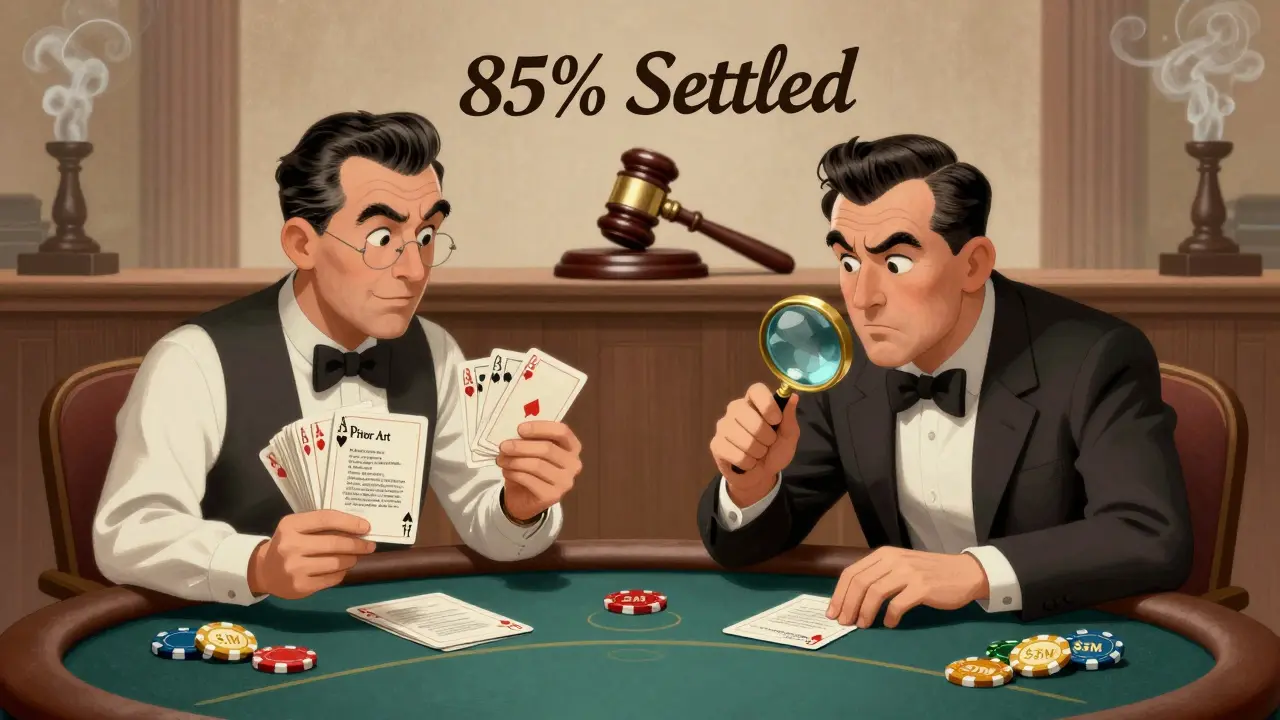
When two companies lock horns over a patent, they aren’t just fighting over legal rights-they’re fighting over money, market share, and future innovation. Most people think patent battles end in courtrooms with gavels and jury verdicts. But the truth? Patent settlement happens far more often than trial. In fact, over 85% of patent disputes are resolved before a single judge even hears the case. That’s not luck. It’s strategy.
Think of it like a high-stakes poker game. Each side holds cards: patents, prior art, financial data, and business goals. The goal isn’t to bluff the other player out. It’s to find a deal where both walk away with something valuable-even if it’s not everything they wanted.
Why Do Companies Settle Instead of Litigate?
Litigating a patent case isn’t cheap. The average cost to take a case through trial? Between $3 million and $5 million. And that’s just for cases under $25 million in claimed damages. For a small company, that’s a death sentence. For a big one, it’s a costly distraction.
Take Apple and Samsung. In 2012, they were locked in a war over 10 patents. By the time they settled, they’d cut it down to just five. Why? Because dragging out the fight meant delays in product launches, lost sales, and endless legal fees. Settlement wasn’t surrender-it was a smarter way to move forward.
Companies settle because they have more to lose than gain from a trial. A patent might look strong on paper, but 38.4% of patents asserted in court get invalidated later during post-grant reviews. That’s a huge risk. One weak patent in your portfolio can sink the whole case. So instead of betting everything on a single claim, smart companies look for compromise.
The Anatomy of a Patent Settlement
A good settlement doesn’t just say “you pay us $X.” It’s a carefully built agreement with layers. Here’s what goes into it:
- Patent portfolio assessment: Not every patent matters. Companies pick 3 to 15 key patents that are most likely to be enforced. These are usually the ones tied to core products.
- Claim charts: These map exactly how one company’s product allegedly infringes on the other’s patent claims. It’s like a technical blueprint of the dispute.
- Validity analysis: Are the patents even valid? Companies spend $150,000 to $300,000 on this before even sitting down to negotiate. If a patent is likely to be knocked out by prior art, it’s not worth fighting for.
- Financial modeling: How much is this patent really worth? Royalty rates usually range from 1.5% to 5% of product revenue. For a smartphone selling at $800, that could mean $12 to $40 per unit. Multiply that by millions of units, and the numbers add up fast.
The most common settlement structures are simple payments, cross-licensing, or hybrid deals. Cross-licensing-where both companies license each other’s patents-is huge in tech. Think of it as a truce: you let me use your 5G patents, and I’ll let you use mine. No money changes hands, but innovation keeps moving.
How Settlements Really Work: The High-Low Model
One of the most clever structures is the high-low settlement. It started with Stanley Black & Decker in 2015. Here’s how it works:
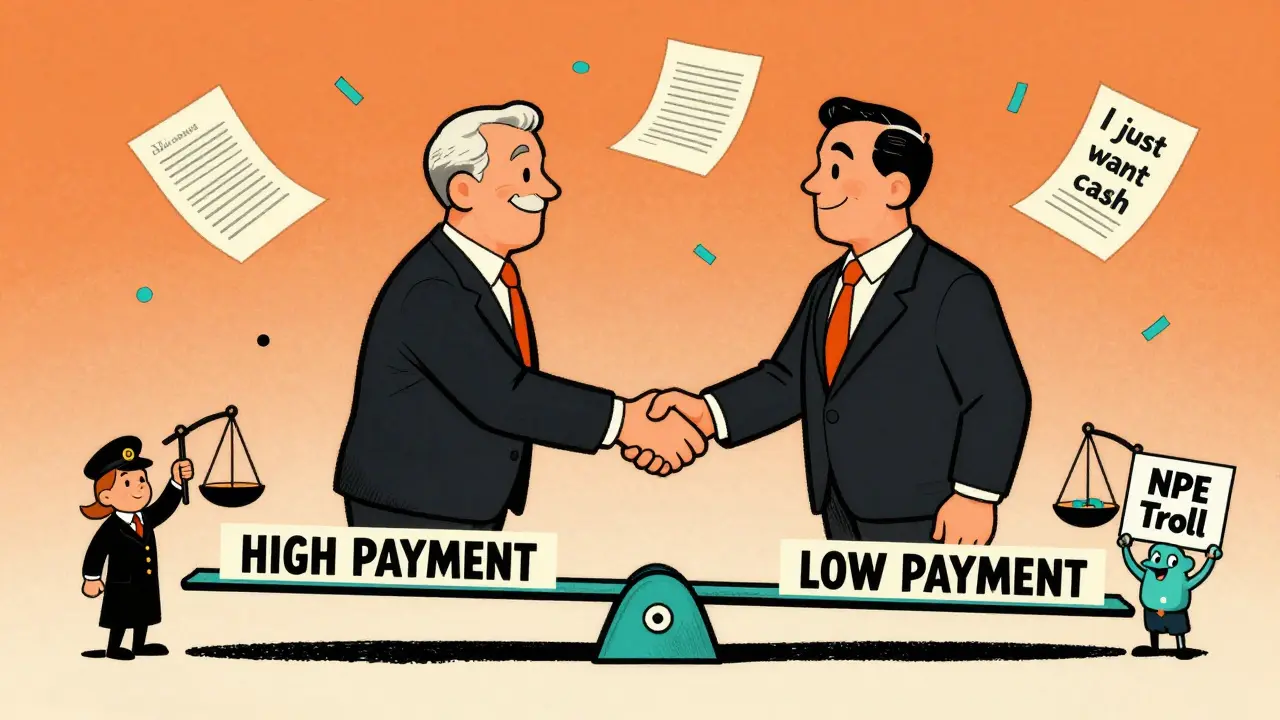
Both sides agree on two numbers: a high payment (if they win on key legal points) and a low payment (if they lose). Then they pick 2 to 5 critical legal issues-like whether a patent claim is valid or whether infringement is proven. The outcome of those issues decides the payout.
Why does this work? Because it removes the all-or-nothing pressure of trial. Even if one side loses on one claim, they still get something. It turns a courtroom battle into a structured negotiation. Studies show this method succeeds in 78% of cases-especially when both parties are real competitors with shared interests.
But it fails badly with Non-Practicing Entities (NPEs)-companies that don’t make products, just sue. These “patent trolls” want quick cash, not collaboration. The high-low model doesn’t work for them. They’d rather drag out a case for a nuisance settlement.
Why Some Deals Fail-and How to Avoid It
Not every negotiation works. The biggest reason? Anchoring.
That’s when the first offer sets the tone. If a company demands $50 million, even if it’s unreasonable, the other side starts negotiating from that number. A 2022 University of Chicago study found plaintiffs who ask for 3x their target end up getting 28% more than those who start reasonable. It’s psychological manipulation.
Smart negotiators prepare by doing “patent portfolio stress tests.” They imagine every possible attack: What if a key patent is invalidated? What if a prior art reference surfaces? What if a judge rules against claim interpretation?
Another pitfall? Ignoring business impact. A patent case isn’t just about money. It’s about delays. Lost partnerships. Damaged reputation. One semiconductor company settled a $10 million dispute because the lawsuit was blocking a joint R&D project worth $200 million. The settlement wasn’t about the patent-it was about getting back to innovation.
Real-World Examples That Changed the Game
Ericsson and Samsung’s 2021 settlement is textbook. After 8 months of talks, they signed a 6-year deal. Ericsson got $650 million upfront, plus tiered royalties from 0.5% to 2.5% based on device price. No court. No appeal. Just a clean, long-term agreement.
Intel’s 2018 deal with MEDIATEK is even more interesting. Instead of just paying royalties, they agreed to co-develop 5G tech. The settlement didn’t just end a dispute-it created a new product line. That’s the gold standard: turning a legal fight into a partnership.
And then there’s the European angle. Since the Unified Patent Court launched in June 2023, cross-border settlements in Europe jumped 22% in six months. Why? Because now a single ruling covers 17 countries. Companies don’t want to fight in 17 different courts. So they settle.
The New Tools Changing the Game
Technology is making settlements faster and smarter.
AI tools like PatentSight can now analyze a patent portfolio in 3 to 5 days instead of 3 weeks. That means companies can assess their strengths and weaknesses before negotiations even begin.
The USPTO’s Patent Evaluation Express (PEX) program lets parties get a non-binding validity opinion for 60% less than a full post-grant review. Already, 17% of new settlements use PEX to de-risk negotiations.
And in the future? Blockchain smart contracts. IBM and Microsoft are testing systems that automatically adjust royalty payments based on real-time sales data. Imagine a deal where payments update every time a product sells-no more audits, no more disputes. It’s not science fiction. It’s coming.
What Happens If You Don’t Settle?
Some companies think they can win. They go to trial. And they lose.
Take a mid-sized medical device maker that sued a competitor over a sensor patent. They spent $4 million on legal fees. At trial, the judge invalidated the patent. The company went bankrupt.
Or look at Qualcomm. The European Commission fined them €242 million in 2018 for using settlement terms that blocked competitors from entering the market. That’s not just a fine-it’s a warning. If you use patent settlements to stifle competition, regulators will step in.
Settlement isn’t weakness. It’s wisdom.
Who’s Winning? Big Companies vs. Small Players
Big companies settle 89% of their patent disputes before trial. Why? They have resources: legal teams, in-house experts, patent analysts. They can afford to do deep portfolio analysis.
Small entities? Only 63% settle. They often lack the capital to run a full validity analysis. They’re forced into risky positions. That’s why many startups now work with firms like IPwe or IPVALUE-specialized brokers who help value patents and structure deals.
Even so, size doesn’t guarantee victory. A small biotech company once defeated a pharma giant by proving a key patent was based on publicly available research. The lesson? It’s not about who has the most patents. It’s about who has the strongest evidence.
What’s Next for Patent Negotiations?
The future is complex. In AI and quantum computing, a single product can touch 500+ patents across dozens of countries. That’s 300% more complex than a smartphone from 10 years ago.
Companies are already building “patent mapping teams”-groups that track which patents cover which features in which markets. It’s like GPS for IP.
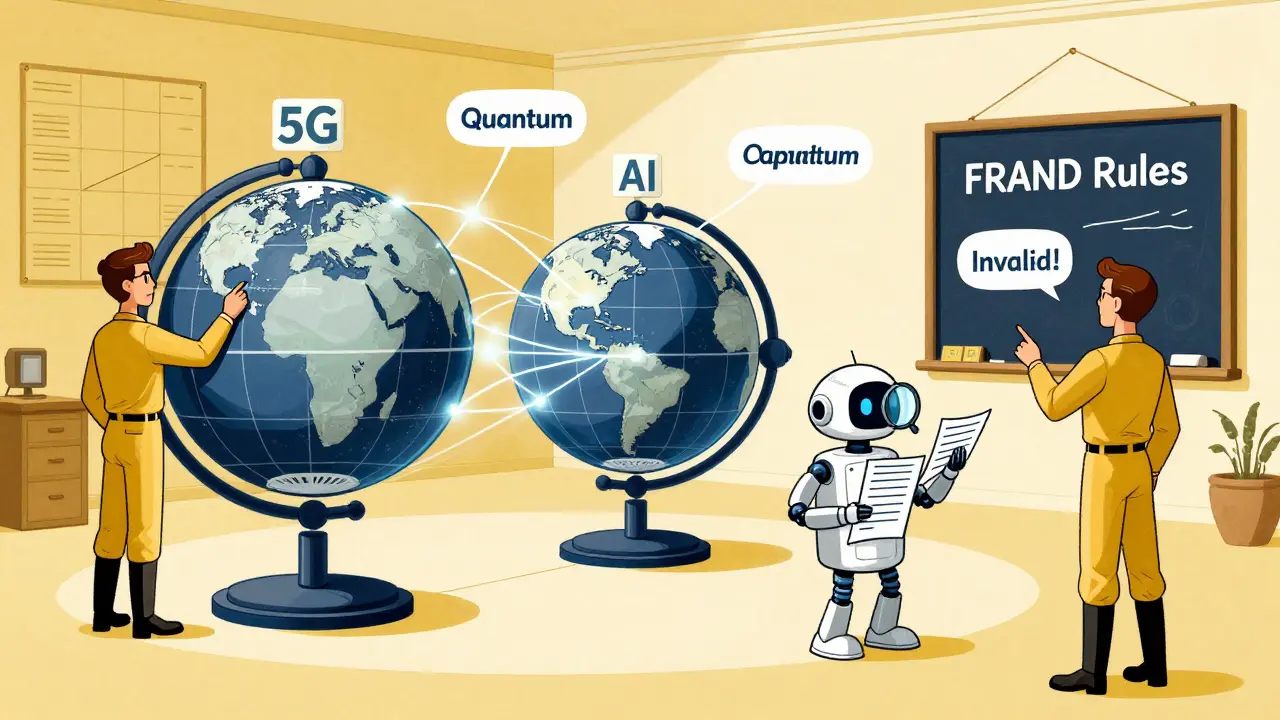
FRAND rules (fair, reasonable, non-discriminatory) for standard-essential patents will keep evolving. Regulators are watching. And as AI gets better at spotting prior art, weak patents will keep getting weeded out.
One thing won’t change: the need for skilled negotiators. It takes 3 to 5 years of experience to read the signals in a patent dispute. The best negotiators don’t just know the law. They know the business. They know the people. And they know when to walk away.
What percentage of patent disputes settle before trial?
Over 85% of patent disputes are settled before reaching trial, according to a 2022 Stanford Law School study of 10,000 cases between 2010 and 2020. This high rate reflects the cost and risk of litigation, making settlement the preferred path for most companies.
How much does a patent settlement typically cost?
Settlement values vary widely. For cases involving Non-Practicing Entities (NPEs), the median settlement is around $1.2 million. For disputes between direct competitors, it’s closer to $8.7 million. Costs also include legal fees ($3-5 million to go to trial) and expert analysis ($150,000-$300,000 for validity reviews).
What is a high-low settlement in patent disputes?
A high-low settlement sets two predetermined payment amounts: a high value if one side wins key legal issues, and a low value if they lose. It’s used to reduce the risk of all-or-nothing outcomes. This structure works best between competitors with mutual business interests and has a success rate of 78% in such cases.
Do cross-licensing agreements really work?
Yes. In industries like semiconductors and telecommunications, 73% of patent disputes are resolved through cross-licensing. Instead of paying cash, companies exchange rights to each other’s patents. This avoids litigation and often leads to joint innovation-like Intel and MEDIATEK co-developing 5G tech after their settlement.
Can AI help with patent settlements?
Absolutely. Tools like PatentSight’s AI analyzer cut portfolio review time from weeks to days. AI helps identify weak patents and prior art faster, giving negotiators better leverage. However, AI still misses about 18.7% of relevant prior art, so human experts remain essential.
What’s the biggest mistake companies make in patent negotiations?
The biggest mistake is starting with an unreasonable offer-known as anchoring. A 2022 study found plaintiffs who demand 3x their target end up getting 28% more than those who start reasonably. But the real error is failing to assess your own patent weaknesses. If you don’t know which patents are vulnerable, you’re negotiating blind.


Comments
Patent settlements? More like corporate chess. You don't win by checkmating-you win by making the other guy think they have a move left.
85% settle? Yeah. Because the real game isn't in court. It's in the boardroom.
And nobody talks about how the lawyers bill $1,200/hour to make that happen.
85% settle because the system is rigged. Courts are for the rich. The rest of us get handed a settlement offer with a side of silence.
Who really owns innovation? The patent trolls? Or the ones who actually build things?
bro this is wild 🤯 i had no idea patent stuff was this dramatic like its basically the financial thriller of tech 😭💸
The premise that settlement is 'wisdom' is fundamentally flawed. The data presented omits the systemic asymmetry: corporations with deep pockets can afford to litigate, while smaller entities are coerced into settlements under threat of existential legal costs. The 85% settlement rate is not evidence of rationality-it is evidence of economic coercion. Furthermore, the high-low model, while elegant in theory, is only viable when both parties possess comparable leverage. In practice, this rarely occurs. The notion that cross-licensing fosters innovation is equally misleading: it often entrenches monopolistic behavior under the guise of collaboration. The real innovation lies in dismantling the patent system’s structural inequities, not in refining its mechanics.
I’ve seen this play out firsthand. One startup I worked with got hit with a patent claim from a giant. They didn’t have $5M to fight it. So they settled. Got a license. Two years later, they built a better product and moved on.
Settlement isn’t surrender. It’s strategy.
This entire piece reads like a corporate PR pamphlet. Settlements? That’s just legal extortion dressed up as diplomacy. The real winners? The law firms billing $1,000/hour. The losers? The innovators who can’t afford to play.
The evolution of patent negotiation reflects broader global shifts in innovation economics. In the United States, the emphasis on litigation avoidance is rooted in a culture of efficiency and risk mitigation. However, in regions like the European Union, where the Unified Patent Court now harmonizes enforcement across 17 jurisdictions, the calculus shifts. Settlement becomes not merely a cost-saving measure but a mechanism for regulatory alignment. Moreover, the integration of AI-driven analytics into pre-negotiation due diligence represents a paradigm shift-moving from intuition-based bargaining to data-driven strategy. This transition, however, requires not just technological investment but institutional adaptation. The future of IP negotiation will not be defined by who holds the strongest patents, but by who can most effectively synthesize legal, technical, and commercial intelligence into a coherent negotiation framework.
AI tools like PatentSight? Sure. But who owns the data they're trained on? Who’s auditing the algorithms? What if the 'prior art' they miss is buried in a Soviet-era technical journal no one translated? This whole system is built on trust in machines that were coded by people with vested interests. And we call this progress? 🤔
I can’t believe this didn’t mention Qualcomm’s €242M fine. That’s the whole damn story right there. Patent settlements aren’t about innovation-they’re about control. And when you use them to crush competitors? The system fights back. 💥