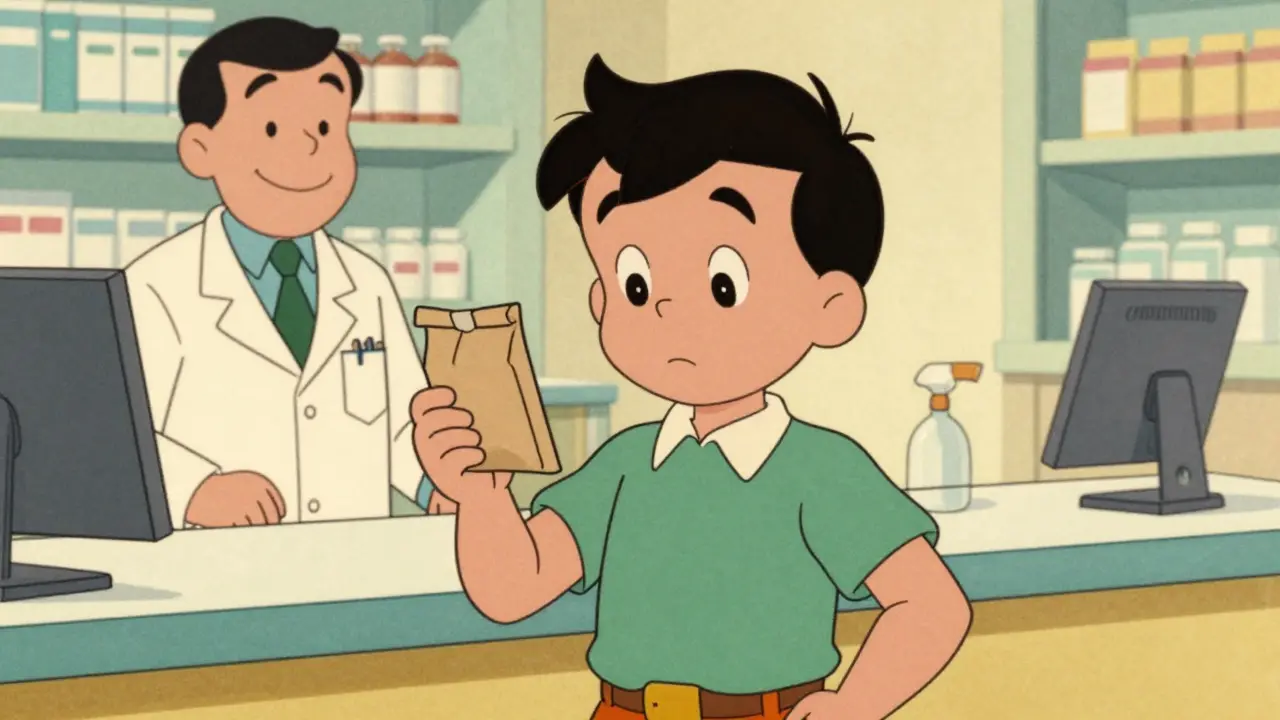
You've waited in line, paid for your prescriptions, and the pharmacist has handed you your bag. Most of us just walk out the door and head home. But did you know that roughly 1.5 million people in the US alone are affected by dispensing errors every year? According to the Institute for Safe Medication Practices, these mistakes don't just cause stress-they lead to billions in additional medical costs. The truth is, your eyes are the final safety checkpoint. Taking just 30 seconds to audit your bag before you leave the store can prevent 8 out of 10 errors from ever reaching your medicine cabinet.
The Seven-Point Safety Check
Don't just glance at the bag. To really protect yourself, you need a structured approach. A casual look often misses subtle mistakes, but a focused audit catches the vast majority of pharmacy slips. Here is exactly what you need to verify before you step away from the counter.
First, check the patient name. It sounds obvious, but the National Community Pharmacists Association found that nearly 13% of errors happen because of similar names. Ensure the label matches your legal name exactly. Next, verify the medication name. Look at both the brand and generic names. Look-alike/sound-alike drugs are a common culprit for errors, and confirming the name against your prescription is the only way to be sure.
Third, look at the dosage strength. Check the numbers and the units. Are you seeing 5 mg or 50 mg? A tiny decimal point or a missing zero can lead to a serious mistake, and strength errors account for about 32% of serious dispensing slips. Fourth, count your quantity. Does the pill count match what your doctor ordered? Roughly 8% of errors involve incorrect counts, which could leave you without meds before your next refill.
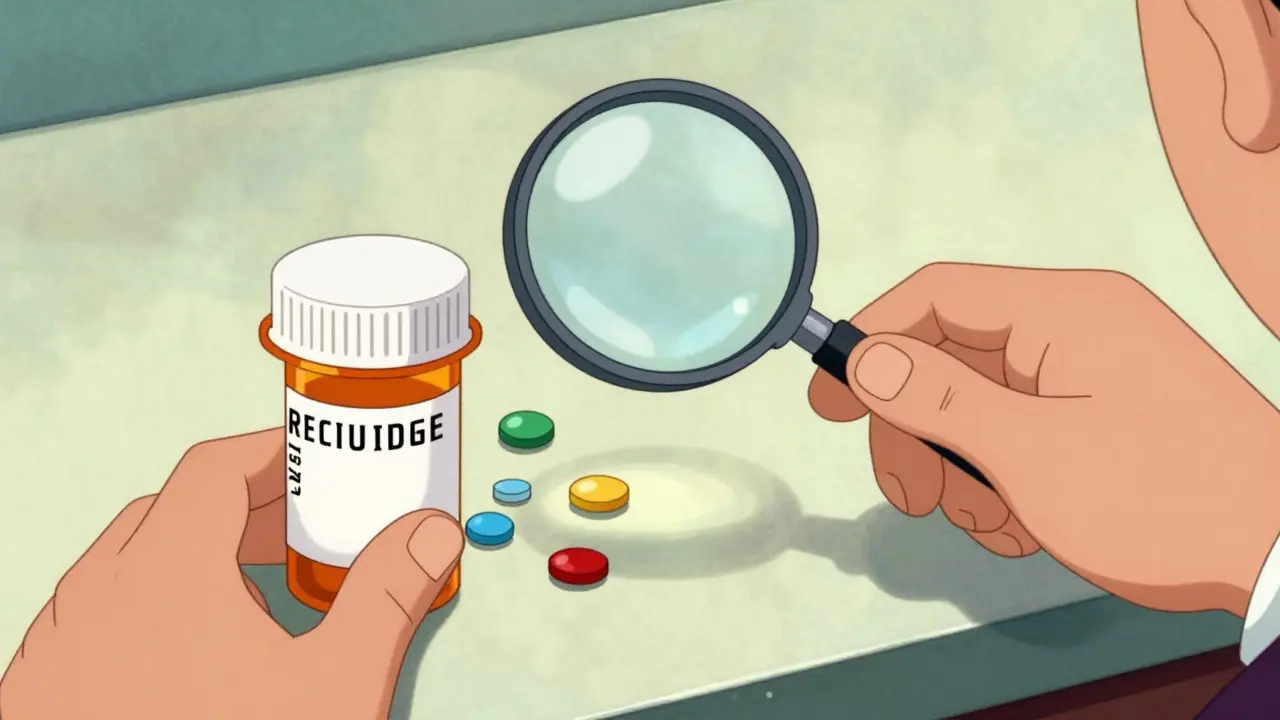
Fifth, scan the expiration date. For medications you take every day, you want the date to be at least six months in the future. This ensures the drug remains potent and effective. Sixth, check the appearance. If the pill is supposed to be a small white circle but you see a large yellow oval, stop immediately. You can compare the pill's color, shape, and markings to the official images in the Drugs@FDA database, which provides verified visual references for medications.
Finally, verify the instructions. Does the dosage schedule match what your doctor told you? About 14% of errors involve incorrect directions, such as taking a pill twice a day when it should be once a week.
| Verification Point | What to Look For | Common Risk |
|---|---|---|
| Patient Name | Exact legal match | Wrong patient (similar names) |
| Drug Name | Brand/Generic match | Look-alike/Sound-alike drugs |
| Dosage Strength | Correct numerical value & units | 10-fold dosing errors |
| Quantity | Correct pill count | Short-filled prescriptions |
| Expiration | 6+ months remaining | Degraded medication potency |
| Appearance | Color, shape, markings | Wrong medication in bottle |
| Instructions | Correct schedule/frequency | Incorrect usage directions |
Comparing Verification Methods
Depending on your tech-savviness and the number of meds you take, different methods work better. The seven-point audit is the gold standard for most people because it's fast and requires no equipment. Research from the University of California San Francisco shows it outperforms a casual check by 83%.
If you prefer technology, tools like MedSafe a mobile application that allows patients to scan medication barcodes to verify National Drug Codes are becoming popular. These apps can be incredibly accurate, but they aren't for everyone. For example, a large portion of seniors struggle with the interface, making the manual check more reliable for them. Then there is the "Brown Bag Review," where you bring every single med you own back to the pharmacy. While this is great for a deep clean of your medication list, it's not practical when you're just trying to pick up a quick prescription.
For those managing complex health issues-like taking 10 or more different medications-a simple audit might not be enough. In these cases, programs like MedsCheck a comprehensive pharmacist-led medication review program developed by the Canadian Pharmacists Association are much more effective, offering up to 92% accuracy through professional oversight.
Overcoming Common Barriers
Let's be honest: pharmacy labels are often printed in tiny, hard-to-read fonts. If you have vision issues, like macular degeneration, auditing can feel impossible. Many pharmacies, including several Walgreens locations, now provide magnifying cards to help patients see the fine print. If you struggle with the jargon, remember that "mg" stands for milligrams. If the label says something you don't understand, don't guess-ask the pharmacist to explain it in plain English.
Another hurdle is the feeling of being rushed. You don't want to hold up the line, so you spend 10 seconds glancing at the bottle. But a study in Patient Education and Counseling found that checks lasting under 15 seconds only catch 22% of errors. When you take 30 seconds or more, that detection rate jumps to 87%. It is better to be the person slowing down the line for a moment than the person taking the wrong dose of a high-risk drug like warfarin.

The Power of Shared Verification
The best way to ensure safety is to turn this into a team effort. Instead of auditing in silence, engage the pharmacy staff. This is called "shared verification." When the pharmacist prompts you to check the dose and name together, errors drop by 73%. It shifts the process from a lonely chore to a professional safety check.
Some pharmacies are already integrating this into their workflow. In California, law actually requires pharmacists to verbally prompt patients to verify their medications. If your pharmacist doesn't do this, you can initiate it. Simply ask, "Can we double-check the strength and instructions together real quick?" Most pharmacists welcome this because it protects them from malpractice claims just as much as it protects you from a medical error.
What should I do if the medication looks different than my last refill?
Do not leave the pharmacy. Ask the pharmacist why the appearance has changed. It could be a generic switch (different manufacturer), or it could be a dispensing error. Verify the pill against the Drugs@FDA database or a physical reference guide before accepting it.
How long should a proper medication audit take?
You should spend at least 30 seconds per medication. Rapid checks (under 15 seconds) are significantly less effective at catching errors, detecting only about 22% of mistakes compared to 87% when taking more time.
Is it possible for the label to be correct but the drug to be wrong?
Yes. This is why the "Appearance Verification" step is critical. A label can be printed perfectly, but the wrong pill could have been put in the bottle. Always compare the physical pill (color, shape, imprint) to what you expect or to an official image.
What if I have trouble reading the small print on the label?
Ask the pharmacist for a magnifying card or request a large-print label. You can also use your smartphone camera to zoom in on the text, or ask the pharmacist to read the key details (name, dose, frequency) aloud while you follow along.
Are there apps that can help me verify my medications?
Yes, tools like the FDA MedCheck app and MedSafe allow users to verify medication details and barcodes. However, these should supplement, not replace, your own visual and cognitive check of the medication and label.
Next Steps for Your Safety
If you are picking up a new medication for the first time, be extra vigilant. New drugs are where the highest risk of confusion occurs. Consider downloading the FDA MedCheck app before you head to the pharmacy so you have a digital reference ready. If you are caring for a senior or someone with cognitive challenges, perform the audit for them and keep a written log of the verified strengths and colors for future refills.
For those with complex regimens, schedule a comprehensive review with your pharmacist once a year. This goes beyond a simple bag audit and looks at how all your medications interact. By combining a quick seven-point check at the counter with a yearly professional review, you build a robust safety net around your health.



Comments
It is imperative to emphasize that verifying the imprint on the pill is perhaps the most critical step of all. Many generic substitutes look identical in color but vary in shape or markings. If you are uncertain, please do not hesitate to request a consultation with the pharmacist to ensure the medication is appropriate for your specific condition.
Funny how they tell you to double check everything because they can't be trusted. Why is the system designed to fail us in the first place? Probably just another way to push us toward those "approved" apps that track every single thing we put in our bodies. Total control.
The notion that a simple seven-point check is a "gold standard" is quaint, to say the least. While it may suffice for the layperson, those of us with a more rigorous understanding of pharmacology recognize that the systemic failure of pharmacy workflows is a structural issue, not a patient-checking issue. One would think the burden of accuracy would lie with the licensed professional rather than the consumer, though I suppose that is far too optimistic for the current state of healthcare.
I totally get how nerve-wracking it is to feel like you're holding up a line. I've been there, and it's honestly just stressful. It's really helpful to remember that our health comes first regardless of who is waiting behind us.
It is truly disheartening... simply tragic... that some people lack the basic discipline to check their own medication!!! One would think that health would be a priority, but apparently, a few seconds of effort is too much for the average person... how utterly pathetic!!!
Keep pushing for your safety everyone! You've got this! Just take a deep breath and take those 30 seconds for yourself. Your health is worth every single second of that wait!
just check the bottle and go
the whole idea of "safety checkpoints" is just a laungage game to make us feel in control of a random universe. why do we even care about a 6 month exp date when the entrophy of the cosmos is basically making us obsolete every second anyway... it's all just a big joke and the pharmacy is the punchline
This is such an empowering guide! Please stay safe! We can all do this!
listen up if you think the pharmacist is doing it for you they arent do it yourself or you will pay the price later dont be lazy about your life
too much reading for a bag of pills