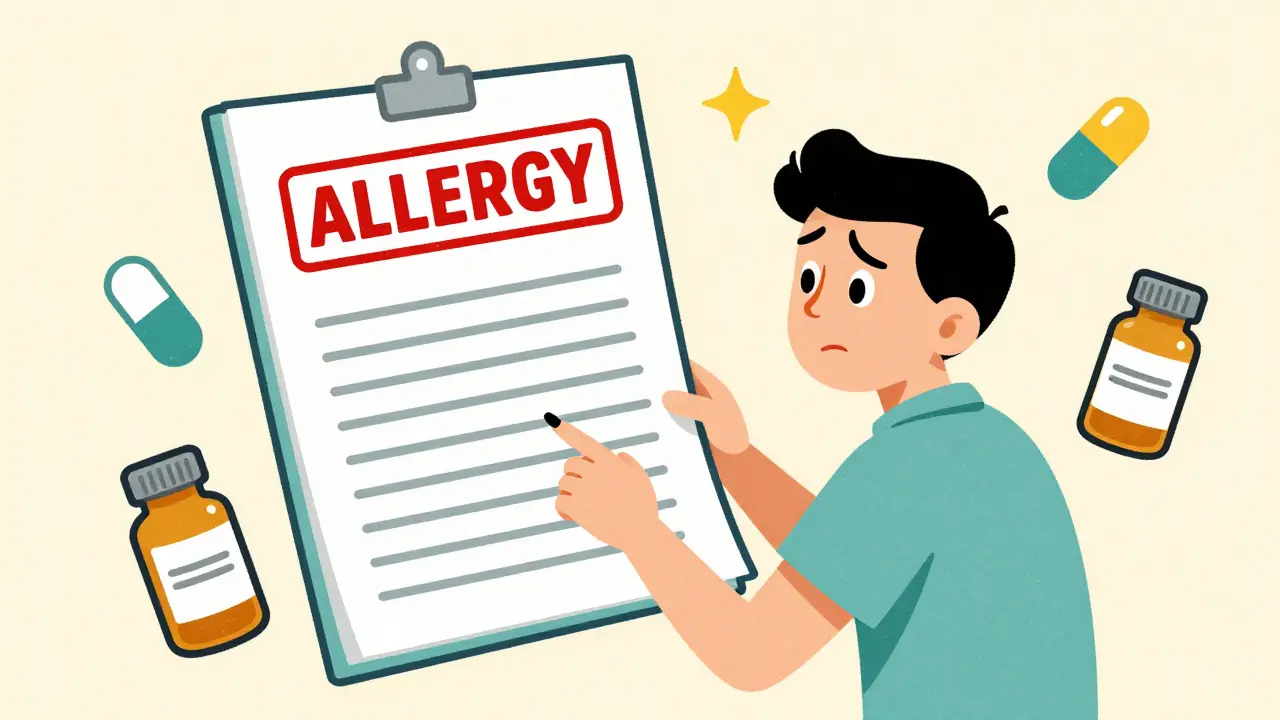
Imagine being told you're allergic to a common medication like penicillin, only to find out years later that you might not be. For many, a "drug allergy" label on a medical chart is based on a guess or a single bad experience, which can lead to using stronger, more expensive, or less effective alternatives. Drug allergy skin testing is a diagnostic procedure used to identify specific substances that trigger an allergic response by observing localized skin reactions. It is often the only way to move from a "suspected" allergy to a confirmed fact, potentially opening up better treatment options for you.
Quick Summary: What You Need to Know
- Purpose: Safely identifies if you are actually allergic to a specific drug without giving you a full dose.
- Common Methods: Skin Prick Tests (SPT), Intradermal Tests (IDT), and Patch Tests.
- Key Prep: You must stop taking antihistamines for 5-7 days before the test.
- Accuracy: Very high for certain drugs (like penicillin) but varies by medication class.
- Safety: Performed by specialists who can manage rare systemic reactions.
Why Skin Testing is the Gold Standard
When you tell a doctor you had a rash after taking a pill, they can't always tell if it was a true allergy (an immune system overreaction) or a side effect. Simply avoiding the drug forever is the safest bet, but it isn't always the best. This is where Allergy Diagnostics come in. Specialists consider skin testing the gold standard because it allows them to expose your immune system to a tiny, controlled amount of the drug on the surface of your skin rather than throughout your entire body.
For example, about 10% of people in the U.S. report a penicillin allergy, yet research shows that roughly 90% of those people can actually tolerate the drug. By "delabeling" these patients through testing, hospitals have seen a significant drop in the use of broad-spectrum antibiotics, which helps fight antibiotic resistance and reduces infections like C. difficile.
The Three Main Types of Skin Tests
Depending on your history and the drug in question, your allergist will choose one or a combination of these methods. Most people start with the least invasive option first.
The Skin Prick Test (SPT)
Skin Prick Test is a method where a tiny drop of the drug allergen is placed on the skin and lightly pricked into the upper layer of the epidermis. Think of this as the "screening" phase. It's the safest and easiest test. The doctor will place a few drops on your forearm or back and use a small lancet to break the skin slightly. You'll wait about 15 to 20 minutes. If you're allergic, you'll see a "wheal"-a raised, itchy bump similar to a mosquito bite.
The Intradermal Test (IDT)
If the prick test is negative but the doctor still suspects an allergy, they move to the Intradermal Test, which is a procedure where a small amount of allergen (usually 0.02-0.05 ml) is injected just beneath the skin's surface. This is more sensitive than a prick test, meaning it's better at catching subtle allergies. It involves a tiny needle that creates a small bleb of fluid. You'll likely feel a stinging sensation for a few minutes. A positive result is typically defined as a bump that increases in diameter by 3mm or more after 20 minutes.
The Patch Test
Not all drug reactions happen instantly. Some take days to appear. For these "delayed" reactions, a Patch Test is used. A small amount of the drug is placed in a chamber and taped to your back for 48 hours. This is used for drug-induced rashes that develop slowly, rather than immediate reactions like hives or swelling.
| Method | How it's Done | Best For... | Sensitivity | Wait Time |
|---|---|---|---|---|
| Skin Prick (SPT) | Surface drop + prick | Initial screening | Moderate | 15-20 Mins |
| Intradermal (IDT) | Under-skin injection | Confirming suspected allergy | High | 20 Mins |
| Patch Test | Adhesive patch | Delayed reactions/rashes | Varies | 48-72 Hours |
How to Prepare and What to Expect
You can't just walk in off the street and get tested. The most critical part of your preparation is your medication list. Specifically, Antihistamines (like Claritin, Zyrtec, or Benadryl) must be stopped for 5 to 7 days before your appointment. Why? Because these drugs block the very reaction the doctor is looking for. If you take them, you might get a "false negative," meaning the test says you're fine when you're actually allergic.
During the appointment, the doctor will use two "controls" to make sure the test is working:
- Positive Control (Histamine): This is meant to cause a bump. It proves your skin is capable of reacting. If this doesn't bump up, the test results are unreliable.
- Negative Control (Saline): This is just salt water. It should not cause a reaction. If it does, you might just have very sensitive skin, which can make interpreting other results tricky.
The whole process usually takes about 45 to 60 minutes. While it can be itchy or slightly uncomfortable, the substance stays in the top layer of your skin and doesn't enter your bloodstream in large amounts. This means the risk of a full-body reaction is very low.
Understanding Your Results
A positive result is usually straightforward: you have the antibodies for that drug, and you should likely avoid it. However, a negative result can be a bit more complicated depending on the drug class.
For Beta-lactam antibiotics (like penicillin and amoxicillin), a negative result on both SPT and IDT is very reliable. There is a high "negative predictive value," meaning if the tests are negative, you are almost certainly not allergic. For other drugs, like NSAIDs or certain non-beta-lactam antibiotics, the tests are less sensitive. In those cases, your doctor might suggest a "drug challenge"-where you take a tiny dose of the medication under strict medical supervision-to be absolutely sure.
Will the test make me have a full allergic reaction?
While extremely rare, it is possible. This is why these tests are only performed by trained allergists who have emergency equipment (like epinephrine) on hand. Because the drug is applied to the skin rather than ingested or injected into a vein, the risk is significantly lower than taking the medication normally.
What if I have asthma? Can I still be tested?
If you have severe, uncontrolled asthma, your doctor may delay skin testing. This is because an allergic reaction during a test can trigger a severe asthma attack, making the procedure riskier. Your asthma needs to be stable before proceeding.
How long do I have to wait for the final results?
For prick and intradermal tests, you'll have your answers within an hour. For patch tests, you'll need to return to the clinic after 48 to 72 hours so the doctor can remove the patches and read the skin's reaction.
Does a negative skin test mean I'm 100% safe?
Not always. While highly accurate for penicillin, some drugs don't trigger skin reactions even if you are allergic. This is why doctors look at your clinical history and may use a supervised drug challenge to confirm a negative skin test.
Can I use a topical steroid cream before the test?
Generally, no. Just like antihistamines, topical steroids can suppress the skin's inflammatory response and lead to a false-negative result. Be sure to tell your doctor about any creams or ointments you're using on your arms or back.
Next Steps and Troubleshooting
If you suspect you have a drug allergy, your first step is to request a referral to an allergist or immunologist. When you book the appointment, ask specifically about the "pre-test medication protocol" so you don't accidentally take a pill that ruins the test results.
If you've already had a test and are confused by the results, ask your doctor for the "negative predictive value" of that specific drug test. This helps you understand if a negative result is a "definite no" or just a "probably no." If the tests were inconclusive, discuss whether a supervised oral challenge is a safe next step for you.



Comments
this is such a great reminder to take charge of our health everyone you got this!! its so empowering to know we can actually double check those old labels and maybe get better meds omg so exciting 🌟
Typical oversimplification 🙄 Most people don't even realize that 'gold standard' is just a buzzword for 'this is what the insurance companies will actually pay for.' Also, calling it a 'screening phase' is a bit reductive when you're dealing with potential anaphylaxis. Honestly, the lack of nuance here is just staggering 🤡🤡🤡
makes a lot of sense. glad i can check this
Sure, they call it 'safe' because they're injecting you with chemicals in a controlled environment, but who's to say the 'controls' aren't just there to mask what's actually happening? I bet the pharma companies love it when we 'delabel' ourselves so they can push more of these broad-spectrum drugs into our systems under the guise of 'fighting resistance.' It's all a giant loop to keep us dependent on the clinic and their epinephrine pens. Wake up, people, they aren't telling you about the long-term systemic effects of these 'tiny' doses of allergens that just sit in your dermis for god knows how long before they migrate. I've seen the forums, and the stories about these tests triggering lifelong sensitivities are being scrubbed from the mainstream medical sites. Don't trust the white coat just because they have a fancy table of methods!
Actually, it's super interesting that it takes 5-7 days for antihistamines to clear out! 🌸 I always tell my friends that the pharmacokinetics of these drugs can be really tricky, and if you just skip one dose, you're totally risking a false negative. It's all about that histamine response being completely uninhibited for the prick test to actually show the wheal! ✨💖
Listen here, the US medical system is the only place in the world where this is done with actual precision and grit. These other countries just guess, but we've got the best damn specialists in the business. If you're too chicken to get a needle in your arm for a bit of clarity, that's on you. Absolute nonsense to be scared of a tiny bleb of fluid when the alternative is taking some third-rate drug from a generic lab. Get it done or stop complaining about your rash! :-)
I find it absolutely laughable that anyone would believe a 20-minute wait for a 'wheal' is sufficient diagnostic evidence for a lifelong medical condition, especially when the subjective nature of 'itchiness' is being used as a primary indicator of a systemic immune response. My own experience with a similar procedure was an absolute nightmare of incompetence, where the practitioner barely glanced at my arm before declaring me 'clear,' only for me to develop a full-blown dermatitis flare-up three days later that practically required an exorcism to resolve. It is truly the height of arrogance to suggest that a simple skin prick can capture the complexity of a human's unique biochemical makeup, and quite frankly, the medical community's obsession with these rapid tests is just a way to churn through patients like cattle in a slaughterhouse of convenience.
It's important to remember that every patient's history is different. While the guide is helpful, please make sure you have a direct conversation with your specific doctor about your risks before proceeding.
I had a similar scare with penicillin as a kid and finally got tested last year. It's a huge relief to know I can actually use the medication if I ever really need it. Definitely worth the effort!