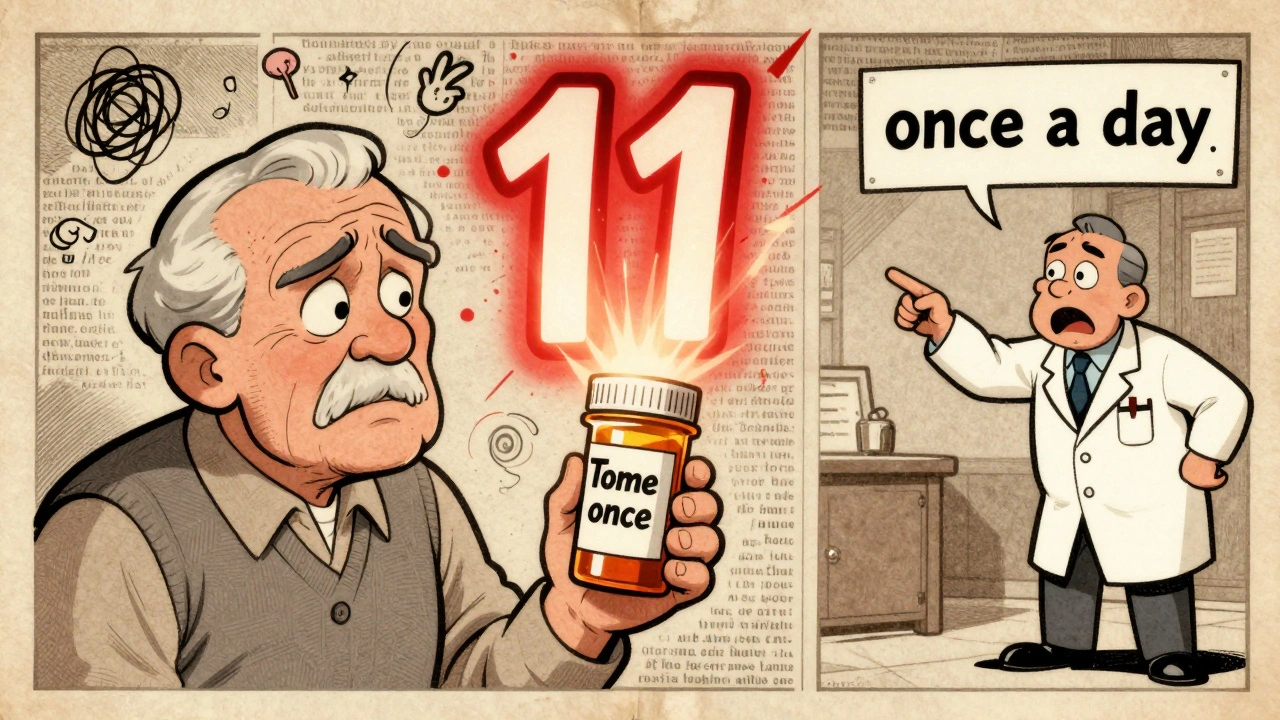
Imagine taking your medicine because the label says "take once a day"-but it actually meant "take eleven times a day". That’s not a typo. That’s what happens when a computer translates "once" from English to Spanish as "once," which means eleven. And it’s happening more often than you think.
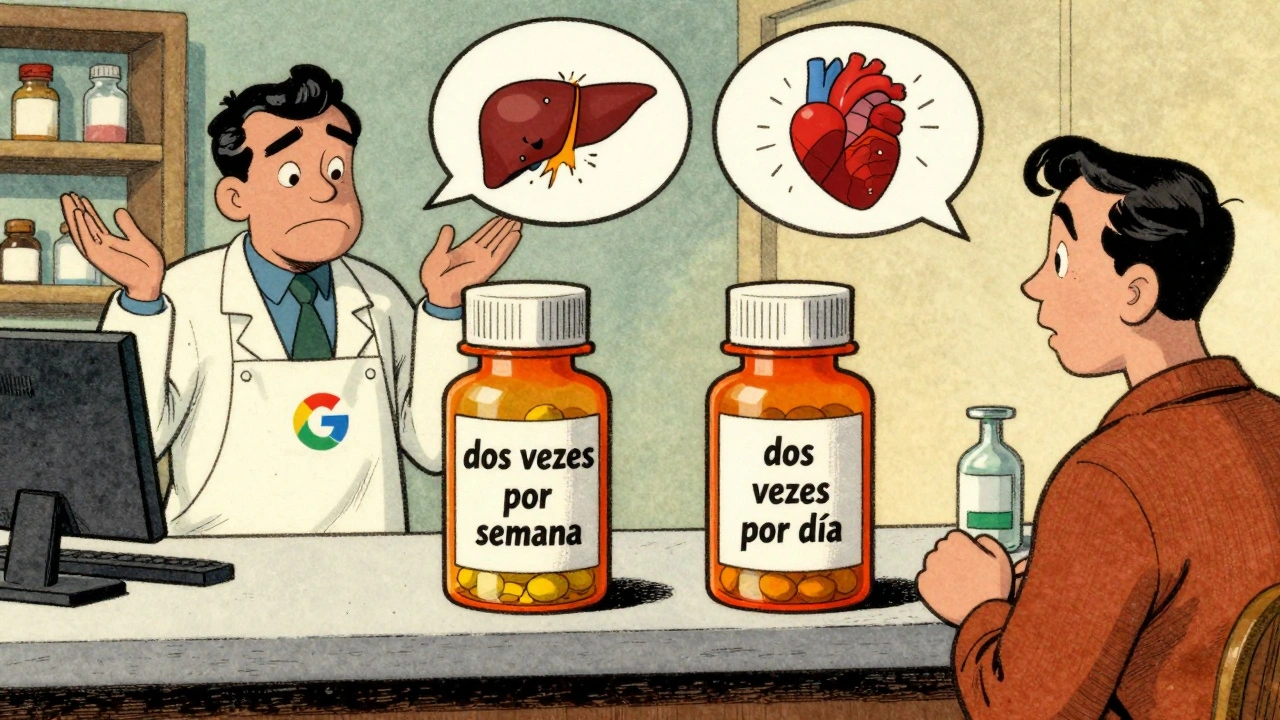
For millions of Americans who don’t speak English well, prescription labels are a minefield. A 2010 study in the Bronx found that 86% of pharmacies used automated translation systems-mostly free, low-quality tools-to generate Spanish labels. Half of those labels had dangerous mistakes. Some told patients to take pills twice a week instead of twice a day. Others confused "alcohol" (rubbing alcohol) with "alcohol" (drinking alcohol). One patient nearly overdosed because the label said "take eleven times a day" instead of "once a day."
Why Computer Translations Fail on Prescription Labels
Most pharmacies use cheap, off-the-shelf translation software that doesn’t understand medical terms. These tools treat every word like a dictionary entry, ignoring context. "Take one tablet by mouth twice daily" becomes "Tome una pastilla por boca dos veces diario"-which sounds right, until you realize the pharmacy down the street translated the same phrase as "Tome una pastilla por boca dos veces por semana." Same drug. Same pharmacy chain. Different instructions.
False cognates are the biggest problem. Words that look familiar but mean something totally different:
- "Once" in English = one time. "Once" in Spanish = eleven.
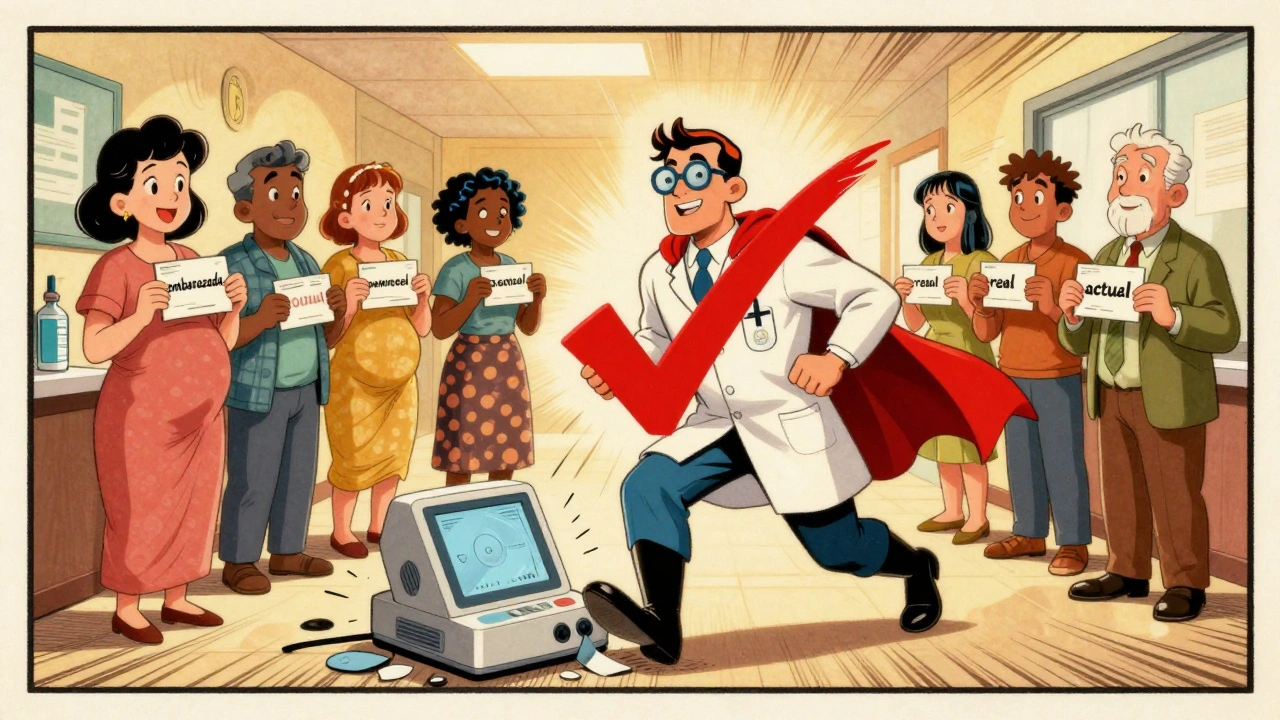
- "Embarazada" in Spanish = pregnant. Not "embarrassed."
- "Actual" in Spanish = current. Not "real" or "factual."
These aren’t just grammar errors. They’re life-or-death mistakes. A 2017 NIH study found that 40% of critical dosage instructions were mistranslated by automated systems. Even small errors-like confusing "every 8 hours" with "every 12 hours"-can cause toxicity or make the medicine useless.
Language Isn’t One Thing-Dialects Matter
Spanish isn’t the same everywhere. In Mexico, "jarabe" means syrup. In Spain, it can mean a type of cough medicine. In Latin America, "alcohol" means rubbing alcohol. In Spain, it means drinking alcohol. A label translated in California might be misleading in Florida if the patient is from Puerto Rico.
Same goes for Chinese. Simplified Chinese used in mainland China isn’t the same as Traditional Chinese used in Taiwan or Hong Kong. Vietnamese translations vary between dialects in the U.S. and Vietnam. Most pharmacy systems don’t account for this. They pick one version-usually the most common-and assume it works for everyone.
Who’s Responsible? And Who’s Getting Help?
Only two states-California and New York-require pharmacies to use professional translators for prescription labels. California passed SB 853 in 2016. Since then, medication errors among Spanish-speaking patients dropped by 32%. ER visits related to prescription mistakes fell by 27%.
But in the other 48 states? There’s no rule. Pharmacies can still use Google Translate. And they do. A 2022 survey found that only 23% of major pharmacies offer translation in Chinese, Vietnamese, or Arabic. Spanish? That’s available at 87% of locations. Everything else? You’re on your own.
Patients are paying the price. A 2023 survey by the National Health Law Program found that 63% of people with limited English proficiency didn’t understand their prescription labels. 28% admitted they took the wrong dose because of the translation.
What Works: Real Solutions That Save Lives
Professional human translators with medical training get it right 98-99% of the time. That’s not a guess. It’s from RxTran’s 2023 whitepaper. These aren’t just bilingual staff. They’re certified medical translators who know the difference between "tablet" and "capsule," and how to translate "take on an empty stomach" without making it sound like a diet plan.
Kaiser Permanente spent two years setting up a system that uses:
- Certified translators with 5+ years in pharmacy work
- Two-person verification: one translates, another checks
- Translation memory tools that store approved phrases
- Staff trained on Title VI of the Civil Rights Act
The cost? About $15,000 per pharmacy location. But for every dollar spent, they saved $3.80 in avoided hospital visits, according to McKinsey’s 2024 analysis.
Walgreens and CVS are now testing AI systems that combine machine translation with pharmacist review. Walgreens’ MedTranslate AI cut errors by 63% in pilot stores. CVS’s LanguageBridge does the same. These aren’t perfect-but they’re better than Google Translate.
What You Can Do Right Now
If you or someone you care about struggles with English and gets prescriptions:
- Ask for a live interpreter. By law, pharmacies must provide one if you ask-even if they don’t offer it upfront. Call ahead and say: "I need a certified medical interpreter for my prescription."
- Don’t trust the label alone. If you’re unsure, call the pharmacy and ask them to read it back to you in your language. Record it on your phone if you can.
- Bring someone who speaks English. A family member, friend, or community health worker can help verify instructions.
- Use free translation tools wisely. Try Google Translate or DeepL, but never rely on them alone. Copy the exact English text, paste it, then ask a bilingual person to confirm.
- Report bad translations. If a label is wrong, tell the pharmacist. File a complaint with your state’s pharmacy board. California’s Health Advocates forum has logged over 300 complaints since 2021-many led to policy changes.
Some pharmacies, like Walgreens in Miami, have certified translators on staff. They verify heart meds, diabetes drugs, and blood thinners before handing them out. That’s the standard everyone should have.
The Bigger Picture: This Is a Public Health Crisis
More than 25 million Americans have limited English proficiency. That’s 1 in 8 people. And prescription labels are one of the most dangerous places where language fails.
It’s not just about convenience. It’s about safety. A mistranslated dose can cause kidney failure, liver damage, or death. The FDA says patient labels must be clear and accurate. But right now, they’re not.
Progress is happening. The HHS launched a $25 million grant program in March 2024 to help pharmacies pay for better translation tools. Eighteen states are considering new laws in 2025. The market for medical translation is growing fast-projected to hit $500 million by 2030.
But until every pharmacy uses certified translators, patients are still at risk. You can’t wait for the system to fix itself. You have to demand better.
How to Spot a Dangerous Translation
Here are red flags to watch for:
- Words that look like English but mean something else (like "once" for eleven)
- Instructions that don’t match what your doctor said
- Phrases that sound awkward or mixed (like "take two tablet two times day")
- Different labels for the same drug at different pharmacies
- No translator’s name or certification listed on the label
If you see any of these, stop. Don’t take the medicine. Call the pharmacy. Ask for a human interpreter. Write it down. Your life might depend on it.
What should I do if my prescription label is in a language I don’t understand?
Don’t guess. Call the pharmacy and ask for a certified medical interpreter. By law, they must provide one at no cost. If they refuse, ask to speak to the manager or file a complaint with your state’s pharmacy board. You can also bring a trusted friend or community health worker to help you read the label.
Can I trust machine-translated labels from big pharmacies like CVS or Walgreens?
Not fully. Even big chains use automated systems that make dangerous mistakes. Some now use AI with pharmacist checks, which is better-but not perfect. Always verify instructions with a human. If the label says "take once a day" but you’re unsure, ask: "Can you read this to me in my language?"
Why don’t all pharmacies use professional translators?
Cost and outdated systems. Professional translation costs 5 to 15 times more than automated tools. Many pharmacies use old software that can’t integrate with new translation services. Some also don’t realize how dangerous errors can be. Only California and New York require it by law-other states don’t force them to change.
Are there free resources to help me understand my prescription?
Yes. Many community health centers offer free interpreter services. Nonprofits like the National Health Law Program and local immigrant aid groups can help you read labels and call pharmacies. You can also use apps like Google Translate or DeepL to double-check-but never rely on them alone. Always confirm with a person.
What’s being done to fix this problem?
The FDA is pushing for clearer, plain-language labels. The HHS is giving $25 million in grants to pharmacies to improve translation. Walgreens and CVS are testing AI tools that cut errors by over 60%. California’s program reduced medication errors by 32%. More states are considering laws like California’s. But change is slow-patients still need to speak up now.

Comments
So many people don’t realize how deadly simple translation errors can be. I’ve seen labels in my mom’s language that made zero sense-like ‘take once’ meaning eleven times. Scary stuff. Glad someone’s talking about this.
Also, why do we still let pharmacies use Google Translate? It’s 2025.
Let’s be real-this isn’t about translation. It’s about corporations saving $0.20 per label while risking lives. The FDA? The government? They’re all in on it. You think they don’t know? They do. And they don’t care until someone dies on national news.
Next they’ll translate ‘do not drive’ as ‘drive carefully’ in Portuguese. And we’ll all shrug and say ‘oh well.’
Wow. This is absolutely critical. I work in public health, and I can confirm: automated translation systems are a disaster in clinical settings. The false cognates alone-‘once’ for eleven, ‘embarazada’ for embarrassed-are terrifying.
Also, dialectal differences matter: ‘jarabe’ in Mexico vs. Spain? That’s not a minor nuance-it’s a medication error waiting to happen. And the fact that only two states mandate human translators? It’s a national scandal. Pharmacies should be legally required to use certified medical translators-period. No excuses.
Also, if you’re reading this and you’re a pharmacist: please, for the love of God, stop using machine translation. Your liability insurance won’t cover this kind of negligence.
Y’all, I just got back from picking up my grandma’s meds and the label said ‘take once’ but she’s from Guatemala and she thought it meant ‘once a week’ because her cousin said that’s what it meant in ‘the old country’ 😭
She almost skipped her insulin for three days. I called the pharmacy, they were like ‘oh we use auto-translate’ and I just lost it. We need real people reading these labels. Like, right now. Not AI. Not Google. PEOPLE.
Also-can we start a petition? I’ll make the graphics. 💪
The fact that this is even a conversation is ridiculous. We have the technology, the trained professionals, and the data to fix this. But we don’t have the political will. It’s not a technical problem-it’s a moral failure.
Every time a pharmacy uses a machine translator instead of a certified human, they’re choosing profit over safety. And that’s not just negligence-it’s malpractice.
California’s law works. Why aren’t we copying it? Why are we waiting for another death?
I’ve worked in community clinics for 12 years. I’ve seen patients cry because they didn’t understand their label. One woman thought ‘take two pills every 8 hours’ meant ‘take two pills, then wait eight hours’-so she took four pills total in a day instead of nine. She ended up in the ER.
Human translators aren’t a luxury. They’re a lifeline. And the fact that most pharmacies don’t even offer them unless you ask? That’s systemic neglect.
Also-ask for an interpreter. Don’t wait. Don’t assume. Say it loud. It’s your right. And if they say no, ask for the manager. Then file a complaint. You’re not being difficult-you’re being alive.
Just had this happen to my uncle-he’s from Honduras. Label said ‘take once’ but he thought it meant ‘once a week’ because in his village, that’s how they say it. He didn’t take his blood pressure med for two weeks. His BP hit 210/110.
He’s fine now but… yikes. I asked the pharmacist if they had a translator on staff. They said ‘we have an app.’ 😑
Can we just… stop? This is not okay. We’re not talking about ‘some typos’ here-we’re talking about people dying because of a $0.05 software license.
i had a friend who took her meds wrong cuz the label said ‘take eleven times’ and she thought it was a typo… she went to the er. they had to pump her stomach. she was so embarrassed. but like… why does this keep happening??
my mom’s from mexico and she still trusts the labels even when they sound weird. we need to fix this.
Thank you for writing this. I’ve been trying to tell people this for years. I’m from London but my mum’s from Jamaica-we used to get meds translated wrong all the time. Even the pharmacy staff didn’t realize how bad it was.
My favorite part? The Kaiser Permanente model. $15k per location? That’s less than one bad ER visit. Why isn’t this standard everywhere?
Also-call your state reps. Demand a law like California’s. This isn’t ‘minor.’ It’s a public health emergency. And we’re all just… scrolling past it. 😔