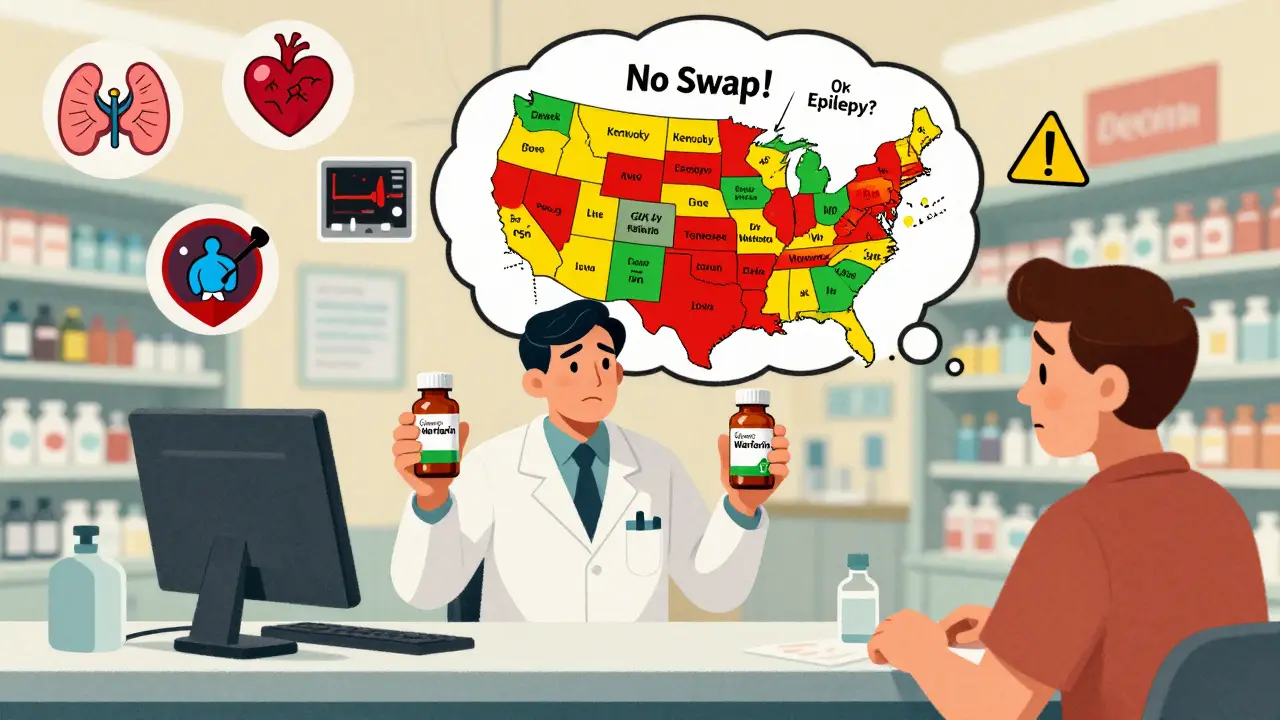
When you take a medication like warfarin, levothyroxine, or phenytoin, even a tiny change in dose can mean the difference between staying healthy and ending up in the hospital. These are called NTI drugs-narrow therapeutic index drugs. They don’t leave much room for error. A 5% shift in blood levels might cause a seizure, a blood clot, or a thyroid crash. That’s why pharmacists can’t just swap them out for generics like they do with most other pills. But here’s the problem: every state has different rules.
What Makes a Drug an NTI Drug?
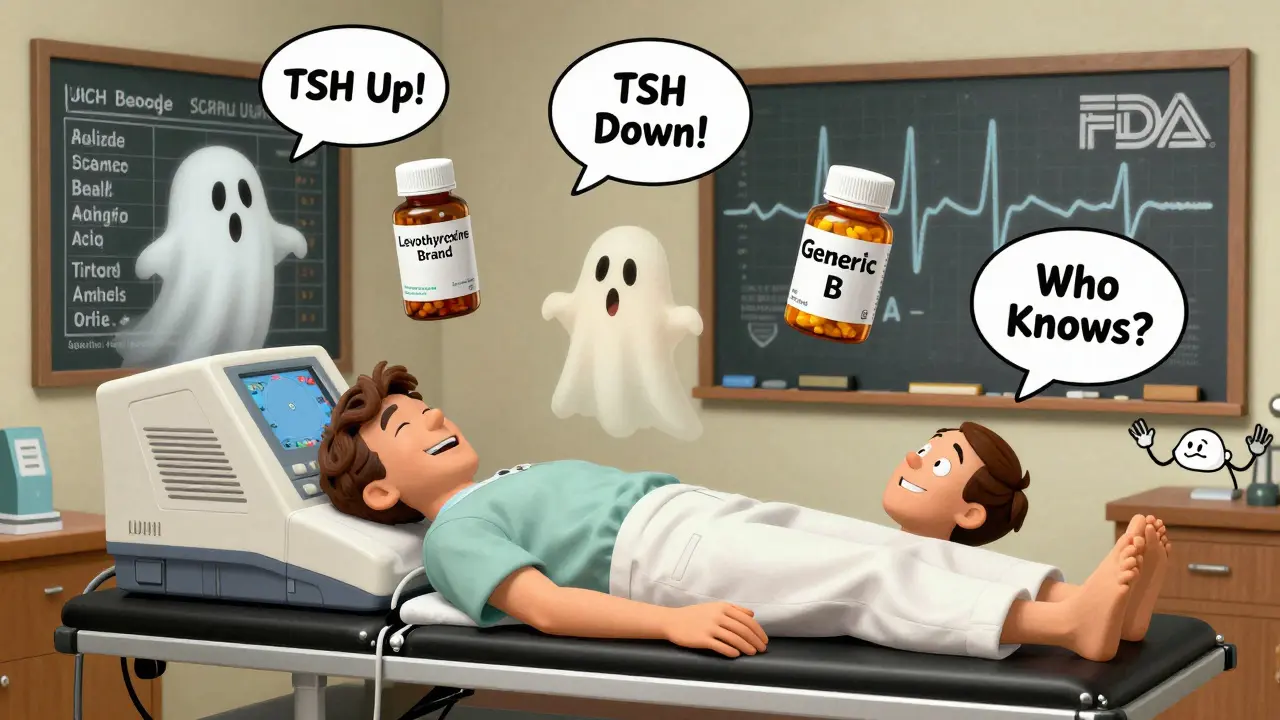
There’s no official federal list. The FDA doesn’t label drugs as NTI in its Orange Book, even though it’s the go-to resource for therapeutic equivalence. Instead, it uses an ‘A’ or ‘B’ rating system. An ‘A’ rating means the generic is considered bioequivalent to the brand. But bioequivalence is based on a 20% range in absorption. For most drugs, that’s fine. For NTI drugs, it’s not. A 20% variation in warfarin levels can turn a safe dose into a dangerous one. The same goes for levothyroxine. Studies show that over one-third of patients stabilized on brand-name levothyroxine had to adjust their dose after switching to a generic. Their TSH levels jumped or dropped, sometimes enough to require a doctor visit.
So how do states handle this? Some rely on clinical evidence. Others use their own lists. Kentucky, for example, has a formal list that includes digitalis glycosides, antiepileptic drugs, and warfarin tablets. Pennsylvania does the same. South Carolina goes further, warning against substitution for not just NTI drugs, but also insulin, cardiac glycosides, and time-release asthma meds. Tennessee allows substitution for most A-rated drugs-but blocks it completely for antiepileptics used in epilepsy patients. California defines ‘critical dose drugs’ as those where a 10% or less change in blood concentration can be life-threatening. Texas bans substitution for anticonvulsants in epilepsy patients unless the prescriber approves it.
Why the Patchwork of Rules?
The FDA’s position has been consistent since 1997: the current bioequivalence standards are enough for all drugs, including NTI ones. But state boards of pharmacy don’t agree. They see real-world harm. A 2022 study in the Journal of the American Pharmacists Association found that states with NTI substitution restrictions saw 18.7% fewer adverse events tied to warfarin. That sounds big-but it’s only a 0.3% drop in total events. Still, for the people affected, that 0.3% matters. A stroke, a bleed, a seizure-those aren’t statistics. They’re life-changing events.
Dr. John Jenkins, former head of the FDA’s drug evaluation office, says the system works. Dr. Jerry Avorn from Harvard says it’s a gamble. He points out that levothyroxine has a half-life of seven days. If you switch generics, your body doesn’t adjust overnight. The new version might absorb slightly slower. That tiny delay builds up. Over time, your thyroid hormone levels drift. You get tired. Your heart races. Your cholesterol climbs. And you might not even know why.
The American College of Clinical Pharmacy backed up Avorn’s concerns in 2023. Their review of 17 studies showed that 32.4% of patients on brand-name levothyroxine had clinically significant changes in thyroid function after switching to generics. That’s more than one in three. For patients with heart disease, pregnancy, or thyroid cancer, that’s not acceptable.
How Pharmacists Are Struggling
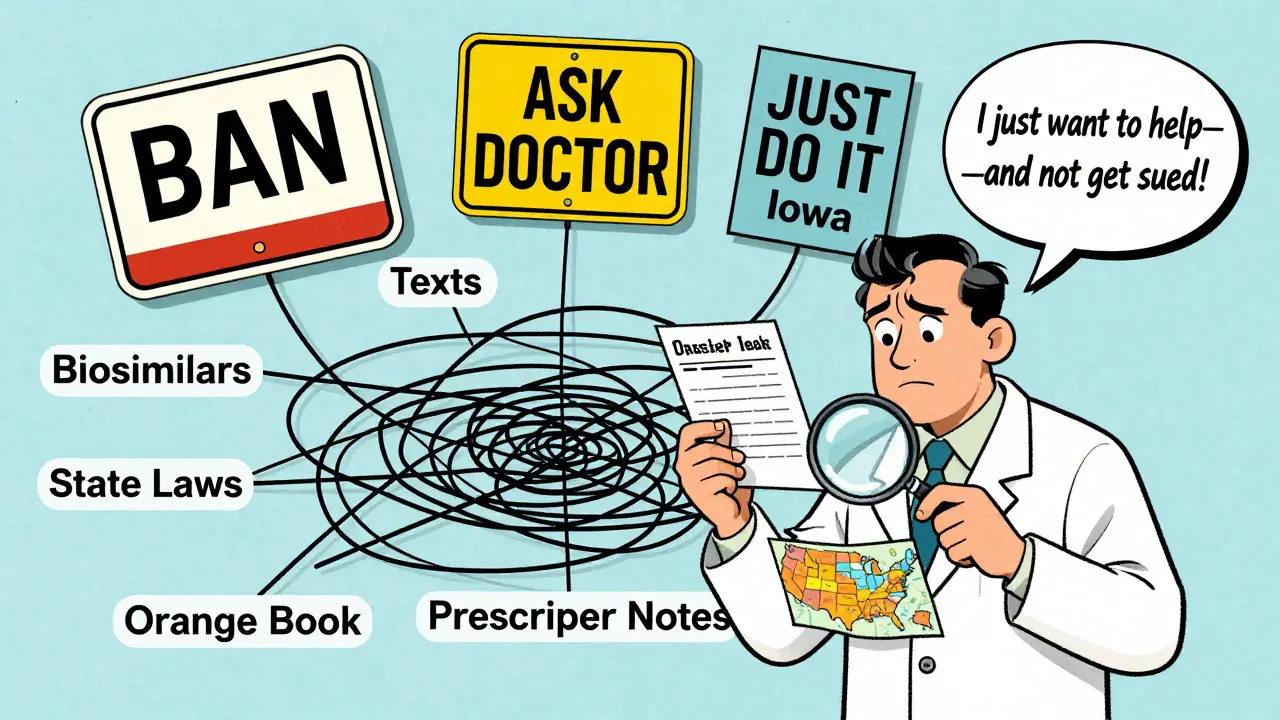
Imagine you work at a pharmacy chain that spans three states. In one, you’re required to substitute unless the doctor writes ‘do not substitute.’ In another, you’re forbidden from substituting any NTI drug. In the third, you’re told to use your judgment based on the Orange Book-but you’re not sure which drugs qualify. That’s not theoretical. A 2023 survey by the National Community Pharmacists Association found that 68.3% of pharmacists who work across state lines have been confused by the rules. Over 40% admitted they accidentally broke a substitution law in the past year.
One pharmacist in Tennessee described the chaos: ‘When I’m in Knoxville, I can’t substitute antiepileptics. But in Chattanooga-same state, same company-I have to check if the patient has epilepsy. If they do, no substitution. If they don’t, maybe it’s okay. But I’m not a neurologist. How am I supposed to know?’
And it’s getting worse. Now there are biosimilars too. Forty-eight states have rules for those. So pharmacists are juggling two sets of confusing rules for two types of complex drugs. A single prescription might involve a brand-name NTI drug, a generic version, and a biosimilar alternative-all with different substitution rules.
What’s Changing in 2025 and Beyond
Change is coming. In January 2024, the National Association of Boards of Pharmacy released the Model State NTI Substitution Act. It’s a standardized list based on clinical evidence-not guesswork. Twelve states have already introduced it as legislation. At the same time, the FDA announced in September 2024 that it’s reconsidering its stance. Pressure from the Senate Committee on Aging, backed by a Government Accountability Office report showing nearly 3,000 adverse events linked to NTI substitutions between 2019 and 2023, forced a reevaluation.
Meanwhile, pharmacy benefit managers are feeling the cost. Express Scripts reported a 5.7% increase in administrative costs because of NTI substitution rules. Each time a pharmacist has to call a doctor, check a state list, or fill out paperwork, it adds time, labor, and delay. But it’s also preventing errors. IQVIA predicts that by 2027, 38 states will have adopted standardized NTI rules. That could cut prescription errors by over 20%. But it might also mean fewer generic substitutions for these drugs-potentially reducing generic use by 8.3 percentage points compared to other medications.
What You Need to Do
If you’re on an NTI drug, don’t assume your pharmacist can switch you to a cheaper version. Always ask:
- Is this drug on my state’s restricted list?
- Has my doctor written ‘do not substitute’ on the prescription?
- Have I been on the same generic for more than a few months? If not, watch for symptoms like fatigue, heart palpitations, or mood swings.
Keep a list of your NTI medications. Write down the brand name and the generic name. If you switch pharmacies, bring it with you. If your doctor changes your prescription, ask: ‘Is this a substitution?’
And if you’re a caregiver for someone on these drugs-especially an older adult or someone with epilepsy, heart disease, or thyroid cancer-pay attention. A small change in behavior, energy, or sleep could be a sign the drug isn’t working the same way anymore.
Are NTI drugs officially listed by the FDA?
No, the FDA does not officially designate or list drugs as NTI in its Orange Book or any public guidance. While the FDA developed a list in 1995 for internal use, it has never made it public or incorporated it into regulatory policy. States that maintain their own NTI lists do so independently, based on clinical evidence and pharmacist input.
Can I be switched to a generic NTI drug without my doctor’s permission?
It depends on your state. In 27 states, substitution for NTI drugs is restricted or banned outright. In some, like Kentucky and Pennsylvania, pharmacists are legally prohibited from substituting. In others, like Iowa, substitution is allowed unless the prescriber says otherwise. In ‘mandatory’ states, substitution happens by default unless the doctor writes ‘dispense as written.’ Always check your state’s pharmacy board rules.
Which drugs are most commonly restricted from substitution?
The most commonly restricted NTI drugs include warfarin (a blood thinner), levothyroxine (for thyroid conditions), phenytoin and carbamazepine (antiseizure drugs), lithium (for bipolar disorder), and digoxin (for heart failure). Some states also include insulin, anticoagulants, and time-release asthma medications. These are the ones with the narrowest margins between effective and toxic doses.
What should I do if I notice side effects after switching generics?
Contact your doctor immediately. Symptoms like unusual fatigue, heart palpitations, unexplained bruising, mood changes, or seizures could indicate a change in drug absorption. Keep track of when you switched, what the new generic is, and what symptoms you’re having. Your doctor may need to check your blood levels-like INR for warfarin or TSH for levothyroxine-to see if the dose needs adjustment.
Will my insurance cover the brand-name NTI drug if I can’t switch to generic?
Usually, yes. Most insurance plans have exceptions for NTI drugs when substitution is restricted by law or when a doctor provides a medical necessity note. You may need to fill out a prior authorization form, but insurers generally approve it because the risk of switching outweighs the cost savings. If your claim is denied, ask your pharmacist to help you appeal-it’s common and often successful.
Final Thoughts
NTI drugs aren’t about cost. They’re about safety. The fact that 27 states have taken action shows that the real-world consequences are too serious to ignore. The FDA’s one-size-fits-all approach might make sense for antibiotics or blood pressure pills-but not for drugs where a 5% difference can kill. Until federal rules catch up, patients must be their own advocates. Know your drugs. Know your state. And never assume a cheaper pill is the same one.




Comments
This whole NTI mess is a bureaucratic nightmare. Pharmacists are stuck between state laws that contradict each other and a federal agency that refuses to acknowledge real-world harm. I’ve seen patients go from stable to seizure-prone after a generic switch. It’s not theoretical-it’s happening every day. And now we’re supposed to trust a patchwork of 50 different rulebooks? No wonder errors are rising.
You think this is bad? Wait till you find out the FDA’s been quietly pushing biosimilars into NTI drugs under the radar… and the pharmaceutical giants are funding state legislators to keep substitution legal. I’ve got documents. I’ve got emails. This isn’t about safety-it’s about profit. The ‘A’ rating? A scam. They don’t test for long-term absorption differences. They test for 24-hour peaks. That’s it. You’re being lied to.
The 2022 JAPhA study showed a 0.3% reduction in adverse events-but that’s still 18.7% fewer events in the subset of cases where substitution was restricted. That’s not noise. That’s lives. States like Kentucky and California aren’t being overly cautious-they’re being scientifically responsible. The FDA’s 20% bioequivalence window is a relic from the 1980s. It’s time to update the standard for NTI drugs to ±5%.
I’m from Texas. We banned substitution for anticonvulsants in epilepsy patients years ago. Guess what? No one died. No one even complained. Meanwhile, the insurance companies are screaming about costs. But when your kid has a seizure because some pharmacist swapped a pill because ‘it’s cheaper,’ you don’t care about the cost. You care that your child is alive.
OH MY GOD. I JUST REALIZED-MY MOM WAS SWITCHED TO A GENERIC LEVOTHYROXINE LAST YEAR AND SHE’S BEEN FATIGUED, GAINING WEIGHT, AND HER HEART HAS BEEN RACING. I THOUGHT IT WAS JUST AGING. NOW I’M GOING TO CALL HER DOCTOR. THIS IS A TERROR. WHY DIDN’T ANYONE TELL US? I’M SO ANGRY. I’M CRYING. THIS IS A CRIME. THEY LET THIS HAPPEN. THEY LET THIS HAPPEN.
The FDA doesn’t want to admit they were wrong. They never do. But here’s the truth: the same companies that make brand-name NTI drugs also own the generic versions. They’re playing both sides. They profit from the brand. They profit from the generic. And they profit from the confusion. The ‘A’ rating? It’s a marketing tool. Not a medical one. The real solution? Ban generics for NTI drugs entirely. Period.
I get why states are acting. But here’s the thing-pharmacists aren’t the enemy. They’re the frontline. Imagine being told in one state you can’t substitute, then in the next state you have to, and in the third you’re supposed to ‘use clinical judgment’ without any training. The real failure is the lack of a national standard. We don’t need 50 lists. We need one. Clear. Evidence-based. Enforceable.
I’m a nurse. I’ve watched elderly patients get switched to generics and spiral into confusion, falls, hospitalizations. One woman thought her husband was cheating on her because she was hallucinating-turns out, her digoxin levels spiked. That’s not ‘minor variation.’ That’s a psychiatric emergency. And now we’re debating whether it’s ‘cost-effective’ to prevent this? We’re not just failing patients-we’re failing our humanity.
It’s fascinating how we’ve allowed a market-driven system to override clinical necessity. We accept that drugs are commodities, but for NTI agents, they’re not. They’re precision instruments. Yet we treat them like toilet paper. The FDA’s reluctance isn’t scientific-it’s philosophical. It assumes equivalence is absolute, when biology is probabilistic. Maybe the real question isn’t ‘Should we restrict substitution?’ but ‘Why do we treat life-saving drugs like commodities at all?’
Oh wow. So now we’re supposed to believe that 38 states will adopt ‘standardized rules’ by 2027? That’s like saying ‘by 2030, everyone will stop eating sugar.’ The FDA’s been wrong for 27 years. The pharmacy boards are just now catching up. And you think bureaucracy will fix this? Please. This is a system built on greed, not science. The only thing changing is the branding. Not the harm.
If you’re on an NTI drug, and you’ve switched generics without knowing, please, please, please get your blood levels checked. TSH for levothyroxine. INR for warfarin. Lithium levels. It’s simple. It’s cheap. It’s life-saving. And if your doctor says ‘it’s fine,’ ask for the lab report. Don’t trust intuition. Trust data. You are your own best advocate. This isn’t paranoia. This is pharmacology.
I appreciate the depth of this post. The fact that 68% of pharmacists are confused across state lines speaks volumes about systemic failure. But rather than vilifying regulators or manufacturers, we should focus on building bridges. A national NTI database, accessible to pharmacists via EHR, with real-time state law updates, could resolve most confusion. It’s technically feasible. It’s politically difficult. But not impossible.
I’m on levothyroxine. I switched generics last year. I felt fine. Then I got dizzy. Then I passed out. Turned out my TSH was off the charts. My doctor said it was ‘probably coincidence.’ I didn’t believe him. I switched back. I’m fine now. Don’t wait until you pass out. Ask. Always ask.
The fact that we even have to have this conversation is embarrassing. We live in a country where a 5% difference in a drug’s absorption can kill you, and we’re still letting pharmacy chains make the call. This isn’t healthcare. It’s a casino. And the house always wins. The only reason states are acting now is because the public is finally screaming. Too little, too late.
It is imperative to note that the FDA's current bioequivalence paradigm, predicated upon a 20% absorption variance, is fundamentally incompatible with the pharmacokinetic profiles of narrow therapeutic index agents. The clinical implications are not merely theoretical; they are empirically verifiable through longitudinal studies, as evidenced by the 32.4% incidence of clinically significant thyroid function perturbations following generic substitution. This is not a policy debate-it is a pharmacological imperative.