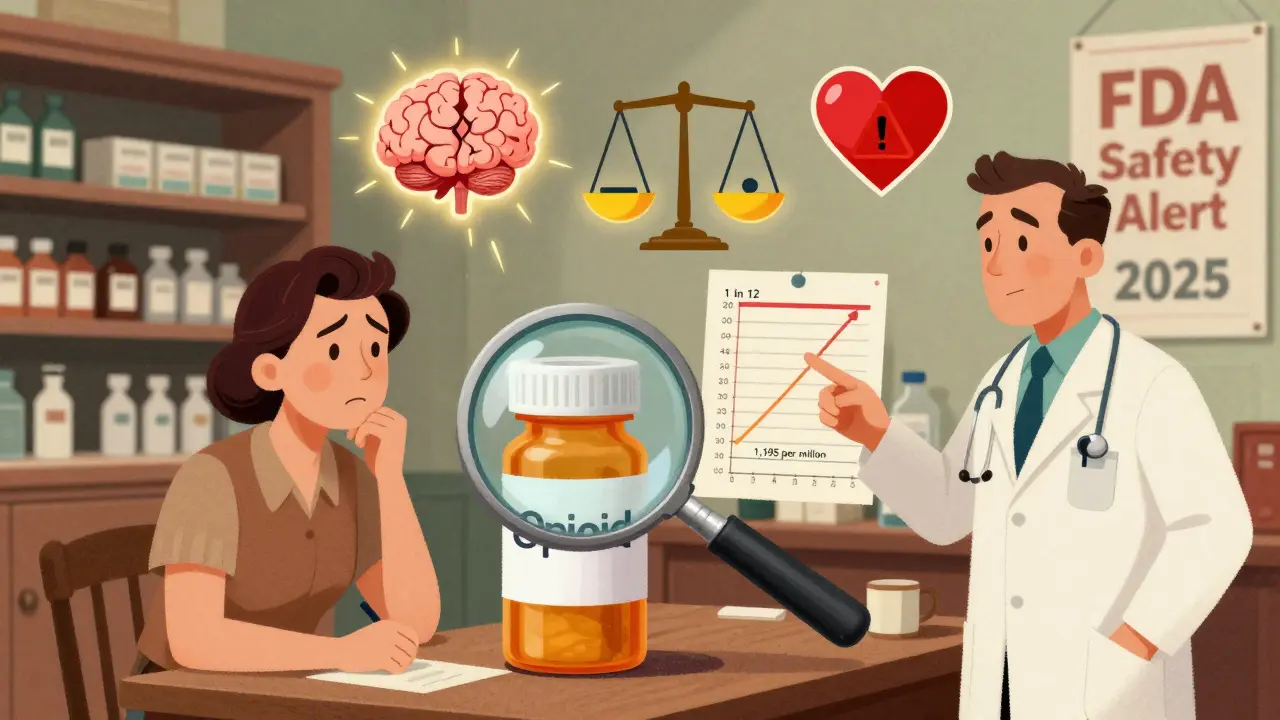
The U.S. Food and Drug Administration (FDA) doesn’t just approve drugs - it watches them closely after they hit the market. That’s because some risks only show up when thousands or millions of people start using a medicine over time. In 2025 alone, the FDA issued more than 60 Drug Safety Communications (DSCs), each one a direct warning to patients and doctors about newly discovered dangers. These aren’t vague notices. They’re detailed, data-backed alerts that can change how a drug is prescribed, used, or even pulled from shelves.
What Exactly Is a Drug Safety Communication?
A Drug Safety Communication is the FDA’s way of saying, ‘We just found something serious.’ Unlike pre-approval trials, which involve a few thousand people over months, real-world use reveals rare side effects, long-term damage, or dangerous interactions. For example, the opioid a class of pain medications including oxycodone, hydrocodone, and fentanyl warnings updated on July 31, 2025, weren’t based on lab studies. They came from two massive postmarketing studies involving over 1.2 million patients. The data showed that 1 in 12 people who take opioids for more than 90 days develop an opioid use disorder. That’s not a guess - it’s a hard number, now required on every prescription label.
Each DSC must include four things: the safety concern, the evidence behind it, what patients should do, and what doctors must change. The FDA uses its authority under Section 505(o)(3) of the Federal Food, Drug, and Cosmetic Act to force these updates. It’s not optional. Manufacturers have 60 days to revise labels or face penalties.
Top 5 Recent Alerts That Changed Prescribing
- July 31, 2025 - Opioid Labeling Overhaul: All 46 approved opioid pain medications now carry updated warnings. For the first time, labels include specific risk numbers: 10.2% chance of addiction after 90+ days, 1 in 200 risk of fatal overdose with long-term use, and a new warning about toxic leukoencephalopathy - a rare brain injury linked to opioid overdose. The FDA also requires clinicians to discuss availability of naloxone (Narcan) with every patient.
- June 30, 2025 - ADHD Stimulants and Weight Loss: Extended-release stimulants like Adderall XR and Vyvanse now carry a new warning for children under 6. Studies showed up to 15% of these kids lost more than 10% of their body weight in the first year. Doctors are now required to measure weight at baseline and every 3 months.
- June 25, 2025 - mRNA COVID-19 Vaccines and Myocarditis: Pfizer’s Comirnaty and Moderna’s Spikevax now include a specific risk estimate: 1,195 cases of myocarditis per million second doses in males aged 12-29. The FDA also updated the warning to clarify that most cases are mild and resolve quickly, but monitoring is still advised for 1 week after vaccination.
- May 16, 2025 - Zyrtec and Xyzal Allergy Pills: Cetirizine and levocetirizine products now carry a warning about rare but serious liver injury. The FDA received 27 reports of acute liver failure in adults, mostly after long-term use. Patients are told to stop taking the drug and seek care if they notice yellowing skin, dark urine, or severe fatigue.
- August 28, 2025 - Leqembi (lecanemab) and MRI Monitoring: This Alzheimer’s drug, the first to slow cognitive decline, now requires two MRIs - at 5 and 14 months after starting treatment. Why? Because 274 patients developed ARIA (amyloid-related imaging abnormalities), a brain swelling or bleeding risk. The FDA says the benefit outweighs the risk, but only if monitored.
When a Drug Gets Recalled - Not Just a Warning
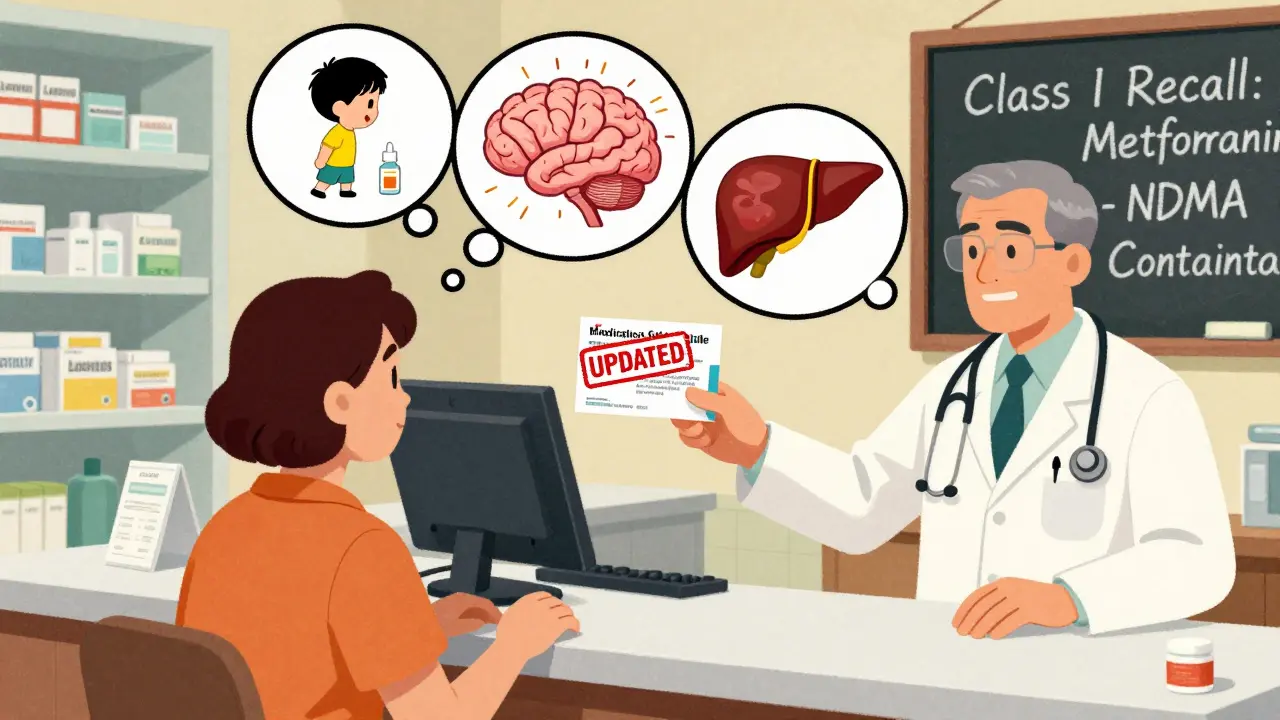
Not all DSCs lead to recalls. But some do. In early 2025, the FDA ordered a recall of a generic version of metformin after testing found NDMA levels above safe limits. NDMA is a probable carcinogen. The recall affected 12 different lots across three manufacturers. Another recall in March involved a batch of losartan because of unexpected impurities that could damage the liver. These aren’t isolated events. The FDA issued 18 recalls in 2025, up from 11 in 2023.
Recalls happen in three levels:
- Class I: Highest risk. Use could cause serious injury or death. (e.g., contaminated injectables)
- Class II: May cause temporary health problems. (e.g., incorrect dosage in pills)
- Class III: Unlikely to cause harm, but violates labeling rules. (e.g., missing warning sticker)
Patients don’t always get direct notice. Pharmacies are required to notify prescribers, who then contact patients. If you’re on a long-term medication, check the FDA’s Recalls, Market Withdrawals, and Safety Alerts page monthly. You can also sign up for email alerts.
How This Affects You - Patient and Provider
If you’re taking a long-term medication, here’s what you need to do:
- Check your pill bottle. Look for updated Medication Guides. If you haven’t received one in the last 6 months, ask your pharmacist.
- Review your list. Make sure your doctor knows every drug you take - including over-the-counter painkillers and supplements. Many dangerous interactions (like opioids + gabapentin) weren’t known until after approval.
- Ask about alternatives. For chronic pain, the FDA now expects doctors to discuss non-opioid options like physical therapy, nerve blocks, or non-addictive pain meds before prescribing opioids.
- Know your symptoms. For example, if you’re on Leqembi, watch for headaches, confusion, or vision changes - signs of ARIA. For ADHD stimulants in kids, track weight monthly. Don’t wait for the doctor to bring it up.
For providers, the burden is real. A 2025 AMA survey found 63% of primary care doctors feel they don’t have enough time to explain new safety alerts during a 15-minute visit. That’s why the FDA created free clinician fact sheets and accredited CME modules - 1.0 AMA credit for learning how to talk about opioid risks.
Why This Matters Beyond the U.S.
While these are FDA actions, they influence global practices. Australia’s TGA, the UK’s MHRA, and Health Canada often follow suit within 6-12 months. For example, after the 2025 opioid labeling update, Canada updated its own guidelines in October 2025. The global biologics market - including drugs like Leqembi and CAR-T therapies - is growing fast. As these complex treatments become more common, safety monitoring will only get stricter.
Pharmaceutical companies are responding. Postmarketing safety studies are now budgeted 28.5% higher than in 2020. The Opioid Postmarketing Consortium alone spent $187 million on the studies that led to the 2025 label changes. That’s money spent because regulators now demand proof - not promises.
What’s Coming Next
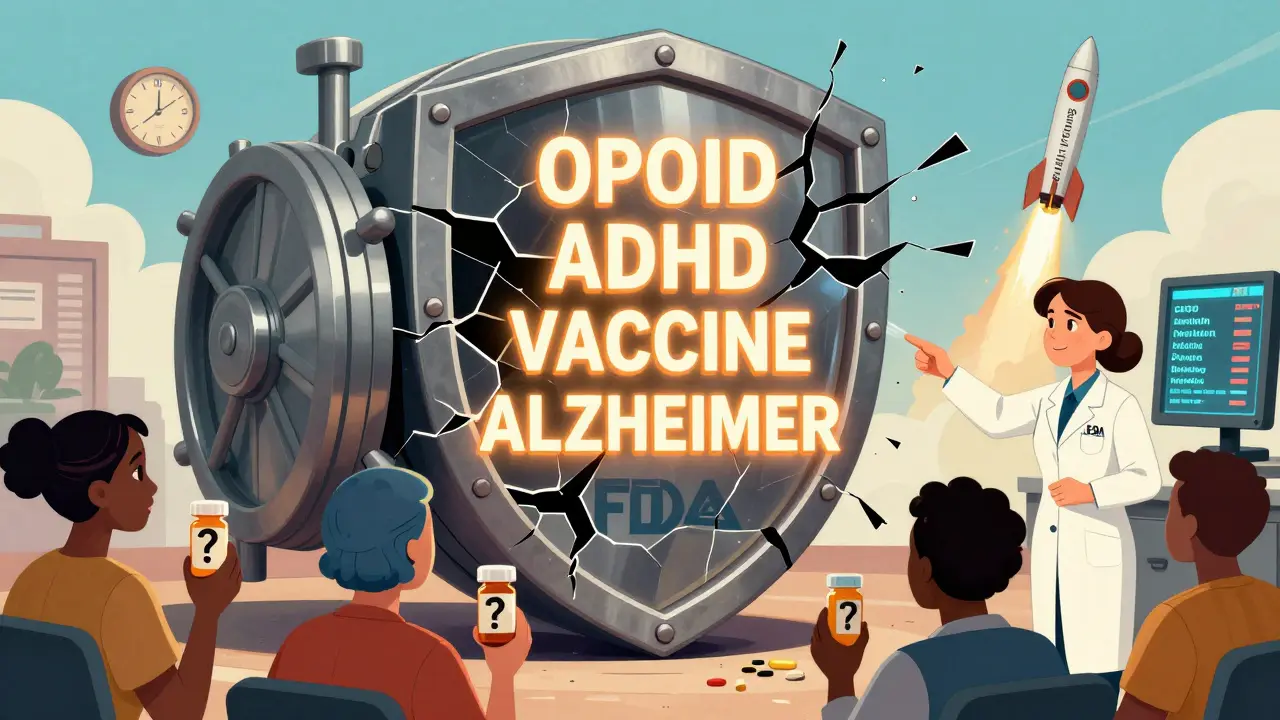
The FDA’s 2026-2030 plan says this: ‘We will issue safety communications within 30 days of confirming a risk.’ Right now, it takes 60-90 days. That’s changing. The Sentinel Initiative, which tracks health data from 300 million patients, will soon be able to flag risks in real time. By 2027, it could cut detection time in half.
Also coming: mandatory real-world evidence for all drugs with black box warnings. That means if a drug has the strongest possible warning (like those for clozapine or certain cancer drugs), the manufacturer must prove its safety in daily use - not just in trials. This could delay new drug approvals, but it will make the market safer.
And don’t forget: the FDA removed the REMS program for clozapine in August 2025. That’s rare. It means, after 35 years of strict monitoring, the agency now trusts that the risks are well understood and manageable. It’s a sign that safety systems can evolve - not just tighten.
How do I know if my medication was affected by a recent FDA safety alert?
Check the FDA’s official Drug Safety Communications page and Recalls page. You can search by drug name or date. If your medication is listed, your pharmacy should have received a notice and will update your Medication Guide. If you’re unsure, call your pharmacist and ask if your drug has had any recent safety updates. Don’t rely on your doctor’s memory - they may not have seen the alert yet.
Should I stop taking my medication if I see a safety alert?
Never stop a prescribed medication without talking to your doctor. Many alerts ask you to monitor for symptoms, not quit the drug. For example, the Leqembi alert doesn’t say stop - it says get an MRI. Stopping suddenly can be dangerous. For opioids, the FDA specifically warns against abrupt discontinuation in chronic pain patients. Always consult your provider before making changes.
Are generic drugs included in these safety alerts?
Yes. The FDA treats generics the same as brand-name drugs when it comes to safety. If the active ingredient is the same, the warning applies. For example, the opioid labeling changes affect all 46 approved opioid products - including generics. The same goes for the metformin and losartan recalls. Always check the active ingredient on your label, not just the brand name.
Can I get compensation if I was harmed by a recalled drug?
The FDA doesn’t provide compensation. If you believe you were harmed by a drug, you can report the event to the FDA’s MedWatch program. For legal action, you’d need to consult a lawyer. Some manufacturers have settlement programs, especially for recalls involving contamination or manufacturing errors. Check the recall notice - some include instructions for filing claims.
Why do some drugs get warnings while others don’t?
It’s not about popularity - it’s about evidence. The FDA acts when data shows a clear, measurable risk. For example, the Zyrtec liver injury warning came after 27 confirmed cases. If a drug has millions of users and only one rare side effect, it may not trigger a DSC. But if 1 in 100 users develop a serious reaction - like the myocarditis with mRNA vaccines - the FDA must act. The system is designed to respond to patterns, not isolated incidents.
What to Do Next
Stay informed. Sign up for FDA email alerts. Keep your medication list updated. Ask your pharmacist for the latest Medication Guide. If you’re managing chronic pain, ask about non-opioid options. If you’re on an ADHD stimulant, track your child’s weight. If you’re on a new biologic like Leqembi, schedule those MRIs. The FDA doesn’t just warn - it empowers you with data. Use it.


Comments
Man, I’ve been on oxycodone for my back for five years now. I never thought about addiction risk until this FDA update. 1 in 12? That’s wild. I mean, I’ve got my dose down to a science - no mixing, no extra pills, always got Narcan in the glovebox. But still… it hits different when you see the numbers. I’ve seen two friends go down hard. One’s in rehab, the other’s dead. This ain’t theoretical. It’s real. And yeah, I’m switching to gabapentin and PT next month. No shame in it.
THIS IS WHY WE CAN’T HAVE NICE THINGS. Big Pharma has been lying for DECADES. They knew. They KNEW. The opioid crisis wasn’t an accident - it was a calculated bloodbath. And now they slap a 10.2% warning on the bottle like that’s some kind of disclaimer? That’s not a warning - it’s a death sentence with a receipt. Meanwhile, the FDA takes 60 days to act? That’s not oversight - it’s complicity. I’ve got a cousin who OD’d on a generic oxycodone. She was 22. They didn’t even tell her the label changed. This system is broken. And no, I won’t shut up about it.
Let’s interrogate the epistemological framework here. The FDA’s reliance on postmarketing surveillance is a posteriori by design - a reactionary mechanism masquerading as proactive governance. The very notion that a drug can be deemed ‘safe’ based on trials of 5,000 subjects over 18 months, then released to 10 million, is a statistical fallacy of catastrophic proportion. The 1 in 12 addiction rate among long-term opioid users isn’t a finding - it’s an inevitability of probabilistic exposure. We are not testing drugs; we are conducting open-field, uncontrolled human experiments. The requirement for naloxone co-prescription? A Band-Aid on a hemorrhage. The real solution? Ban all Schedule II opioids from outpatient use. Period. The data doesn’t lie - our ethics do.
Hey, I’m a pharmacist, and I love this breakdown. Just wanted to add - when the Zyrtec liver injury alert dropped, we had 12 patients come in within a week asking about it. We started asking about dark urine and fatigue proactively. Also - did you know the 27 cases of liver failure? 21 were in people taking it for over 2 years. One guy was on it for 8 years. Long-term use is the red flag. And yeah, generics are 100% included - same active ingredient, same risk. I always print out the FDA alert for patients. It’s easier than explaining jargon. Also, if you’re on Leqembi - get those MRIs. Seriously. I’ve seen ARIA get missed because everyone thought ‘headache’ was just stress.
Big fan of the FDA’s transparency here. As a med student, I’ve seen how chaotic prescribing can be. I had a patient on Adderall XR who lost 18 lbs in 4 months - no one caught it. Now with mandatory weight checks? Yes. Also - the opioid naloxone requirement? Genius. I’ve handed out Narcan to 17 patients this year. None of them thought they needed it. Then they saw the stats. Now they keep it in their wallet. It’s not about fear - it’s about preparedness. And yeah, the 15-minute visit thing? Real. But at least we’ve got those free CMEs now. Thanks, FDA.
Just wanted to say - I’m from rural Maine. We don’t have specialists. Our docs are overworked. When the Leqembi MRI rule came out, our clinic didn’t have an MRI on-site. Took 3 months to get referrals lined up. Patients were scared. We had to make a handout: ‘Here’s what to watch for. Here’s who to call. Here’s why this matters.’ I printed 500 copies. People kept them taped to their fridges. The FDA doesn’t just issue alerts - they give us tools. And that’s huge. We need more of this. Not less.
oh my gosh!! i just read this and i cried?? like seriously?? my mom’s on metformin and i didn’t even know about the recall?? i checked and her batch was affected?? i called the pharmacy and they said they sent a notice?? but she’s 78 and doesn’t check email?? so i just drove 45 mins to pick up her new prescription?? and i’m so glad i did?? because the new ones don’t have the NDMA?? i just wanna say thank you to whoever wrote this?? and to the FDA?? you saved my mom?? i’m telling everyone i know?? ❤️❤️❤️
From a clinical pharmacologist: The 1,195 myocarditis cases per million second doses in young males is statistically significant but clinically nuanced. The absolute risk is 0.12%. Most cases are mild, self-limiting, and resolve with NSAIDs. Compare that to the 3,000+ per million cases of COVID-induced myocarditis in the same demographic. The benefit-risk ratio still heavily favors vaccination. Also - the FDA’s 2026 real-world evidence mandate? Long overdue. Phase IV trials are the future. We need longitudinal, real-time data, not 12-month trials with cherry-picked populations. This isn’t regulation - it’s evolution.
So let me get this straight - the FDA says opioids cause addiction, but they’re still on the market? And the ‘evidence’? From studies funded by the same pharma companies that lobbied for approval? LOL. Wake up. This is all a distraction. The real issue? The CDC’s opioid prescribing guidelines were pushed by Bill Gates and the WHO to depopulate the U.S. You think 1 in 12 is bad? Wait till the 5G chips in your pills start syncing with satellites. They’re already testing AI-driven dosing. Next thing you know, your insulin will be remotely controlled. This isn’t safety - it’s control. And they’re using ‘addiction’ as the Trojan horse.
Oh wow. The FDA finally noticed that opioids are addictive? Took them long enough. And now they’re slapping a ‘10.2% chance’ label like that’s some kind of ethical win? Congrats, you’ve turned a public health disaster into a fine print footnote. Meanwhile, the same people who approved these drugs in 2002 are now on the advisory board. This isn’t oversight - it’s a revolving door with a PowerPoint. And don’t even get me started on Leqembi. $26k a year. And now you need TWO MRIs? Sure. Let’s make Alzheimer’s a luxury sport. #PharmaProfit
Let’s be real - the FDA’s got a PR problem. They’re not protecting us. They’re doing damage control with a smiley face. You think the opioid label update was because they care? Nah. It’s because the lawsuits were piling up like dirty laundry. The metformin recall? NDMA levels were known since 2020. Why wait 5 years? Because profits > people. And now they want us to trust their ‘real-time data’? With the same infrastructure that missed the fentanyl contamination in 37 states? Please. The system’s rigged. And if you’re still taking any of these drugs without a lawyer on speed dial - you’re either brave or stupid. I’m choosing brave. But I’m not stupid.
I’ve been reading these FDA updates for 15 years. And here’s what nobody says: most of these alerts come from whistleblower pharmacists, not big labs. The guy who found the NDMA in metformin? He was fired. The nurse who reported the liver injuries from Zyrtec? She got sued. The system doesn’t work unless someone screams. And yeah, I’m one of those people. I’ve submitted 12 MedWatch reports. I’ve emailed my reps. I’ve shown up at town halls. I don’t care if it’s inconvenient. If you’re on long-term meds? You owe it to yourself to be loud. The FDA doesn’t protect you - you protect yourself. And if you’re not doing that? You’re part of the problem.
OMG I just found out my kid’s on a stimulant that causes weight loss?? I had no idea!! I’m gonna start weighing him every week now!! And I’m telling his teacher!! Thanks for this post!! I’m signing up for FDA alerts right now!! ❤️
As an Aussie who’s watched the TGA follow the FDA for years, I gotta say - this is the gold standard. We got our opioid labeling update in October, same numbers, same naloxone push. And guess what? Our overdose deaths dropped 18% in 12 months. That’s not coincidence. That’s science meeting policy. The Leqembi MRI protocol? We adopted it. The metformin recall? We matched it. The FDA’s not perfect - but they’re the ones pushing the global needle. And honestly? We’re better off because of it. Keep doing what you’re doing. We’re watching.
Why are you people so naive? You think the FDA cares about you? They care about liability. The opioid warning? Because 10,000 families sued. The Zyrtec liver alert? Because one lawyer found a pattern. You think they changed the labels because they love you? No. They changed it because they were scared of money. And now they’re giving you ‘free CMEs’? That’s not generosity - it’s damage control. You’re not being protected. You’re being managed. And if you believe this system is working? You’re the reason it never will.
Replying to Brandon - I get your rage. I lost my brother too. But screaming at the system doesn’t change it. Showing up, asking for the guide, calling your pharmacist - that does. I started a support group. 14 people. We share pill bottles. We check dates. We call the FDA hotline together. It’s not glamorous. But it’s working. You don’t have to be angry to be heard. Sometimes, just being smart is enough.