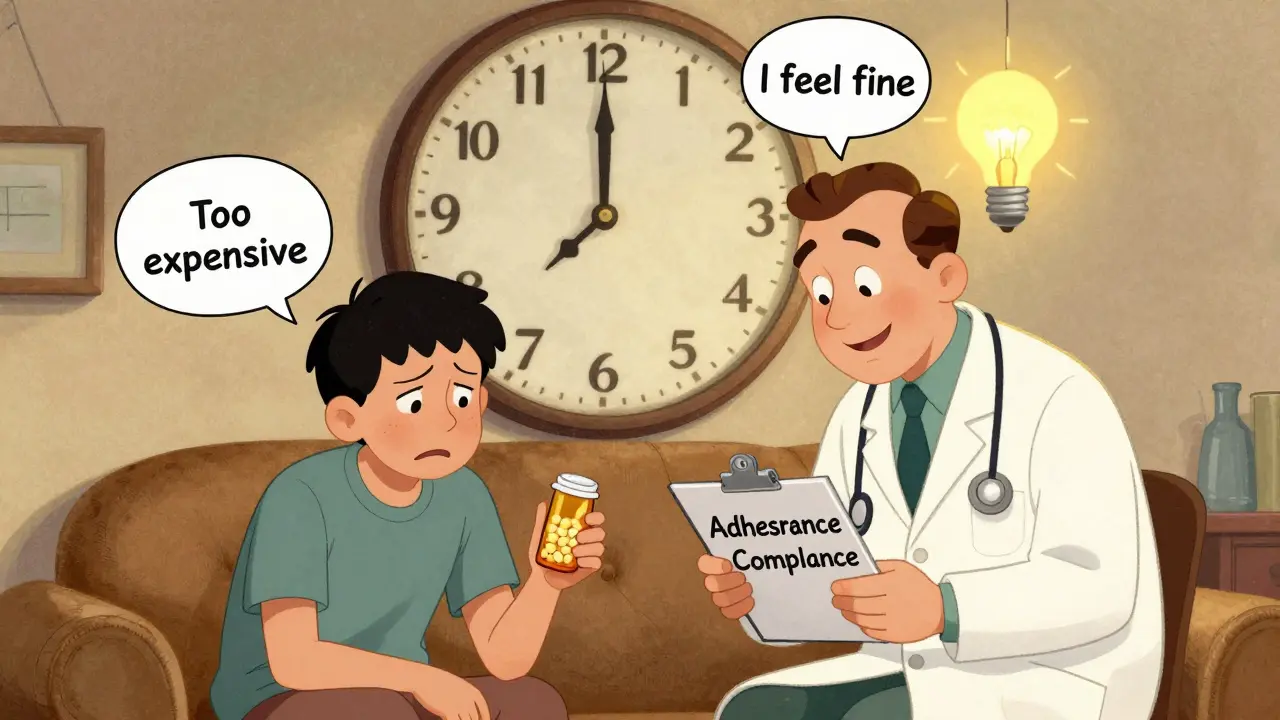
Have you ever skipped a pill because it made you feel sick? Or forgot to refill your prescription because it cost too much? You’re not alone. And more importantly, medication adherence isn’t about whether you followed orders-it’s about whether your treatment actually worked for you.
The Big Difference: Adherence vs. Compliance
For decades, doctors and pharmacists used the word "compliance" to describe whether patients took their meds as told. It sounded simple: take the pill, don’t miss a dose, follow the rules. But that language ignored one big truth: patients aren’t robots. They have lives, fears, budgets, and beliefs. That’s why the healthcare world quietly switched from "compliance" to "adherence." It wasn’t just a word change. It was a mindset shift. Compliance means doing what you’re told. No questions. No input. Just obey. Adherence means choosing to stick with your treatment plan because you understand it, agree with it, and feel supported in doing so. The American Medical Association defines adherence simply: a patient is adherent if they take at least 80% of their prescribed medication over time. That’s it. No judgment. Just measurement. But here’s the kicker: studies show up to half of all people stop taking their chronic disease meds within the first year. Not because they’re lazy. Because they couldn’t afford it. Or the side effects were worse than the symptoms. Or they didn’t understand why it mattered.Why Compliance Fails
Think of compliance like a traffic cop. You get a ticket if you don’t stop. No explanation needed. That works for stop signs. It doesn’t work for heart disease. A 2023 analysis from Fresenius Medical Care called compliance a "one-way street"-where the provider talks and the patient listens. No back-and-forth. No problem-solving. Just "do as ordered." That approach blames the patient when things go wrong. "Why didn’t you take your pills?" becomes the question. Instead of asking: "What got in your way?" The result? Patients feel shamed. They stop talking. They stop showing up. And their health gets worse.Why Adherence Works
Adherence flips the script. It says: "You’re the expert on your life. We’re here to help you make this work." It’s not about checking boxes. It’s about understanding barriers. Maybe your medicine costs $120 a month and you’re on a fixed income. Adherence means helping you find a generic, a coupon, or a patient assistance program. Maybe you take five different pills at different times and get confused. Adherence means switching to a once-daily combo pill or giving you a pill organizer with alarms. Maybe you think your blood pressure meds aren’t working because you don’t "feel" any different. Adherence means explaining that high blood pressure doesn’t come with symptoms-and that’s exactly why the pill matters. The Agency for Healthcare Research and Quality found that adherence-focused care leads to 20-50% higher treatment success rates than compliance-focused care. That’s not a small win. That’s life-changing.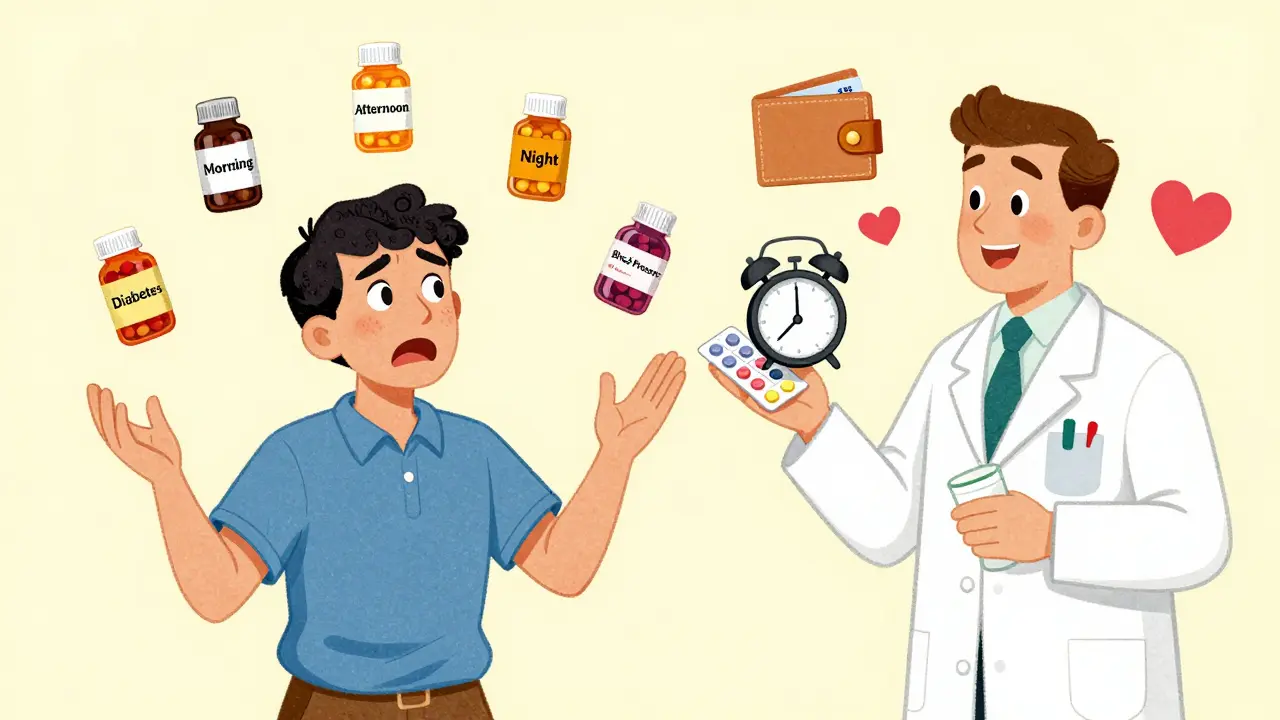
How Adherence Is Measured (And Why It’s More Accurate)
Compliance checks: "Did you take it today?" Adherence asks: "Did you start? Did you keep taking it? Did you stop because of side effects, cost, or fear?" Adherence tracks the whole journey:- Initiation: Did you fill the prescription at all?
- Implementation: Are you taking the right dose, at the right time?
- Discontinuation: Did you stop early-and why?
What’s Changing in Healthcare Right Now
The shift isn’t theoretical. It’s happening fast. - The FDA and European Medicines Agency now require adherence data in clinical trials. - Medicare ties 8% of hospital payments to how well patients stick with their meds after discharge. - The American Medical Association created new billing codes (99487-99489) so doctors can get paid for spending time on adherence counseling. - Over 87% of major U.S. health systems have officially dropped "compliance" from their policies since 2024. Even the language is changing. You won’t hear "non-compliant" anymore. You’ll hear "non-adherent"-and that’s intentional. "Non-compliant" sounds like rebellion. "Non-adherent" sounds like a problem to solve.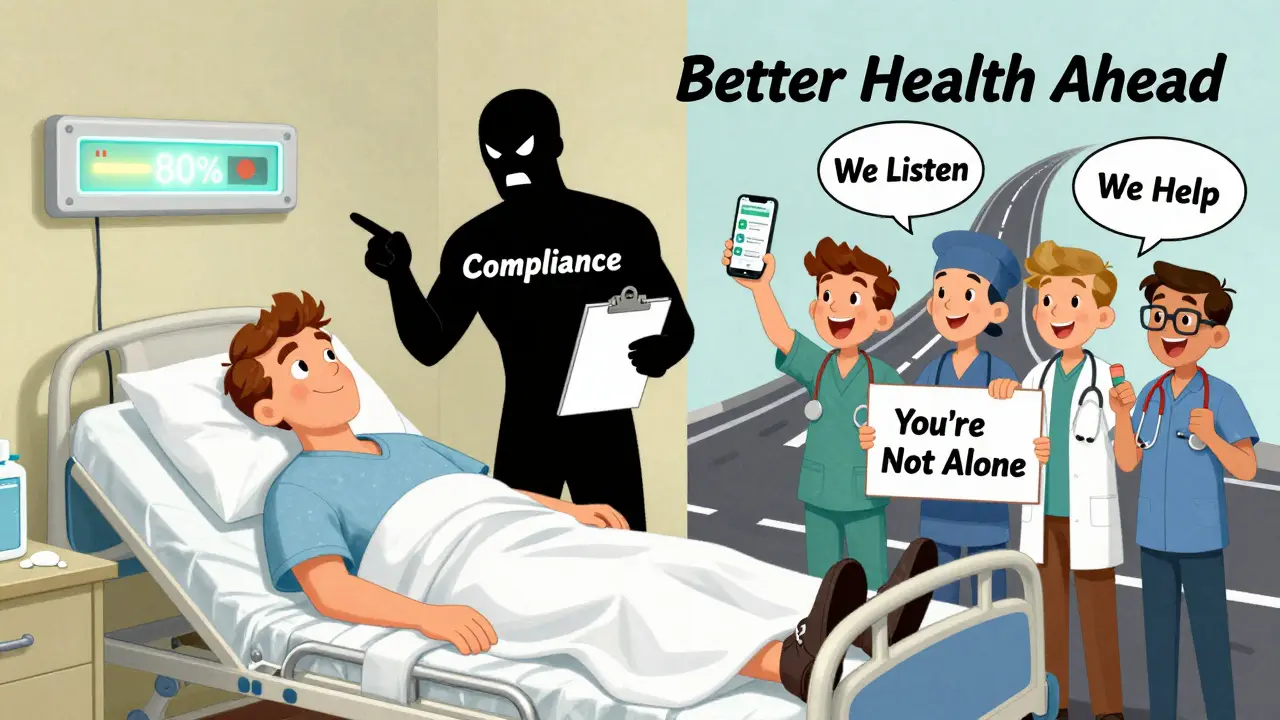
Real-World Impact: Numbers Don’t Lie
The World Health Organization says medication non-adherence causes 125,000 deaths a year in the U.S. alone. That’s more than car accidents. In low- and middle-income countries, it’s worse. The WHO’s 2025 report predicts adherence-focused care could prevent 850,000 premature deaths globally by 2030. And the money? McKinsey & Company found that adherence programs cut avoidable hospital stays by 22-34% and lower overall treatment costs by 18-27%. That’s not just better health. It’s cheaper care.What This Means for You
If you’re on long-term meds-for diabetes, high blood pressure, depression, or anything else-this isn’t about guilt. It’s about partnership. You don’t have to be perfect. You just have to be heard. Ask your doctor:- "Is there a cheaper version?"
- "Can I take this once a day instead of three times?"
- "What happens if I skip a dose?"
- "What side effects should I watch for?"
- "How do I know this is working?"
What’s Next
AI is stepping in. Google Health’s 2024 study showed machine learning can predict whether someone will miss their meds with 83.7% accuracy-by looking at things like income, transportation access, even social media patterns. This isn’t surveillance. It’s support. If the system knows you’re likely to forget because you work two jobs and don’t have a car, it can send a text reminder, help you find a delivery service, or adjust your schedule. By 2035, 95% of healthcare systems will require adherence-focused care. Not because it’s trendy. Because it saves lives.Is medication adherence the same as compliance?
No. Compliance means following instructions without question. Adherence means actively choosing to follow a treatment plan based on understanding, agreement, and support. Adherence recognizes that patients have real barriers-like cost, side effects, or confusion-and works with them to solve those problems. Compliance blames the patient. Adherence partners with them.
What percentage of people are considered medication-adherent?
The American Medical Association defines adherence as taking at least 80% of prescribed medication over time. Studies show that only about 50-60% of people with chronic conditions meet this threshold. For some drugs, like those for high blood pressure or diabetes, adherence can drop below 40% after a year. It’s not about willpower-it’s about system design.
Why do people stop taking their medications?
The reasons vary, but common ones include: side effects (like dizziness or nausea), high cost (especially for brand-name drugs), lack of symptoms ("I feel fine, so I don’t need it"), confusion about how or when to take it, or fear of long-term use. Sometimes it’s as simple as forgetting. The key is that these aren’t "bad choices"-they’re signals that the treatment plan needs adjusting.
Can technology help with medication adherence?
Yes. Tools like electronic pill dispensers (Hero Health), smart pill bottles (MEMS caps), and reminder apps have been shown to reduce missed doses by 30-42%. Some systems even alert pharmacists if a dose is skipped, so they can reach out. But tech alone isn’t enough-it works best when paired with human support, like counseling or personalized education.
Is adherence only important for chronic conditions?
It’s most critical for chronic conditions-like hypertension, diabetes, asthma, or depression-because missing doses over time leads to serious complications: hospitalizations, strokes, kidney failure. But adherence matters for short-term treatments too, like antibiotics. Stopping early can lead to drug-resistant infections. The principle is the same: take it as directed, for the full course, unless your provider says otherwise.




Comments
lol i just forget to take my blood pressure meds half the time 🤷♀️ my pharmacist texts me now and it’s kinda nice? like a little nudge from the universe. also i switched to generics and saved $90/month. my cat approves.
YES. THIS. 🙌 I work in primary care and we switched to 'adherence' 3 years ago. The difference? Patients actually show up to follow-ups now. They talk. They cry. They say 'I couldn't afford it' instead of 'I'm non-compliant.' We're not fixing patients-we're fixing systems. And honestly? It's the most human thing I've done in this job. ❤️
This is why America's healthcare is broken. We're coddling people instead of holding them accountable. If you can't take a pill, maybe you shouldn't be on it. Discipline. That's what we need.
i just want to say thank you to whoever wrote this i been on statins for 5 years and my doc never asked why i was missing doses until last month now we got me on a once daily and a pill organizer and honestly i feel seen for the first time 🥹
The 80% adherence threshold is genius. Realistic. Human. Most studies use 80% because that’s the clinical inflection point where outcomes improve dramatically. Anything below? You’re not 'non-compliant'-you’re in a system that failed you. Period.
i read this and cried a little. my mum died because she stopped her diabetes meds after her husband passed. she said 'i don't need it anymore'. we never asked why. this article should be required reading for every med student.
OMG I LOVE THIS 💖 I work for a pharmacy chain and we started using 'adherence' in all our signage. Sales of pill organizers went up 200%. Patients started asking for help. It’s not magic. It’s just respect. And yeah, I use emojis. So what? 😘
Oh wow. So now we’re blaming doctors for patients being lazy? 🤡 Next they’ll say the pill bottle is racist because it doesn’t text reminders in Spanish. Wake up. People have free will. Stop infantilizing them.
The paradigm shift from compliance to adherence represents a fundamental epistemological reorientation within clinical governance. It necessitates a reconceptualization of patient agency as a co-constructive rather than passive variable, thereby aligning therapeutic outcomes with sociocultural determinants of health behavior. The empirical evidence is unequivocal.
I’ve been a pharmacist for 22 years. I’ve seen patients skip doses because they were afraid of side effects, because they didn’t understand the science, because they were embarrassed to ask. The moment we stopped saying 'you’re non-compliant' and started saying 'how can we help?'-that’s when we started saving lives. Not because we’re nicer. Because we’re smarter.
In the context of chronic disease management, adherence is a dynamic, multi-dimensional construct encompassing initiation, implementation, and persistence. The integration of digital health interventions (DHIs) such as MEMS and AI-driven predictive analytics enhances behavioral monitoring fidelity. This paradigm aligns with WHO’s 2025 global health equity framework. #AdherenceIsJustice
I’m the author of this post. Thank you. All of you. This is why I wrote it. Not for the stats. Not for the policy changes. But for the person who finally feels heard. You’re not failing. The system was. And we’re fixing it-together.