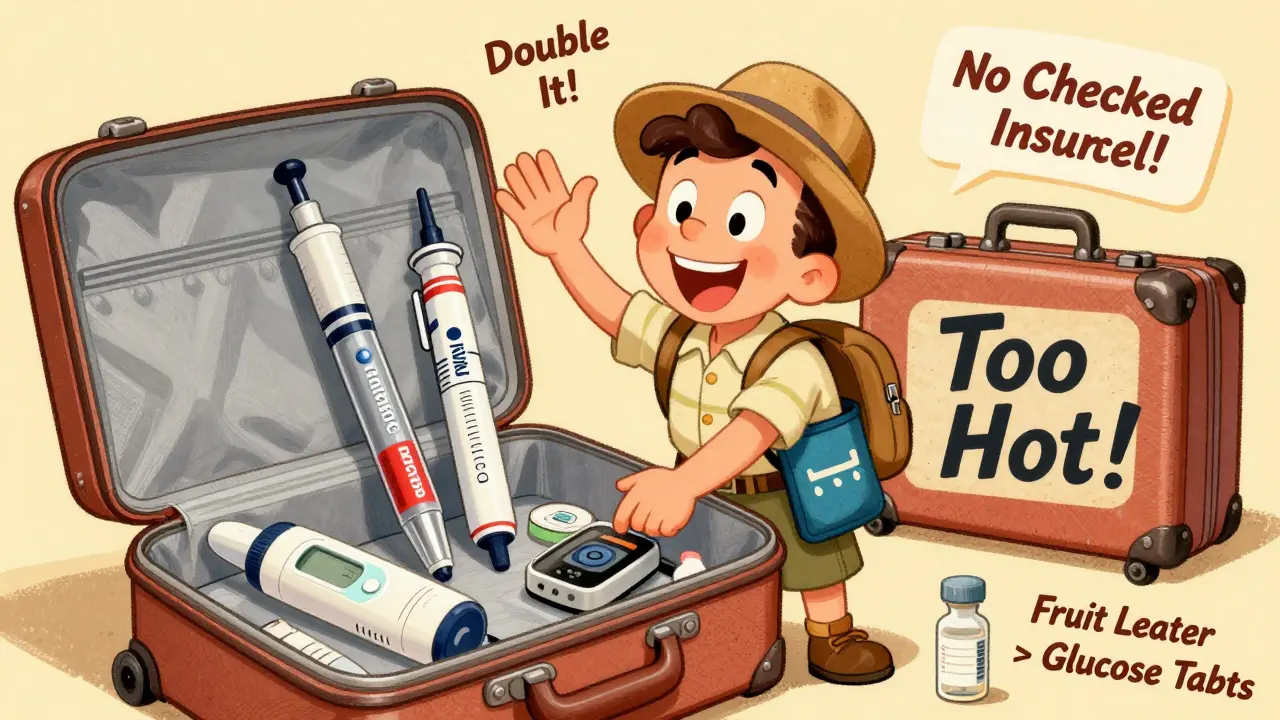
Traveling with diabetes doesn’t have to be stressful-if you plan ahead. Millions of people with Type 1 and Type 2 diabetes fly, hike, road-trip, and explore the world every year. But one wrong move-like forgetting backup insulin or letting your CGM sensor overheat-can turn a vacation into an emergency. The key isn’t packing more stuff. It’s packing the right stuff, the right way.
Double Everything (Yes, Really)
The golden rule of diabetes travel? Bring at least double what you think you’ll need. Not 1.5x. Not “a little extra.” Double. If you use three insulin pens for a five-day trip, pack six. If you go through one CGM sensor every seven days, bring at least two more. Why? Because airlines lose bags. Security lines take longer than expected. Your pump might glitch on a flight. And if you’re hiking in the mountains or stuck in a remote town, you won’t find a pharmacy that stocks your exact brand.Insulin is especially fragile. It works best between 40°F and 86°F. Too cold, and it freezes. Too hot, and it breaks down. Checked luggage can hit 140°F in the cargo hold or drop below freezing. That’s why insulin must always go in your carry-on. The American Diabetes Association says checked insulin can lose up to 30% of its effectiveness. That’s not a risk worth taking.
Insulin: More Than Just the Vials
If you use insulin pens, pack extra pens and cartridges. If you use vials and syringes, bring extra syringes, alcohol wipes, and sharps containers. Don’t forget the backup. Even if you have a pump, bring insulin vials and syringes. Pump failures happen. A user on Reddit shared how they got stranded in Costa Rica when their pump died mid-hike-no backup syringes meant no insulin. They ended up in a clinic, hours from their hotel.For long trips, consider Tresiba U-200. Approved by the FDA in May 2023, this insulin stays stable at room temperature for up to eight weeks. No cooling needed. If you’re traveling to a hot climate or won’t have access to a fridge, this could be a game-changer.
CGM Sensors: The Silent Lifesaver
Continuous Glucose Monitors (CGMs) like Dexcom or Abbott’s FreeStyle Libre are essential for travel. But they’re not foolproof. Sensors can fail, adhesive can peel off, or your transmitter might die mid-flight. Pack at least three sensors for a week-long trip. That’s not overkill-it’s insurance.Use Skin Grip CLEAR tape or similar waterproof adhesive strips to keep sensors stuck down during swimming, sweating, or long walks. Many travelers swear by these. One user reported going 14 days without a sensor failure on a beach trip-just because they used extra tape.
Don’t forget your transmitter. Bring a spare if you can. Some models (like Dexcom G7) have replaceable transmitters. Others don’t. Either way, carry a backup. And if you’re going somewhere with weak Wi-Fi or no cell service, make sure your CGM can still record data offline.
Testing Supplies: Don’t Skip the Meter
Even if you rely on your CGM, bring a blood glucose meter. CGMs can lag, glitch, or give false readings during rapid glucose swings. Always have a backup. Pack at least 50 test strips-more if you’re traveling for more than a week. Throw in extra lancets, alcohol swabs, and batteries. A dead meter battery in a foreign airport? Not fun.Before you leave, compare your meter reading with your CGM. If they’re off by more than 15%, calibrate or replace the meter. You don’t want to be guessing your numbers mid-flight.
Snacks and Treatment: Go Beyond Glucose Tablets
Glucose tablets? Fine. But they’re bulky, messy, and taste like chalk. Many experienced travelers swear by fruit leathers-like Pure Organic Fruit Leathers. They’re thin, lightweight (about half an ounce each), and taste like real fruit. One study found travelers using fruit leathers had 37% fewer low-blood-sugar incidents than those relying on tablets.Keep snacks in multiple places: your pocket, your purse, your carry-on, your checked bag (if it’s not insulin). You never know when you’ll be stuck in a terminal with no food. Pack non-perishable options: nuts, protein bars, peanut butter packets. And don’t forget a fast-acting sugar source-juice boxes, honey sticks, or glucose gel.
Organization: The Secret Weapon
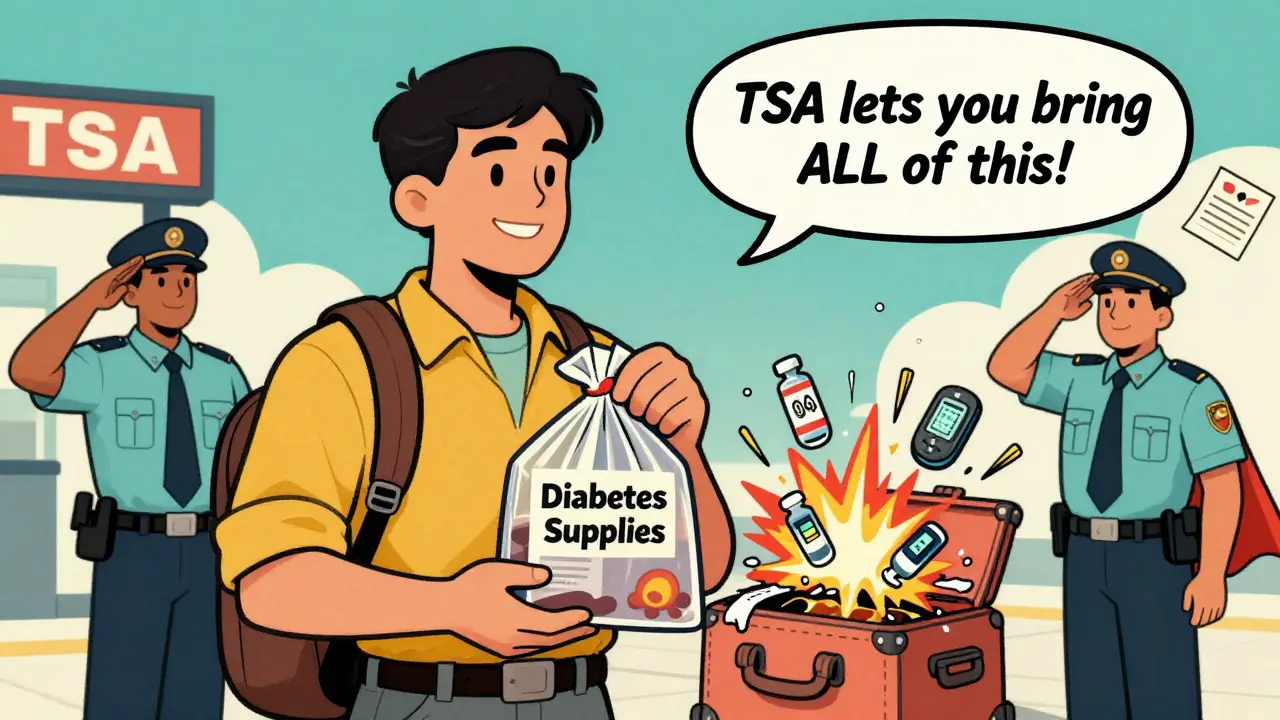
TSA lets you bring all diabetes supplies through security-no exceptions. But if you don’t organize them, you’ll waste time. Put everything in a clear, sealable plastic bag. Label it “Diabetes Supplies.” Separate insulin, CGM, meter, and snacks into small pouches.Pro tip: Use a Sugar Medical Insulated Travel Bag ($39.99). It’s designed to keep insulin cool for up to 48 hours without ice. One user kept insulin safe during a 12-hour flight to Dubai using this bag. Another used a Frio Cooling Sleeve ($24.99), which activates with water and lasts 45 hours. Both are widely recommended.
For families: Pack supplies in two places. Primary set in carry-on. Secondary set in checked luggage-except insulin. Always keep insulin with you.
Documentation: Your Travel Pass
The single most overlooked item? A doctor’s letter. Not a prescription. A letter. It should include:- Your diagnosis (Type 1 or Type 2)
- Your insulin-to-carb ratio
- Your correction factor
- Emergency contact info
- Medication names and dosages
Dr. Anne Peters, Director of USC’s Clinical Diabetes Program, says travelers with this letter have 42% fewer delays at security. The TSA even offers a Disability Notification Card you can print and carry. Show it when you go through screening. It’s not required, but it helps.
Also, keep a digital copy on your phone. Email it to a trusted friend. If your bag vanishes, you’ll still have proof of your needs.

Time Zones and Insulin Timing
Crossing time zones? Adjust your insulin schedule. If you’re flying east, you’ll lose hours. That means your basal insulin might hit harder than expected. If you’re flying west, you gain hours. You might need an extra snack or a tiny dose.Plan ahead. For each time zone crossed, spend 15-20 minutes recalibrating your schedule. Use your CGM to watch trends. Don’t rely on your old routine. Many travelers get lows or highs because they didn’t adjust.
International Travel: Watch Out for U-40 and U-80
In the U.S., insulin is U-100. That means 100 units per milliliter. In some countries-especially parts of Asia, Eastern Europe, and Latin America-you’ll find U-40 or U-80. If you accidentally buy the wrong concentration, you could overdose. A 2022 report from Beyond Type 1 documented several cases of international travelers hospitalized because they didn’t know the difference.Bring all your insulin with you. If you must refill abroad, ask for U-100 specifically. Show your doctor’s letter. Know your brand name. Don’t trust pharmacy staff who say “it’s the same.” It’s not.
What to Do If Something Goes Wrong
- Lost luggage? Call your insulin manufacturer. Tandem, Insulet, and Medtronic offer free loaner pumps overseas. They’ll ship one to your hotel. - CGM fails? Use your meter. If you’re stuck, go to a clinic. Most major airports have medical services. - Low blood sugar? Use your fruit leather or juice box. Don’t wait. Treat it fast. - Insulin won’t work? If your insulin looks cloudy, clumpy, or smells odd-don’t use it. Get a replacement.Most emergencies are preventable. It’s not about luck. It’s about preparation.
Final Checklist
- Double the insulin (pens, vials, syringes)
- 3+ CGM sensors + 1 spare transmitter
- 50+ test strips + extra lancets + batteries
- Fruit leathers or fast-acting sugar snacks
- Insulin cooling solution (Frio, Sugar Medical bag)
- Clear, labeled travel bag for supplies
- Doctor’s letter with care details
- TSA Disability Notification Card (print and carry)
- Digital copies of all documents
- Emergency contact list (local and home)
Traveling with diabetes isn’t about limiting your adventures. It’s about protecting them. The best trips are the ones where you didn’t have to think about your diabetes-because you already planned for it.
Can I bring insulin through airport security?
Yes. The TSA allows all diabetes-related supplies, including insulin, syringes, CGMs, and test strips, through security. You must declare them and separate them from other items in a clear bag. Insulin must be in your carry-on-never in checked luggage.
Do I need a doctor’s note to travel with diabetes?
Not legally required, but highly recommended. A doctor’s letter with your diagnosis, insulin doses, and emergency protocols can speed up security screening and help if you need medical care abroad. Include your insulin-to-carb ratio and correction factor.
How many CGM sensors should I pack for a week-long trip?
Bring at least three sensors-even if you normally use one per week. Sensors can fail, adhesive can peel, or you might damage one during travel. Extra sensors are cheap insurance against a low-blood-sugar emergency.
Is it safe to store insulin in a hotel fridge?
Yes, as long as the fridge stays between 40°F and 86°F. But don’t rely on it. Always carry insulin in your carry-on. If you’re staying somewhere without a fridge, use a cooling sleeve like Frio or an insulated travel bag.
What should I do if my insulin pump breaks while traveling?
Switch to insulin injections using backup syringes and vials. Most pump manufacturers (Tandem, Insulet, Medtronic) offer free loaner pumps if you’re traveling internationally. Call their customer service as soon as you notice a problem-they’ll ship one to your location.




Comments
Been traveling with Type 1 for 12 years, and this post nails it. Double everything? Absolutely. I once lost my bag in Istanbul and had to rely on backup pens I stashed in my jacket lining. Also, fruit leathers? Game changer. I carry a pouch of them in every pocket. No more sticky glucose tablets in my wallet.
Pro tip: Always carry a small notebook with your insulin ratios and emergency contacts. Not just digital. Paper doesn’t die. And yes, the TSA Disability Card? I print it in bold letters and tape it to my carry-on. Saves hours.
OMG YES. I had a CGM fail mid-flight to Bali and my meter battery died because I was ‘too lazy’ to check. I was PANICKING. Had to beg a flight attendant for juice boxes. She thought I was having a seizure. Then I remembered I had honey sticks in my sock. Yes. In my sock. Because I’m a paranoid genius.
Also, U-100? NEVER trust local pharmacies. I once got U-80 in Thailand. Thought I was safe. Ended up in a hospital with a glucose level of 42. I’m not joking. My doctor had to fax them my prescription in Hindi. Don’t be me. Bring your own. Always.
This article reads like a manual written by someone who’s never left their suburban cul-de-sac. Double everything? Please. I’ve flown to Tokyo, Nairobi, and Reykjavik with one insulin pen, one sensor, and zero backup. I’m still here. Why? Because I’m disciplined. Not paranoid.
And ‘fruit leathers’? That’s not a thing. That’s a TikTok trend. Real people use glucose tabs. Or better yet-eat a damn banana. Nature’s insulin counter. Stop overcomplicating travel. It’s not rocket science. It’s diabetes.
@Jeremy Van Veelen - I get your point, but discipline ≠ survival. 😊
There’s a difference between being ‘not paranoid’ and being ‘unprepared.’ I’ve seen people get hospitalized because they trusted ‘discipline’ over redundancy. One sensor. One pen. One chance. That’s not discipline. That’s Russian roulette with your pancreas.
Also, bananas? Sure, if you’re in a fruit market. What if you’re stranded at 3am in a Norwegian airport? No bananas. No power. No help. Just you and a dead CGM. That’s why the checklist works. It’s not overkill. It’s common sense. 🙏
Ugh. This post is so basic. I’ve been traveling with diabetes since 2011. You think you’re the first person to figure this out? Newsflash: TSA has been letting us through since 2007. And Frio sleeves? Please. I use a Ziploc with a frozen water bottle. Works better. Cheaper. And no one’s selling it for $25.
Also, ‘fruit leathers’? That’s just dried fruit. You can get that at any gas station. Stop marketing junk. People just want to live. Not buy a $40 ‘Sugar Medical Insulated Travel Bag’ like it’s a luxury SUV.
Did you know the FDA doesn’t even regulate insulin storage? I read a whistleblower report. Big Pharma pushes these ‘cooling bags’ because they make billions. The real solution? Keep insulin in your bra. Body heat. Always stable. No gadgets. No scams. Just biology.
Also, why are we trusting doctors’ letters? The government is watching. They know you have diabetes. They’ve been tracking your CGM data since 2020. That’s why they let you through security. You’re not special. You’re being monitored. Bring a Faraday bag. Block the signal. Protect your privacy.
I’m from Mumbai and I travel to the US every year with my insulin. I’ve had my CGM fall off during monsoon season in Goa. I’ve had my insulin freeze in a Delhi airport baggage hold. I’ve been denied boarding because they thought my syringes were ‘weapons.’
This article? It’s sweet. But it’s written for Americans who think ‘overseas’ means Canada. Let me tell you about Bangalore’s only pharmacy that stocks Tresiba. Or how I had to bribe a customs officer with chai to let me through with my 6 pens. Or how I carry my backup insulin in a thermos of hot tea because no one questions tea.
You need to adapt. Not just pack. The world doesn’t care about your checklist. You have to outsmart it. And yes, I use fruit leathers. But I also carry jalebi. Sugar. Flavor. Culture. All in one. That’s the real hack.
It’s fascinating how we’ve transformed a biological necessity into a logistical puzzle of such magnitude. The underlying assumption here is that human physiology can be controlled through external artifacts-cooling sleeves, labeled bags, digital backups.
But what if the real solution lies not in redundancy, but in acceptance? In recognizing that insulin, like life, is inherently unstable? That the goal isn’t to eliminate risk, but to live alongside it?
Perhaps the most profound travel hack isn’t in packing more, but in letting go of the illusion of control. The body adapts. The mind must too.
This is why I hate travel blogs. So much noise. Just bring extra insulin. Done.