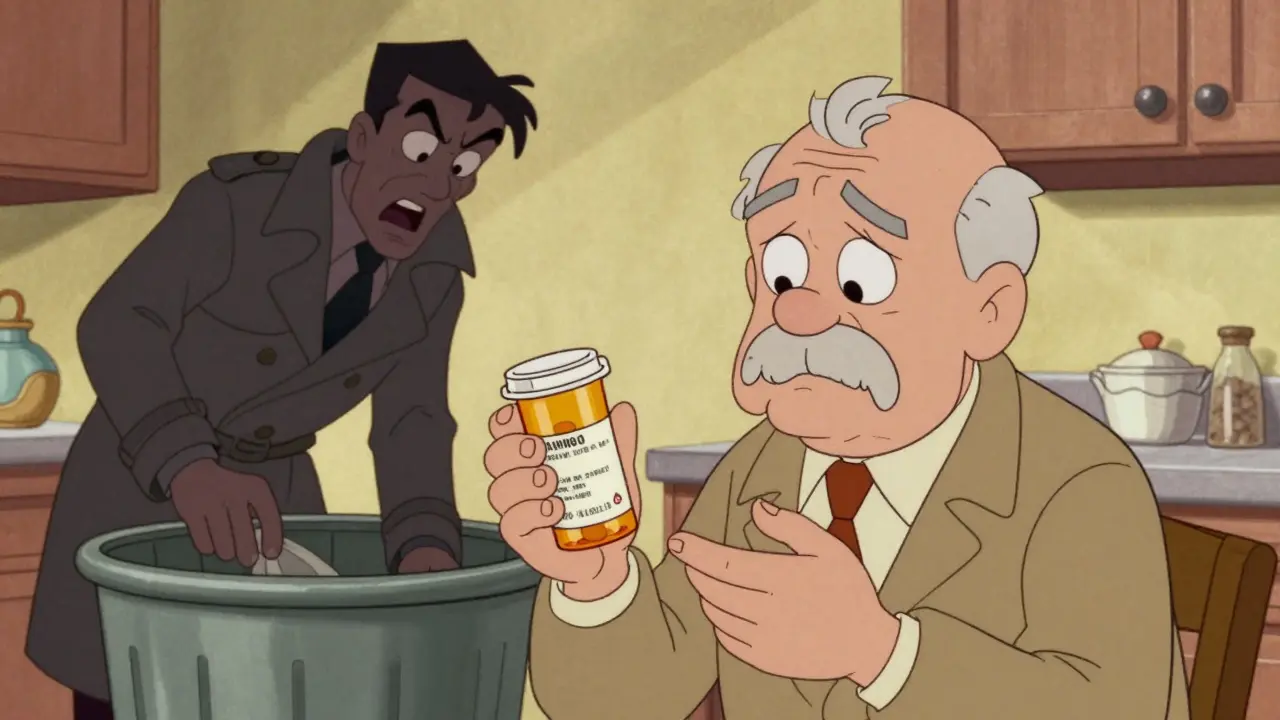
Throwing away old pills might seem like a simple chore, but if you’re not careful, you’re risking more than just clutter. Your prescription bottles hold more than medicine-they hold your name, your doctor’s notes, your diagnosis, even your insurance number. That’s not just junk mail. That’s privacy waiting to be stolen.
Imagine this: someone digs through your trash, finds an empty bottle of oxycodone, and uses the label to order more pills-or worse, uses your name and address to open credit accounts. That’s not a movie plot. That’s what happened to a woman in Ohio in 2023. She lost $1,200 to fraud after tossing out her pill bottle without scratching off her info. And she’s not alone. A 2021 study found that 42% of prescription bottles thrown in the trash still had readable personal details. That’s nearly half of all discarded bottles.
Why Prescription Labels Are a Goldmine for Identity Thieves
Most people don’t realize how much personal data is printed on those little pharmacy labels. It’s not just your name. It’s your birth date, your doctor’s name, the name of your condition (like "Type 2 Diabetes" or "Anxiety Disorder"), your prescription number, and often your insurance ID. That’s enough for someone to impersonate you, file fake claims, or even get prescriptions in your name.
The U.S. Department of Health and Human Services calls this Protected Health Information, or PHI. Under HIPAA rules, healthcare providers must protect it-even after you leave the pharmacy. But once that bottle hits your trash can, the responsibility shifts to you. And most people don’t know how to handle it.
The Three Safe Ways to Dispose of Medications
There are three real options for getting rid of old meds safely-and only one of them gives you full privacy protection.
1. Use a Drug Take-Back Program (Best for Privacy)
This is the gold standard. Every April and October, the DEA runs National Prescription Drug Take Back Days. In April 2024 alone, over 820,000 pounds of medications were collected across 6,000 locations nationwide. These aren’t just drop boxes. They’re secure, monitored collection sites run by law enforcement. Your meds go straight into industrial shredders or incinerators. No one ever sees your name. No label is ever read.
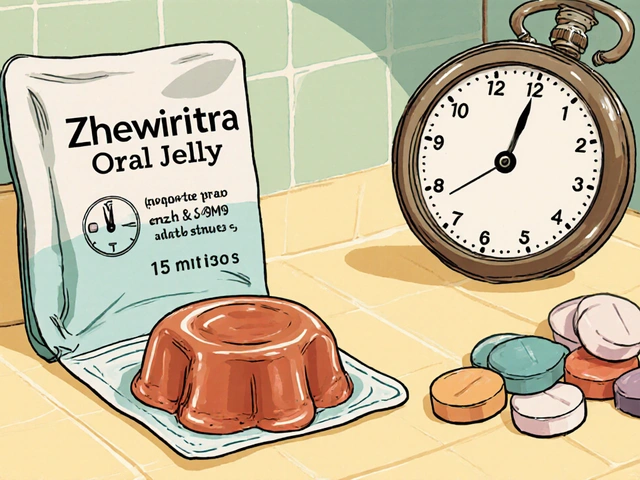
You don’t have to wait for take-back day. Many pharmacies-CVS, Walgreens, and others-have permanent drop-off bins. In 2024, 87% of chain pharmacies offered them. Just bring your unopened or expired pills in their original containers. No need to remove labels. The pharmacy handles the rest.
2. Mail-Back Envelopes (Great Alternative)
If you can’t get to a drop-off site, mail-back envelopes are your next best bet. Companies like Walgreens and DisposeRx sell these for under $7. You put your pills in, seal it, and mail it. The envelope is pre-paid and goes directly to a licensed disposal facility. No one sees your name. No one touches your bottle. You don’t even need to scratch off the label-though it’s still a good idea.
These are especially handy for people in rural areas or those with mobility issues. And unlike take-back bins, you can use them anytime.
3. At-Home Disposal (Only If Nothing Else Works)
If you have no access to take-back or mail-back options, the FDA says you can dispose of most meds in the trash-but only if you do it right. Here’s how:
- Take pills out of their original bottles.
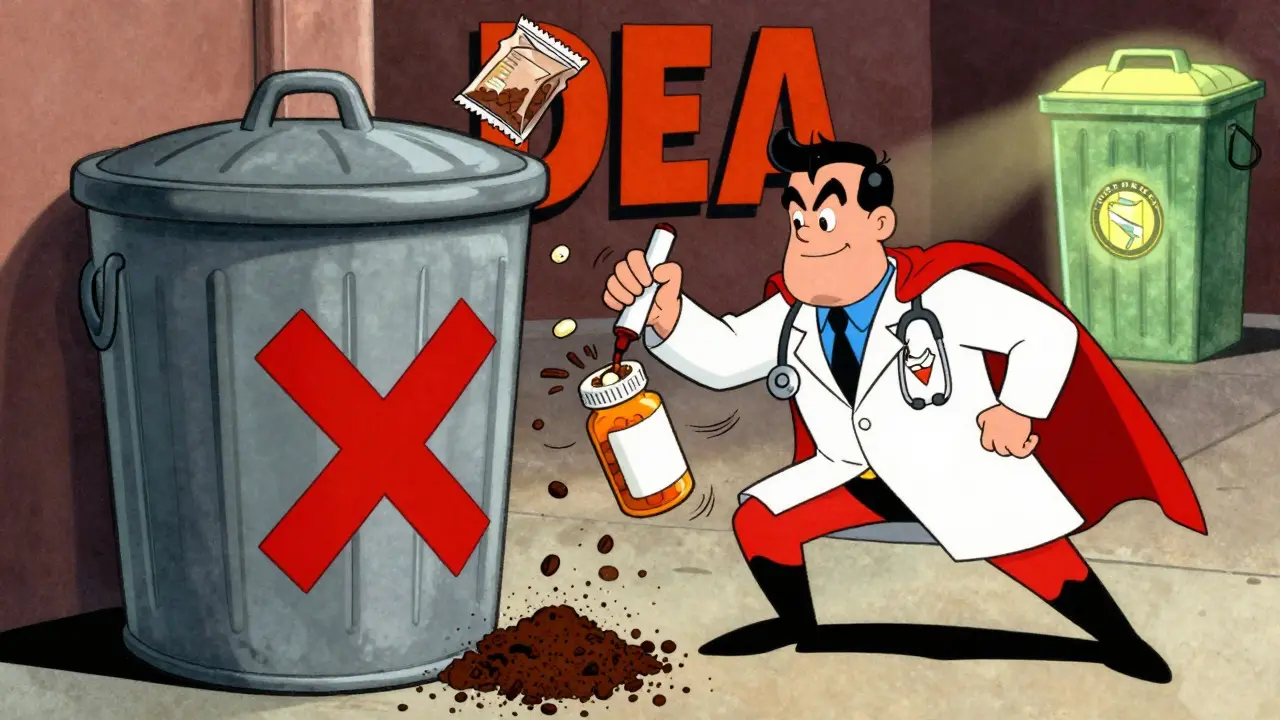
- Mix them with something unappetizing-used coffee grounds, cat litter, or dirt.
- Pour the mix into a sealed container (like a jar or plastic bag).
- Scratch out or cover every bit of personal info on the empty bottle with a permanent marker or duct tape.
- Put the sealed container in your regular trash.
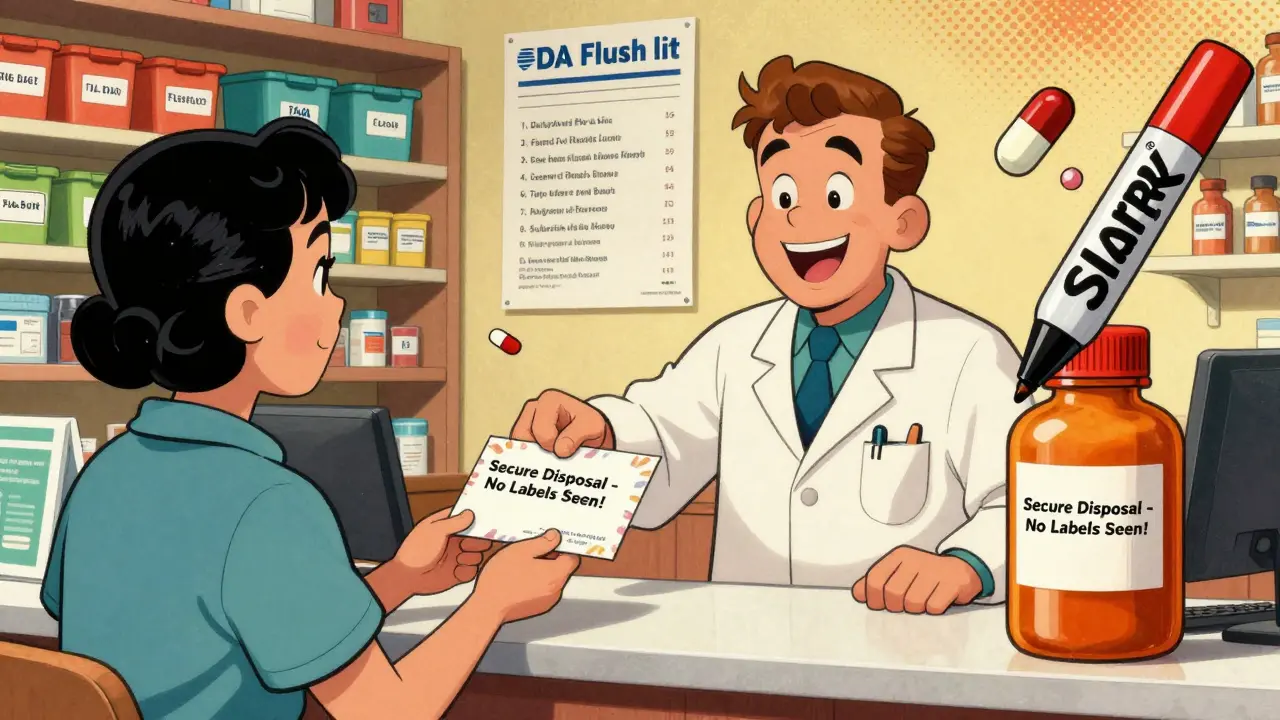
Don’t just toss the bottle. Don’t flush it (unless it’s on the FDA’s Flush List-more on that in a minute). And don’t assume the label will come off easily. A 2023 University of Michigan study found that 47% of people struggled to remove labels from plastic bottles. That’s why marking over the info with a Sharpie is the most reliable trick.
What About Flushing Medications?
The FDA has a list of 15 medications that are dangerous enough to flush immediately. These are mostly powerful opioids and sedatives that could kill a child or pet if found in the toilet or trash. As of May 2024, the list includes drugs like fentanyl patches, oxycodone, and naloxone. You can check the current list on the FDA’s website or use the free DisposeRx app.
For these, flushing is the safest option. No need to scratch labels. Just remove the pills, flush them, then throw the empty bottle in the trash-after covering the label.
Why Most People Get It Wrong
Most of us don’t know what to do. A 2023 Consumer Reports survey found that 54% of Americans didn’t realize prescription labels could be used for identity theft. Another survey showed that 63% of people admit they sometimes forget to remove personal info from pill bottles.
And it’s not just laziness. Elderly patients, especially those on multiple medications, often get overwhelmed. A Kaiser Family Foundation survey found that 37% of adults over 65 felt confused about disposal steps. That’s why simple tools matter. A permanent marker costs $2. A mail-back envelope costs $3. A take-back bin is free. You don’t need a PhD to do this right.
What’s Changing in 2025 and Beyond
Privacy-focused disposal isn’t going away. In fact, it’s getting smarter. By 2027, experts predict 40% of major pharmacies will have smart kiosks that automatically destroy labels and meds in one step. New federal bills are also pushing for more funding-like the Safe Drug Disposal Act of 2024, which would give $50 million a year to expand access to safe disposal.
And the cost of ignoring this? A 2023 IBM report found that each healthcare data breach involving prescription info costs an average of $498 per record. That’s not just a number. That’s your credit score, your insurance premiums, your peace of mind.
Quick Checklist: Your Privacy Protection Plan
- ✅ Always remove meds from original bottles before disposal.
- ✅ Mix pills with coffee grounds or cat litter before tossing.
- ✅ Cover or scratch out ALL personal info on empty bottles with a permanent marker.
- ✅ Use take-back bins whenever possible-free, secure, and easy.
- ✅ Only flush meds if they’re on the FDA’s Flush List.
- ✅ Keep the DisposeRx app handy to check if your meds are on the list.
It takes less than five minutes. One bottle at a time. But if you do it right, you’re stopping identity theft before it starts. That’s not just good hygiene. That’s protecting your life.

Comments
So I’ve been doing this wrong for years. Honestly, I just tossed the bottles in the trash like they were soda cans. No big deal, right? Wrong. After reading this, I went through my bathroom cabinet and found three empty oxycodone bottles from last year. I didn’t even remember taking them. The label was still totally legible. I marked over everything with a Sharpie, dumped the pills in coffee grounds, and sealed it in a ziplock. Felt like I just saved my future self from a nightmare.
Also, I didn’t know Walgreens had permanent drop boxes. That’s a game changer. I’m going to start dropping off my expired stuff every time I go for refills. No more lazy disposal. This stuff matters more than we think.
Thank you for this. 🙏
It’s quiet, but deeply important. We don’t talk about how our medicine bottles carry our stories - our pain, our fears, our diagnoses. To throw them away carelessly is to leave our vulnerability exposed. I’ve started keeping a small marker in my medicine cabinet. Just one stroke across the name. One quiet act of self-protection. It costs nothing. But it means everything.
Yeah but who the hell even digs through trash anymore? This feels like fearmongering. People don’t do that. It’s 2025. You think someone’s gonna risk jail for an old pill bottle? Get real. I’ve seen dumpster divers - they’re after cans and cardboard, not your prescription labels. This whole thing’s overblown.
Wait - so you’re telling me the government doesn’t want us to know about this? Why is it so hard to find take-back bins? Why do pharmacies charge for mailers? Why is this even a thing? I’m starting to think this is all part of the pharmaceutical-industrial complex. They want you to keep taking pills. They want you to stay scared. They want you to pay for mailers. They want you to feel guilty. This isn’t about privacy. This is about control. And don’t even get me started on the FDA flush list - that’s just a cover for them to dump toxic waste into the water supply. I’m not flushing anything. I’m burying mine in the backyard. 🤡
While the sentiment is commendable, the article’s reliance on anecdotal case studies and loosely cited statistics undermines its credibility. The 42% figure from the 2021 study - which study, precisely? Published where? Peer-reviewed? And the 87% claim about chain pharmacies offering bins - is that from a press release or a third-party audit? There’s a distinct lack of methodological transparency here. Also, the assertion that ‘no one ever sees your name’ at take-back sites is misleading - law enforcement logs are not public, but they are maintained. Privacy is not absolute. It’s managed. And management requires accountability, not just optimism.
Respectfully, the guidelines provided are accurate and align with best practices recommended by the U.S. Food and Drug Administration and the Drug Enforcement Administration. The three-tiered approach - take-back, mail-back, and at-home disposal - is evidence-based and widely endorsed by public health institutions. The emphasis on obscuring personal identifiers on prescription containers is not merely precautionary but is grounded in documented cases of identity theft and fraud. For individuals residing in regions with limited access to take-back infrastructure, the use of permanent markers and inert mixing agents (e.g., cat litter) remains the most viable, low-cost, and effective mitigation strategy. Consistency in practice is more critical than perfection.
I’ve been using the CVS drop box for two years now. Just bring the whole bottle. They take it. No questions. No forms. No stress.
I used to worry about the label. Now I don’t. They handle it.
Simple. Safe. Done.
It’s interesting how this issue intersects with both public health and data privacy. The prescription label contains more than personal identifiers - it contains a medical history, often more detailed than what’s in your EHR. And yet, we treat it like packaging. The shift toward digital prescriptions and e-pharmacies may eventually render this obsolete, but until then, the responsibility falls on the individual. I appreciate the practicality of the checklist. It’s not perfect, but it’s actionable. One small step at a time.
They want you to think this is about privacy but it’s really about control. Why do you think they make it so hard to get rid of meds? Why do they charge for mailers? Why do they say flush only if on the list? Because they don’t want you to stop taking them. They want you addicted. They want you scared. And they want you paying. This whole thing is a scam. I’m not using any of their bins. I’m taking my pills and flushing them all. Let them try to stop me. 🇺🇸
Take-back bins are the MVP here. No cap. Just drop and go. I’ve been using the Walgreens one since last year and it’s been smooth. No labels, no stress, no mess. Also, the DisposeRx app is legit - it tells you if your med’s on the flush list. Saved me when I had to ditch my dad’s fentanyl patches. Honestly, this is one of those things that seems small but is actually a flex for your future self. Do the thing. It’s 5 minutes.
Also - coffee grounds. Genius. 🙌
This is one of those topics that doesn’t get enough attention, but it should. I’ve been helping elderly neighbors dispose of their meds for years. Many don’t understand the risks. Some think flushing is fine. Others just throw bottles in the trash. I always carry a Sharpie and a small container when I visit. I show them how to mix the pills with dirt or used grounds. Then I mark the bottles. They’re usually surprised it’s this simple. It’s not about fear - it’s about care. A little attention saves a lot of trouble later.
YESSSS this is so important! 💪 I used to just toss my bottles until my cousin got scammed after her mom’s pills were stolen from the trash. Now I’m a total label-destroying ninja. Sharpie + coffee grounds + ziplock = my holy trinity. Also, I just found out my local library has a take-back bin now. Mind blown. 🤯 If you’re reading this - do the thing. Your future self will thank you. And hey - if you’re feeling overwhelmed, start with one bottle. That’s all it takes to begin.
Let’s be clear - the FDA flush list is a regulatory loophole. The 15 drugs listed are not uniquely dangerous. They’re just the ones with high abuse potential. The rest? They’re not safe. They’re just not politically expedient to flush. This is a classic case of harm reduction being weaponized by bureaucracy. The real solution? Ban prescription labels entirely. Digitize everything. Eliminate the paper trail. Until then, we’re all playing Russian roulette with our PHI.
Who even cares? My pills are mine. My info is mine. If someone steals my identity because I tossed a bottle, that’s on them. I’m not wasting my time marking labels. I’ve got real problems. Also - take-back bins? That’s a government trap. They’re tracking who drops off what. I’m not giving them that data. I’m keeping my meds. I’ll take them if I need them. Who says I’m done with them anyway?